

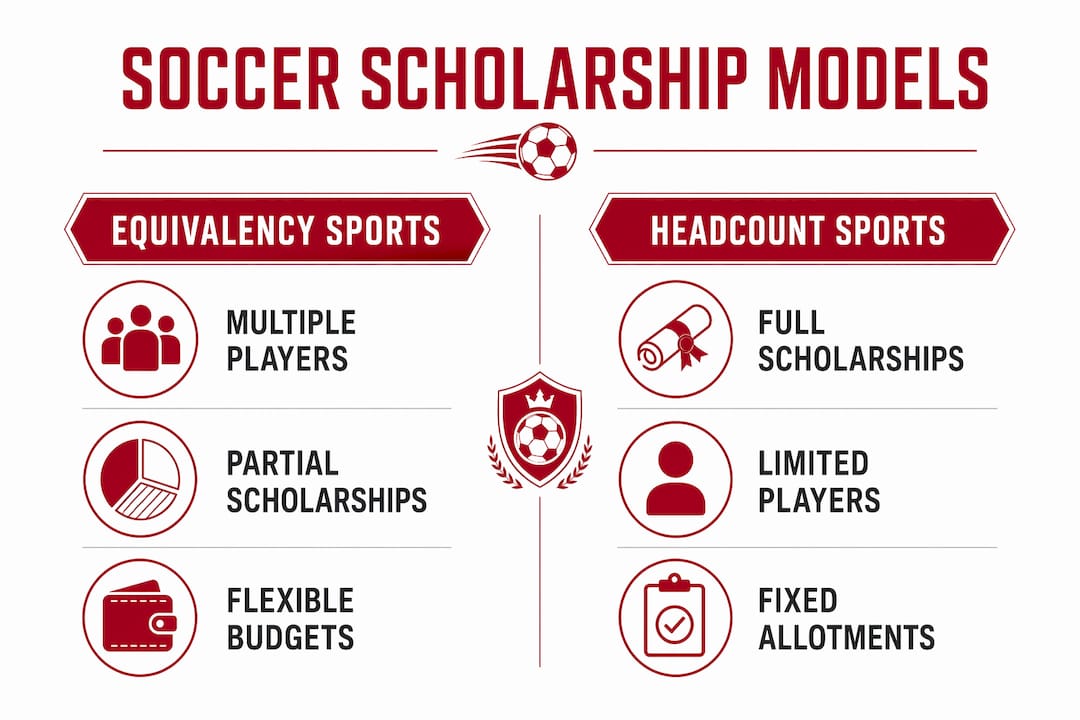
Soccer is an NCAA equivalency sport, which means a program’s scholarship budget is divided among multiple players rather than awarded as full rides to a fixed number of athletes. This classification directly shapes how coaches recruit, how much aid each player receives, and how families should plan financially. Under the equivalency model, a coach can offer 10 players partial scholarships instead of giving two players full rides. The House v. NCAA settlement, finalized for the 2025–26 academic year, changed the scholarship structure further by replacing fixed caps with roster limits. Understanding this system is the first step toward making informed decisions about NCAA soccer scholarship rules and your recruiting path.
Why soccer is an NCAA equivalency sport: the core definition
The NCAA classifies sports into two categories: headcount sports and equivalency sports. Headcount sports, such as Division I women’s soccer, award only full scholarships. Equivalency sports, which include men’s soccer at all NCAA divisions, give coaches a total scholarship budget they can split across the roster in any combination they choose.
Division I women’s soccer is actually a headcount sport with 14 full scholarships, while men’s soccer operates under the equivalency model. That distinction matters because it means two athletes on the same campus can receive very different types of aid depending on their gender and program.

The equivalency model exists because the NCAA designed it to give coaches flexibility in building competitive rosters. A coach can offer a goalkeeper 80% of a scholarship, a midfielder 50%, and a forward 30%, all from the same budget. That flexibility is the defining feature of soccer equivalency opportunities at every level of college athletics.
How the House v. NCAA settlement changed scholarship limits
The old structure for NCAA Division I men’s soccer set a hard cap of 9.9 scholarship equivalencies per program. That number forced coaches to spread limited aid across large rosters, often resulting in very small individual offers. The 2025–26 rule changes replaced that system for programs that opt in.
NCAA Division I men’s soccer moved from the 9.9 equivalency cap to a 28-player roster limit that allows up to 28 equivalency scholarships. That is a significant increase in total aid available, and it gives mid-major programs more room to compete for recruits against larger schools.
The following table shows how scholarship structures compare before and after the rule change, and across divisions.
| Division | Old scholarship cap | New structure (2025–26) | Notes |
|---|---|---|---|
| NCAA DI Men’s Soccer | 9.9 equivalencies | Up to 28 equivalencies (28-player roster limit) | Programs must opt in |
| NCAA DI Women’s Soccer | 14 headcount (full rides) | 14 headcount (unchanged) | Headcount sport, not equivalency |
| NCAA DII Men’s Soccer | 9 equivalencies | 9 equivalencies | No change under current rules |
| NCAA DII Women’s Soccer | 9.9 equivalencies | 9.9 equivalencies | No change under current rules |
| NAIA Soccer | Varies by program | Varies by program | More flexible academic and aid rules |
Budget constraints mean the theoretical maximum is rarely fully funded. A program with 28 available equivalencies may only fund 18 or 20 depending on its athletic department budget. Players and families should ask each program directly what it actually awards, not just what the NCAA allows.
How soccer scholarship equivalency works in practice
Most NCAA soccer scholarships are partial rather than full rides. Coaches divide scholarships to manage team budgets and roster size, commonly offering players amounts in the range of 30–60% of a full scholarship. Full rides in men’s soccer are rare and typically reserved for the highest-priority recruits.
This system creates both opportunities and challenges for players and families. The benefits of soccer scholarships under the equivalency model include:
- More players receive aid. A coach can support 15 or more players from a single scholarship budget rather than fully funding only a handful.
- Stacking is common. Athletes often combine a partial athletic scholarship with academic merit aid, need-based grants, or institutional awards to cover full tuition costs.
- Roster depth improves. Partial scholarship splitting allows coaches to build deeper, more competitive teams by offering competitive aid to more players.
- International athletes benefit. Players from outside the United States can access partial aid that, when combined with other institutional support, makes attendance financially viable.
The main challenge is that families often misread a partial offer. Most players receive partial aid, often combined with other forms of academic or institutional aid, yet the misconception that soccer scholarships are full rides persists. That gap between expectation and reality causes families to decline strong offers or fail to negotiate effectively.
Pro Tip: Ask every coach two specific questions: what percentage of a scholarship are you offering, and what other institutional aid can be stacked on top of it? Those two numbers together tell you the real financial picture.
NCAA DI, DII, and NAIA: how equivalency rules differ
Understanding how soccer scholarships work across divisions helps players target the right programs. The rules differ in scholarship volume, academic requirements, and eligibility certification.
NCAA Division I
Division I programs follow the strictest academic eligibility standards. Players must register with the NCAA Eligibility Center, complete 16 core courses in high school, and meet a sliding scale of GPA and ACT or SAT scores. The NCAA Division I soccer requirements for eligibility are non-negotiable. Under the new roster limit model, DI programs can distribute more equivalency scholarships, but the actual amount funded varies by school.
NCAA Division II
Division II men’s soccer typically offers 9 equivalency scholarships per program. Division II also requires NCAA Eligibility Center registration, though the sliding scale requirements differ slightly from Division I. Division III offers no athletic scholarships at all, relying entirely on academic and need-based aid. Families targeting DII programs should recognize that the smaller scholarship pool means individual offers may be lower, but competition for spots is also less intense than at the DI level.
NAIA
NAIA programs use the PlayNAIA eligibility system rather than the NCAA Eligibility Center. NAIA offers more flexible academic requirements and a wider scholarship window compared to NCAA Division I. International student-athletes in particular benefit from NAIA’s accessibility. The NAIA equivalency model gives coaches similar flexibility to split scholarships, and many NAIA programs actively recruit international players who may not meet NCAA DI academic thresholds.
NCAA eligibility requires players to meet academic core course and sliding scale standards for Divisions I and II. Players who fall short of those standards should evaluate NAIA programs seriously, not as a fallback but as a legitimate path to college soccer and financial aid.
How to navigate soccer equivalency scholarship opportunities
Approaching the equivalency system with a clear plan improves your chances of maximizing aid. The following steps apply whether you are a domestic high school player, a junior college transfer, or an international athlete.
-
Contact coaches early and ask direct questions. Coaches recommend that players and families communicate openly to clarify individual scholarship offers, percentages, and stacking options with academic aid. Do not wait for a coach to volunteer this information.
-
Understand the full financial package. A 40% athletic scholarship at a school with strong academic merit aid may cover more total costs than a 60% offer at a school with no additional institutional support. Calculate the net cost, not just the scholarship percentage.
-
Register with the correct eligibility system. NCAA DI and DII players must register with the NCAA Eligibility Center. NAIA players use PlayNAIA. International athletes must navigate both systems to maximize their scholarship opportunities, since some programs consider athletes for both NCAA and NAIA programs depending on eligibility.
-
Evaluate programs across all divisions. The types of NCAA soccer programs vary significantly in scholarship availability, academic culture, and competitive level. A DII program that fully funds your education may serve your goals better than a DI program offering a small partial scholarship.
-
Account for post-2025 budget variation. Some programs may opt to fund fewer players fully rather than spread thin scholarships across a large roster, depending on administrative priorities and budgets. Ask each program specifically how it is applying the new roster limit rules.
Pro Tip: When you receive a scholarship offer, ask the coach whether that percentage is guaranteed for all four years or subject to annual renewal. Renewal conditions vary by program and affect your long-term financial planning.
Key Takeaways
Soccer is an NCAA equivalency sport because programs divide a fixed scholarship budget among multiple players, making partial scholarships the standard rather than the exception.
| Point | Details |
|---|---|
| Equivalency vs. headcount | Men’s soccer is equivalency; Division I women’s soccer is headcount with 14 full scholarships. |
| 2025–26 rule change | NCAA DI men’s soccer moved from a 9.9 cap to up to 28 equivalencies under the new roster limit model. |
| Partial scholarships are the norm | Most players receive 30–60% of a scholarship, often stacked with academic or institutional aid. |
| Division and NAIA differences | DII offers 9 equivalencies; NAIA offers more flexibility and is accessible for international athletes. |
| Ask direct questions | Contact coaches to confirm scholarship percentage, stacking options, and whether the offer is multi-year. |
What I’ve learned from watching families misread equivalency offers
The biggest mistake I see families make is treating a partial scholarship offer as an insult. A coach offering 35% is not being stingy. That coach is managing a fixed budget across 20 or more players, and 35% may represent a serious investment in your athlete relative to what the program has available.
The second mistake is assuming the new roster limit rules automatically mean more money for every player. They do not. Updated NCAA roster limits give programs more flexibility, especially benefiting mid-major schools with bigger scholarship pools, but a program that was underfunding scholarships before will likely continue to do so. The rule change expanded the ceiling, not the floor.
What actually works is asking precise questions early, understanding the full financial picture including academic aid, and evaluating programs across all divisions without bias toward a name or ranking. I have seen players turn down a fully funded DII offer for a 20% DI offer because of prestige, then struggle financially for four years. The partial vs. full scholarship conversation is one every family needs to have before the first offer arrives, not after.
The equivalency system rewards informed families. Coaches respect players who ask smart questions. That combination of preparation and communication is what separates athletes who maximize their aid from those who leave money on the table.
— Canas
How Canasrecruiting supports your scholarship positioning
Canasrecruiting works directly with soccer players and families to clarify NCAA equivalency scholarship rules, evaluate program fit across DI, DII, and NAIA, and prepare athletes for productive conversations with coaches.
The college soccer recruiting process involves more variables than most families anticipate, from eligibility certification to scholarship negotiation to roster limit changes. Canasrecruiting provides personalized guidance at each stage, including direct coach outreach and scholarship positioning support. Families who want to avoid the most common financial and recruiting errors can also review the common soccer recruiting mistakes guide before committing to a program.
FAQ
What does equivalency sport mean in the NCAA?
An equivalency sport gives coaches a fixed scholarship budget they can divide among multiple players in any combination, rather than awarding only full scholarships to a limited number of athletes.
Is women’s soccer an equivalency sport in the NCAA?
NCAA Division I women’s soccer is a headcount sport with 14 full scholarships, not an equivalency sport. Division II women’s soccer operates under the equivalency model with 9.9 scholarships.
How many soccer scholarships can a Division I program award?
Under the 2025–26 rule change, NCAA DI men’s soccer programs that opt in can award up to 28 equivalency scholarships under the new roster limit structure, replacing the old 9.9 cap.
Can international players receive NCAA soccer scholarships?
Yes. International athletes can receive equivalency scholarships at NCAA DI, DII, and NAIA programs, though they must register with the NCAA Eligibility Center or the NAIA’s PlayNAIA system depending on the division.
Should players accept a partial scholarship or wait for a full ride?
Most players should seriously evaluate partial offers, since full rides in men’s soccer are rare. A partial athletic scholarship stacked with academic aid often covers more total costs than waiting for a full offer that may never arrive.