

Most families approach Ivy League soccer recruiting the same way they approach every other Division I program. They focus on highlight videos, tournament results, and scholarship offers. That approach will cost you time and, more importantly, real opportunities. What Ivy League soccer recruiting involves is fundamentally different from any other college soccer path in the country. It combines a rigorous academic evaluation with athletic assessment, operates without athletic scholarships, and requires a level of early preparation that most players and families are not ready for. This article covers the full picture: timelines, evaluation criteria, financial aid, likely letters, and communication strategies that actually work.
Table of Contents
- Key takeaways
- What ivy league soccer recruiting involves: the core structure
- The dual evaluation: athletics and academics
- Likely letters and the admissions-athletics coordination
- Timelines, communication, and preparation
- Financial aid realities for recruited athletes
- My perspective on what most families get wrong
- How Canasrecruiting supports your Ivy League recruiting path
- FAQ
Key takeaways
| Point | Details |
|---|---|
| No athletic scholarships | Ivy League schools offer need-based financial aid only, not athletic scholarships, so academic and financial planning must start early. |
| Academic Index is non-negotiable | Every recruit must meet a minimum Academic Index score based on GPA and test scores before a coach can advocate for them. |
| Likely letters are near-guarantees | A likely letter signals combined coach and admissions advocacy and typically arrives in the fall or winter of senior year. |
| Recruiting starts sophomore year | Coaches evaluate athletes over multiple years, so building your profile early is critical to staying in contention. |
| Fit management beats scholarship negotiation | Success in Ivy League recruiting depends on demonstrating academic and athletic fit, not negotiating financial awards. |
What ivy league soccer recruiting involves: the core structure
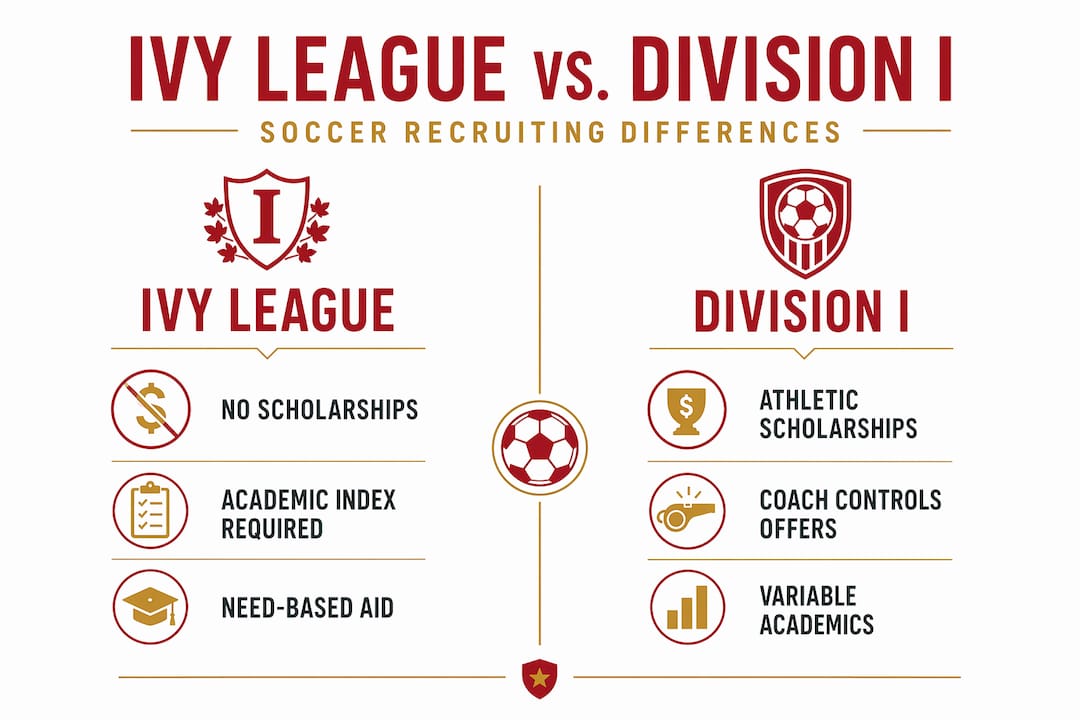
The most important thing to understand about Ivy League soccer recruitment is what it does not include. No athletic scholarships exist at any of the eight Ivy League schools. A 2026 court ruling upheld this policy, confirming that financial aid at these institutions is determined entirely by demonstrated financial need, not athletic ability. That single fact changes everything about how you approach the process.
Compare this to a standard Division I program. At most schools, a coach controls a scholarship budget and can offer a full or partial athletic scholarship as part of the recruiting conversation. At Harvard, Yale, Princeton, or Columbia, that conversation does not exist. Instead, families work through the financial aid office based on income, assets, and family circumstances. A recruited athlete with high financial need may receive a package that covers most or all of the cost of attendance. A family with significant assets may receive little to no aid regardless of athletic talent.
| Feature | Ivy League Programs | Standard Division I Programs |
|---|---|---|
| Athletic scholarships | Not permitted | Available up to full cost of attendance |
| Financial aid basis | Need-based only | Athletic merit and need |
| Academic requirements | Academic Index required | Minimum NCAA eligibility standards |
| Admissions process | Coordinated with coach advocacy | Separate from athletic offer |
| Likely letters | Yes, issued before regular decisions | Not applicable |
The Academic Index requirement adds another layer. Each Ivy League school calculates a score from a recruit’s GPA and standardized test scores. Coaches cannot advocate for any recruit who falls below the school’s minimum threshold. This is not a soft guideline. It is a hard constraint built into the admissions and recruiting coordination process.
Pro Tip: Use the net price calculators on each Ivy League school’s website before you invest heavily in recruiting outreach. Knowing your estimated financial aid package early prevents surprises and helps your family plan realistically.
The dual evaluation: athletics and academics
Ivy League coaches do not simply watch you play and decide whether you are good enough. The recruiting process starts as early as sophomore year and involves tracking both your athletic development and your academic trajectory over time. Coaches are building internal cases for recruits long before any formal contact is permitted under NCAA guidelines.
On the athletic side, evaluation happens through multiple channels:
- Showcase tournaments and camps: Coaches attend high-level events to observe players in competitive environments. Attending Ivy League school camps gives coaches a direct look at your technical and tactical ability.
- Highlight video review: A well-produced highlight reel that shows decision-making, positioning, and technical skill under pressure carries significant weight. It is often the first impression a coach forms of you.
- Film and game footage: Full-game film allows coaches to evaluate your off-ball movement, defensive effort, and team play, things a highlight reel can obscure.
- Academic documentation: Transcripts, course rigor, and standardized test scores are reviewed alongside athletic material. A strong GPA in standard courses is less compelling than a solid GPA in AP or IB coursework.
The concept of an “academic pre-read” is one that many families have never heard of. Before a coach can formally advocate for a recruit inside the admissions office, they submit the athlete’s academic profile for an informal review. This pre-read determines whether the recruit is academically viable for admission. If the pre-read comes back unfavorable, the coach cannot proceed with recruiting that athlete regardless of their soccer ability.
Successful Ivy League recruits look like complete applicants. They have strong grades, challenging coursework, meaningful extracurricular involvement, and a clear athletic profile. Coaches use this full picture to justify their advocacy to the admissions office.
Pro Tip: Do not wait until junior year to address academic gaps. If your GPA or test scores need improvement, sophomore year is the time to act. Coaches need to see an upward trajectory, not a last-minute correction.
Likely letters and the admissions-athletics coordination
A likely letter is one of the most misunderstood elements of Ivy League athletic recruitment. It is not an official acceptance letter. It is a communication from the admissions office, sent before regular decision notifications, indicating that a recruited athlete will very likely be admitted. In practice, it functions as close to a guarantee as the Ivy League system allows.
Understanding how likely letters work requires knowing what happens behind the scenes:
- Months 1 to 6 before senior fall: The coach identifies a recruit as a priority target and begins internal discussions with the admissions office about the athlete’s academic viability.
- Months 6 to 12: The coach formally advocates for the recruit, submitting academic materials and athletic justification. The admissions office evaluates the full profile.
- Senior fall or early winter: If the advocacy is successful and the recruit has submitted their application, the admissions office issues a likely letter. The athlete receives written confirmation that their admission is expected.
- Regular decision period: The formal acceptance letter arrives with the rest of the applicant pool, but the outcome is already known.
Receiving a likely letter represents the combined advocacy of the coach and the admissions office. It is a milestone that signals genuine institutional commitment to the athlete. Families who understand this process recognize that the real work happens 12 to 18 months before senior year, not during the application itself.
Timelines, communication, and preparation

The college soccer recruiting process for Ivy League programs requires backward planning. You need to know when the likely letter window opens and build your preparation schedule from that date backward. Missing a key milestone early in the process can close doors that are very difficult to reopen.
Here is what a realistic preparation timeline looks like:
- Sophomore year: Begin attending high-level showcases and Ivy League school camps. Start building your highlight video. Prioritize academic course rigor and standardized test preparation.
- Junior year: Initiate direct contact with coaches through email and recruiting questionnaires. Send your highlight video and academic profile. Attend official campus visits where permitted under NCAA contact guidelines.
- Summer before senior year: Confirm your list of target schools. Coaches begin internal advocacy at this stage. Your academic and athletic profile must be complete and polished.
- Senior fall: Submit applications. Await likely letters from schools where the coach has advocated for you.
Communication with coaches should be consistent but purposeful. Do not send generic emails. Reference specific aspects of the program, ask informed questions about playing time expectations, team culture, and the academic support structure. Coaches notice the difference between a player who has researched their program and one who is mass-emailing every school on a list.
Early and consistent engagement through camps and targeted video outreach builds the kind of trust that coaches need before they will commit internal political capital to advocating for a recruit. Families should also prepare a list of direct questions for coaches: What does the typical first-year player’s role look like? How does the program support academic demands during the season? What is the financial aid process for recruited athletes?
Financial aid realities for recruited athletes
Because Ivy League recruiting relies entirely on need-based aid, the financial conversation looks completely different from what most families expect. There is no scholarship offer to negotiate. There is no athletic money to stack on top of academic awards. What exists is an institutional commitment to meeting demonstrated financial need, which can be generous but is not guaranteed.
“Families need to focus on academic admissibility and need-based financial aid rather than expecting scholarship offers. The recruiting conversation is about fit, not financial awards.” — Ivy League recruiting reality, as reflected in the 2026 court ruling upholding the no-scholarship policy.
Several Ivy League schools have eliminated loans from financial aid packages entirely for families below certain income thresholds. For families with household incomes under $75,000, some schools cover the full cost of attendance through grants. This means an Ivy League education can actually be more affordable than a state school for families with demonstrated need, even without athletic scholarships.
The key is early financial planning. Use net price calculators, consult with Ivy League admissions specialists, and understand your family’s expected contribution before you invest years of effort into a recruiting target that may not be financially viable. Athletes who receive likely letters from Ivy schools and then decline due to financial reasons represent a missed opportunity that proper planning could have prevented.
My perspective on what most families get wrong
I have worked with athletes and families across every level of the college soccer recruiting process. The single most underestimated factor in Ivy League soccer recruitment is not athletic ability. It is academic preparation timing.
I have seen technically gifted players get cut from Ivy League consideration in their junior year because their GPA trajectory was not strong enough to survive a pre-read. No amount of tournament performance or highlight video quality could fix that. The academic window closes earlier than most families realize, and by the time they understand the timeline, it is too late to course-correct.
The other thing I tell families directly: stop thinking about this as a scholarship negotiation. The families who succeed in Ivy League athletic recruitment are the ones who approach it as fit management. They ask whether the school is the right academic and athletic environment for their son or daughter. They build relationships with coaches over years, not months. They treat the admissions process as a parallel track, not an afterthought.
The hard truth is that some athletes are better served by a Division I program with athletic scholarship money than by an Ivy League school where they will receive need-based aid and play in a highly competitive academic environment. That is not a failure. That is honest self-assessment. The families who make the best decisions are the ones who evaluate fit honestly rather than chasing a name.
— Canas
How Canasrecruiting supports your Ivy League recruiting path
Navigating the Ivy League soccer admissions process without expert guidance means operating without a clear blueprint at every critical stage.
At Canasrecruiting, we work directly with athletes and families to build the kind of complete recruitable profiles that Ivy League coaches need to advocate internally. Our Scholarship Positioning System™ covers highlight video production, academic profile organization, targeted coach outreach, and timeline management from sophomore year through senior commitment. We also help families understand the financial aid process so there are no surprises when packages arrive. If you are ready to get a clear picture of where your athlete stands, start with a free recruiting assessment or schedule a consultation with our team today.
FAQ
Do Ivy League soccer programs offer athletic scholarships?
No. Ivy League schools prohibit athletic scholarships. All financial aid is need-based, determined by family financial circumstances rather than athletic performance.
What is a likely letter in Ivy League soccer recruiting?
A likely letter is a pre-decision communication from an Ivy League admissions office indicating that a recruited athlete will very likely be admitted. It results from internal coach and admissions advocacy beginning 12 to 18 months before senior year.
When should a soccer player start the Ivy League recruiting process?
Most Ivy League coaches begin evaluating recruits in sophomore or junior year. Starting your recruiting outreach and academic preparation by sophomore year gives you the best chance of meeting both athletic and academic benchmarks on time.
What is the Academic Index and why does it matter?
The Academic Index is a score calculated from a recruit’s GPA and standardized test scores. Coaches cannot advocate for any player who falls below their school’s minimum threshold, making academic performance as critical as soccer ability in the recruiting process.
How do families prepare for the financial side of Ivy League recruiting?
Use each school’s net price calculator early in the process to estimate your expected financial aid package. Consulting with college admissions specialists who understand Ivy League financial aid structures can help families plan realistically before committing significant time to the recruiting process.
Recommended
- Cañas Recruiting Agency | College Soccer Scholarship Experts
- College Soccer Recruiting Services | Scholarship Positioning System™ | Cañas Recruiting
- How Our College Soccer Recruiting Process Works | Cañas Recruiting
- Free Soccer Recruiting Assessment | Evaluate Your College Potential | Cañas Recruiting