

An athletic scholarship is a grant-in-aid awarded by colleges to student-athletes in exchange for participating in collegiate sports, covering expenses that range from tuition and fees to room, board, books, and cost-of-attendance stipends. For teen soccer players and their families, understanding this funding mechanism is the first step toward making college both athletically and financially viable. The NCAA, NAIA, and junior college systems each operate under different scholarship rules, which means the opportunity available to your athlete depends heavily on which division and governing body applies to the programs you target.
What is an athletic scholarship and how does it work?
An athletic scholarship is a financial aid award tied directly to an athlete’s participation on a college team, not to academic achievement alone. Colleges offer this aid as an exchange: financial support in return for the athlete’s contribution to the program’s roster and competitive performance. This distinction separates athletic scholarships from merit-based academic awards, which are granted based on GPA, test scores, or extracurricular achievement.
The NCAA’s full grant-in-aid, the most complete form of athletic scholarship, covers tuition, required fees, room and board, course-related books and supplies, and a cost-of-attendance stipend. That stipend accounts for personal expenses and transportation, making the total package more valuable than the sticker price of tuition alone. Not every athlete receives a full grant-in-aid. Partial scholarships are far more common, particularly in soccer, where equivalency rules govern how aid is distributed.
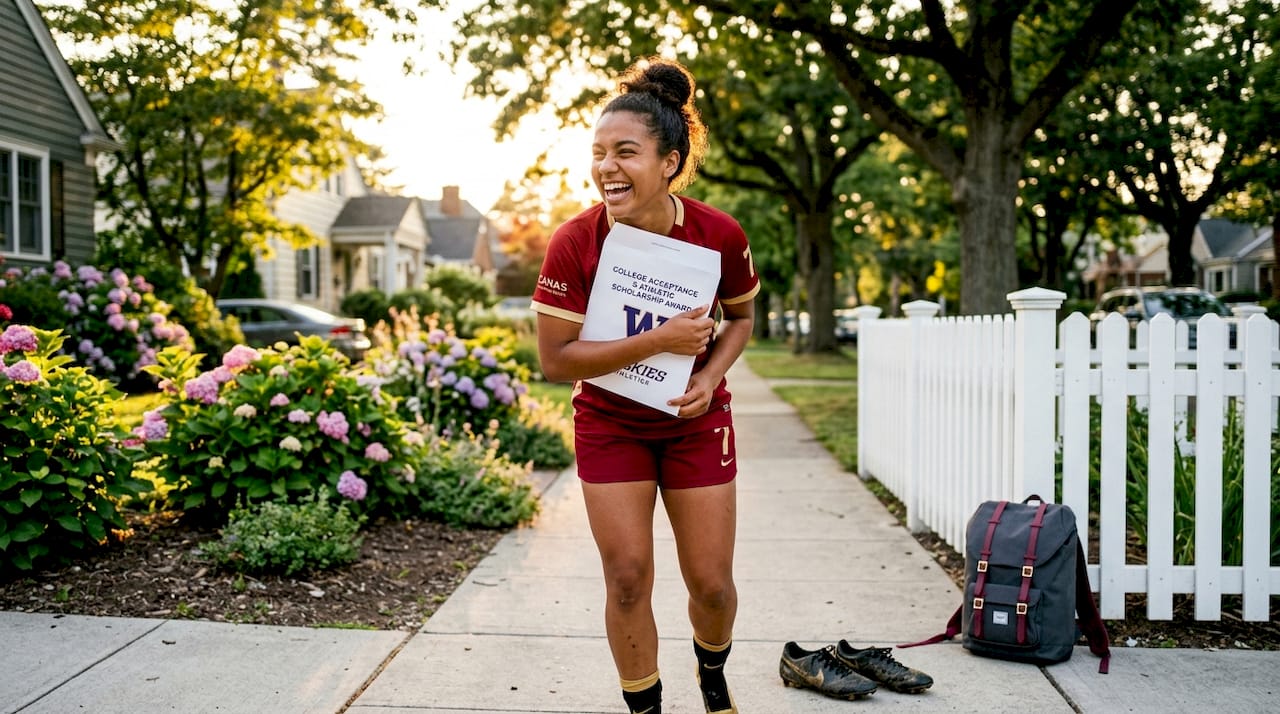
Athletic scholarships are renewable annually. Most programs offer them on a year-by-year basis, and renewal depends on athletic performance and team needs, not on a four-year guarantee. Families should treat each scholarship year as a performance contract, not a locked-in commitment.
What types of athletic scholarships are available?
Athletic scholarships fall into two structural categories: headcount scholarships and equivalency scholarships. Understanding the difference is critical for soccer athletes specifically.
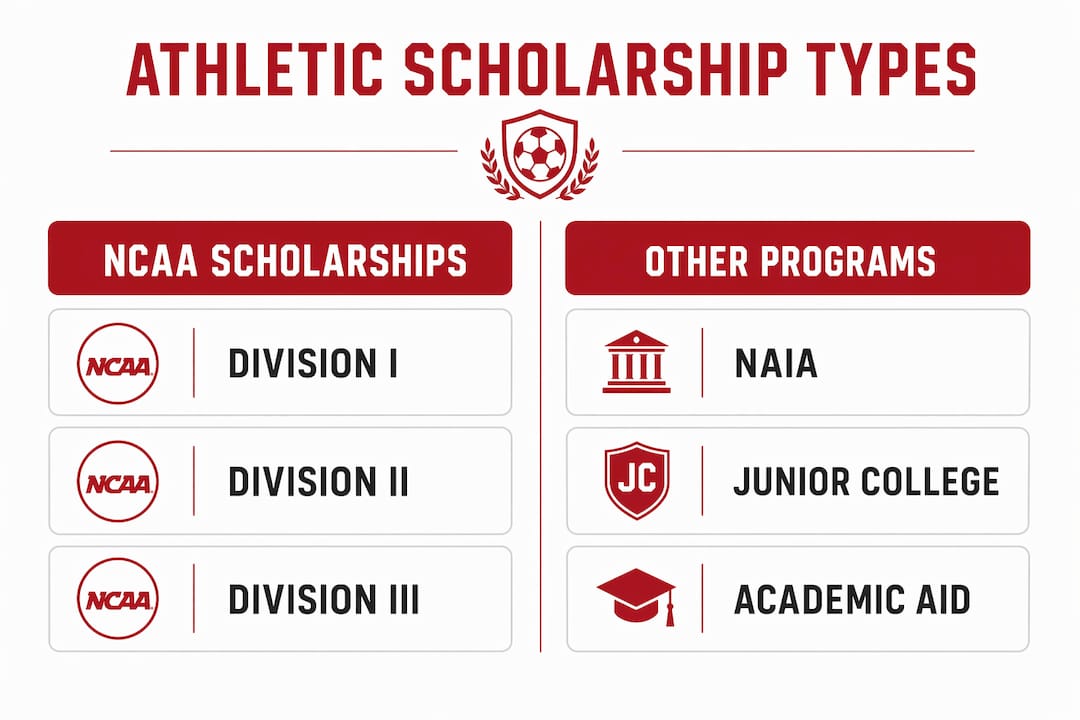
Headcount scholarships cover full tuition and are limited to certain high-revenue sports. Each scholarship counts as one athlete. Football Bowl Subdivision programs and Division I women’s gymnastics use this model. Equivalency scholarships are divided among multiple athletes, meaning a coach can split one scholarship across several players. NCAA Division I women’s soccer operates under an equivalency model with a maximum of 14 scholarships per program. Men’s soccer at the Division I level allows 9.9 equivalencies. This is why most college soccer players receive partial awards rather than full rides.
Here is how scholarship availability compares across governing bodies:
| Governing body | Scholarship type | Soccer equivalencies (women/men) | Full ride possible? |
|---|---|---|---|
| NCAA Division I | Equivalency | 14 / 9.9 | Yes, but rare |
| NCAA Division II | Equivalency | 9.9 / 9 | Partial, common |
| NCAA Division III | None | 0 / 0 | No athletic aid |
| NAIA | Equivalency | 12 / 12 | Yes, more accessible |
| NJCAA (Junior College) | Varies by division | Varies | Yes, in Division I |
NCAA Division III programs offer no athletic scholarships, though they do offer academic and need-based aid. NAIA programs are often overlooked, yet they provide strong scholarship opportunities with fewer recruiting constraints than NCAA Division I. For many soccer athletes, NAIA and Division II represent the most realistic path to meaningful financial aid.
When comparing athletic scholarships vs academic scholarships, the key difference is the award trigger. Academic scholarships require a minimum GPA or test score and are not tied to roster participation. Athletic scholarships require continued athletic contribution and can be reduced or non-renewed if a player’s role on the team changes.
Who qualifies for athletic scholarship eligibility?
Athletic scholarships are awarded based on athletic skill, academic progress, and a program’s roster needs, with coaches holding primary authority over who receives aid. No central application process exists. The coach decides, and the school’s financial aid office executes the award.
Athletic scholarship eligibility rests on three pillars:
- Athletic performance: Coaches evaluate game film, tournament results, and direct observation. For soccer, this means technical ability, tactical awareness, physical profile, and positional fit within the program’s system.
- Academic standing: The NCAA Eligibility Center requires Division I and II recruits to complete a specific core course curriculum and meet minimum GPA and standardized test score thresholds. Failing to clear these benchmarks disqualifies an athlete from receiving aid regardless of talent level.
- Team and roster needs: A program may have a surplus of forwards and zero need for another striker, regardless of how talented you are. Scholarship availability is position-specific and roster-dependent.
Pro Tip: Research each program’s current roster before reaching out to a coach. If a team already has four seniors at your position graduating next year, your timing may align perfectly. If they just signed three players at your position, the fit is poor regardless of your skill level.
NCAA scholarship rules also govern how programs can communicate with recruits. Families navigating these rules for the first time should review NCAA scholarship rules to avoid compliance missteps that could jeopardize eligibility.
Scholarships are not guaranteed for four years. Programs can reduce or decline to renew an award at the end of each academic year, which makes academic performance and team contribution equally important throughout a player’s college career.
How to apply for athletic scholarships as a soccer player
There is no single application form for athletic scholarships. The process is a recruiting relationship, and it begins earlier than most families expect. Recruitment activities commonly start between ages 15 and 17, with some elite programs identifying prospects as young as 13.
Follow this sequence to position your athlete for scholarship consideration:
- Build a recruiting profile. Create a profile on platforms like NCSA or BeRecruited that includes academic information, athletic stats, and highlight video. Coaches search these databases actively.
- Produce a quality highlight video. Keep it under five minutes. Lead with your best 60 seconds. Show technical skill, decision-making under pressure, and athleticism. Poor video quality eliminates candidates before a coach reads a single line of your profile.
- Identify target programs by division and fit. Match your athletic level to the right tier. Targeting only Division I programs when your profile fits Division II or NAIA reduces your scholarship opportunities significantly.
- Initiate direct coach contact. Send a concise, personalized email to the head coach and assistant coaches. Include your graduation year, position, GPA, and a link to your highlight video. Follow up within two weeks if you receive no response.
- Attend camps and showcases. Programs like IMG Academy Showcase, ECNL events, and college ID camps put you directly in front of coaching staffs. These are not just exposure events. They are evaluation opportunities that directly influence scholarship decisions.
- Register with the NCAA Eligibility Center. Division I and II athletes must register at the NCAA Eligibility Center before receiving an athletic scholarship. Start this process in your sophomore year of high school.
- Compare offers carefully. When offers arrive, read every line of the award letter. Understand what is covered, what is not, and what the renewal conditions are.
Pro Tip: Combine your athletic scholarship offer with FAFSA-based need-based aid and institutional merit scholarships. Many student-athletes use multiple aid sources together to reduce out-of-pocket costs to near zero. Never evaluate an athletic scholarship in isolation.
Avoiding common recruiting mistakes is as consequential as executing the right steps. Missteps like contacting coaches too late, sending generic emails, or targeting the wrong division level all reduce scholarship odds. Reviewing common recruiting mistakes before you begin outreach saves significant time and opportunity.
Understanding the real value of athletic scholarships
Scholarship offer letters may list amounts that do not include all cost components consistently, which means athletes must analyze exactly what each award covers to compare offers fairly. A 50% scholarship at a $70,000-per-year private university may be worth more than a full scholarship at a $25,000-per-year public school, depending on what each covers.
Here is a breakdown of what athletic scholarships typically cover and what they often do not:
| Expense category | Commonly covered | Often excluded |
|---|---|---|
| Tuition and fees | Yes | N/A |
| On-campus room and board | Yes (full grants) | Partial scholarships may exclude |
| Course-related books and supplies | Yes (full grants) | Partial scholarships may exclude |
| Cost-of-attendance stipend | Division I full grants | Division II, NAIA partial awards |
| Transportation and personal expenses | Sometimes | Frequently excluded |
| Summer session tuition | Rarely | Most programs |
To calculate the true value of an offer, request the school’s official cost-of-attendance figure from the financial aid office. Subtract the scholarship amount from that total. The remainder is your net cost, and that number is what your family actually pays. A $15,000 partial scholarship at a school with a $35,000 cost of attendance leaves a $20,000 annual gap. Filling that gap with academic merit aid, need-based grants, and work-study programs is both possible and common.
The club soccer investment many families make during the recruiting years should be weighed against realistic scholarship projections. Spending $20,000 annually on club fees and travel to secure a $5,000 partial scholarship is a financial outcome worth planning around, not discovering after the fact.
Key takeaways
Athletic scholarships reward athletic contribution and team fit, not talent alone. Families who understand the structure, eligibility rules, and financial mechanics of these awards make better recruiting decisions.
| Point | Details |
|---|---|
| Definition and structure | An athletic scholarship is annual grant-in-aid tied to roster participation, not a four-year guarantee. |
| Types vary by sport and division | Soccer uses equivalency scholarships, meaning most awards are partial and split among players. |
| Eligibility requires three factors | Athletic skill, academic clearance, and roster fit all determine whether a scholarship is offered. |
| Application is a recruiting process | Direct coach outreach, highlight video, and early engagement drive scholarship outcomes. |
| True value requires calculation | Compare net cost after all aid sources, not just the scholarship amount listed in the offer letter. |
What I’ve learned working with soccer families on scholarships
Working directly with soccer athletes and their families, I’ve seen one pattern repeat more than any other: families overestimate the likelihood of a full-ride scholarship and underestimate the value of partial awards at the right program. Less than 2% of high school athletes earn an NCAA Division I or II athletic scholarship. Full rides are rarer still. That statistic is not discouraging. It is clarifying.
The athletes who secure meaningful scholarship packages are not always the most talented players in the country. They are the players who identified the right division level early, built a credible recruiting profile, and communicated with coaches consistently. NAIA and Division II programs offer real scholarship money and genuine playing time, and they are significantly more accessible than Division I for the majority of college soccer prospects.
NIL (Name, Image, and Likeness) and the transfer portal have changed the college soccer environment considerably since 2021. Scholarship offers now move faster, and roster turnover is higher. This creates more mid-cycle opportunities for athletes who stay engaged and maintain their academic standing. The families who treat recruiting as a multi-year process, not a single event, consistently achieve better outcomes.
My honest advice: start the process earlier than you think you need to, target programs where your athlete can contribute from day one, and never let a partial scholarship feel like a consolation prize. A 40% scholarship at a program where your athlete thrives academically and athletically is worth far more than a full ride at a program where they sit the bench.
— Canas
How Canasrecruiting helps soccer athletes secure scholarships
Canasrecruiting specializes in connecting soccer athletes with college programs across the NCAA, NAIA, and junior college levels through a structured, personalized recruiting process.
The Scholarship Positioning System™ at Canasrecruiting is built specifically to match each athlete’s academic and athletic profile to programs where scholarship opportunities are realistic and attainable. From building your recruiting profile and producing outreach strategy to direct coach communication and offer evaluation, the process is guided at every stage. Families who work with Canasrecruiting avoid the most costly recruiting mistakes and enter conversations with coaches from a position of preparation. Schedule a call with a recruiting expert to assess your athlete’s current profile and identify the programs most likely to offer meaningful financial aid.
FAQ
What does an athletic scholarship cover?
An athletic scholarship typically covers tuition, fees, room and board, and course-related books. Full grants-in-aid at NCAA Division I programs also include a cost-of-attendance stipend for personal and transportation expenses.
Are athletic scholarships guaranteed for four years?
No. Most athletic scholarships are renewed on an annual basis and depend on continued athletic performance and team needs. Athletes should confirm renewal conditions before signing any offer.
How many soccer scholarships does an NCAA Division I program offer?
NCAA Division I women’s soccer programs can award up to 14 equivalency scholarships per year. Men’s Division I programs are limited to 9.9 equivalencies, meaning most players receive partial awards rather than full scholarships.
When should a soccer player start the recruiting process?
Recruiting activities for college soccer commonly begin between ages 15 and 17, though some Division I programs identify prospects earlier. Starting outreach by sophomore year of high school gives athletes the most program options and scholarship leverage.
Can athletic scholarships be combined with other financial aid?
Yes. Many student-athletes combine athletic scholarships with academic merit awards, need-based grants, and private scholarships to minimize total out-of-pocket costs. Evaluating all aid sources together gives the most accurate picture of what a program will actually cost.