

Most players and families treat fall as the only real recruiting window. That assumption costs opportunities. The role of spring soccer season recruiting is more significant than most athletes realize, and it operates differently than fall evaluation. Spring gives coaches a second, often deeper look at prospects. It gives mid-major programs a chance to lock in commitments before power conferences circle back. And starting with the NCAA’s upcoming two-semester model, spring evaluation will carry even more structural weight in the college soccer calendar.
Table of Contents
- Key takeaways
- The role of spring soccer season recruiting in the new NCAA calendar
- Why spring is a high-leverage window for mid-major programs
- Spring leagues, showcases, and where exposure actually happens
- Practical steps to maximize your spring recruiting results
- My perspective on what players actually get wrong about spring
- How Canasrecruiting supports your spring recruiting goals
- FAQ
Key takeaways
| Point | Details |
|---|---|
| Spring is a primary evaluation window | College coaches, especially at mid-major programs, actively scout and extend offers from April through May. |
| NCAA rule changes shift the calendar | The two-semester season model increases spring’s formal role in both competition and coach evaluation. |
| Mid-majors offer real advantages in spring | Spring offers from mid-major programs carry 38% acceptance rates vs. 22% in summer, making them worth pursuing. |
| Rec leagues alone won’t get you seen | Spring development leagues rarely draw coaches; players must attend showcases and send updated film proactively. |
| Communication drives spring commitments | Consistent outreach, updated schedules, and family engagement are what move a prospect from a coach’s watch list to an offer. |
The role of spring soccer season recruiting in the new NCAA calendar
The college soccer calendar is changing, and families need to understand what that means for evaluation timing. The NCAA Division I men’s soccer committee adopted a two-semester playing season model starting in 2027, structured around a fall segment of up to 18 contests and a spring segment of up to 10 contests. This is not a minor adjustment. It restructures how programs plan roster development and when coaches prioritize evaluation trips.
Under the previous model, most recruiting evaluation was front-loaded into fall. Coaches attended fall tournaments, identified targets, and used spring as a low-stakes follow-up window. The new structure changes that logic. With spring competition formalized as a genuine competitive segment, coaches now evaluate how prospects perform across an entire soccer year, not just a single fall showcase.
Here is what the structural shift means in practical terms:
- Fall remains the primary competitive season with higher game volume and national championship implications.
- Spring becomes a defined development and evaluation period, with up to 10 contests giving coaches meaningful data on freshmen and prospects.
- Reduced midweek scheduling under the new model lowers missed class time and supports athletic recovery, factors coaches now weigh when assessing long-term player availability.
- Spring roster decisions and playing time allocations directly affect how coaches evaluate incoming freshmen for fit and development trajectory.
Pro Tip: If you are a class of 2027 or 2028 prospect, begin treating spring evaluation not as a backup window but as a co-equal evaluation period. Coaches at programs preparing for the two-semester model are already adjusting their spring scouting calendars.
The academic balance dimension matters to families, too. The two-semester model’s design explicitly addresses student-athlete wellbeing by reducing fixture congestion. Programs that communicate this to recruits during spring visits are already using it as a differentiator in their pitch. Pay attention to those conversations.
Why spring is a high-leverage window for mid-major programs
Not every program recruits the same way in spring, and understanding those differences helps you target your energy correctly. Power conference programs often have deep fall pipelines and rely on large showcase attendance to fill their boards early. Mid-major programs operate on tighter budgets and smaller staffs, which means they must be more deliberate. Spring is where that deliberateness turns into opportunity for the right player.
The April through May evaluation period is where mid-major coaches prioritize fewer recruits with significantly more attention per prospect. Instead of scanning 200 players at a fall showcase, a mid-major coach may attend three spring club matches specifically to watch two or three players they have already been communicating with. That is a fundamentally different dynamic. You are not competing for a coach’s attention in a crowd. You are being evaluated directly.
The data on spring offer acceptance supports this approach. Spring offers carry a 38% acceptance rate compared to just 22% for offers extended in summer. That gap exists because spring offers come with clearer role definitions and more developed relationships between the coaching staff and the family. When a coach has watched you play twice in April, spoken with your parents, and outlined your development path for your freshman year, the offer lands differently than a summer email.
“Recruiting is an ongoing process; spring recruiting is where sustained communication and evaluation occur, not just a scouting snapshot.” — ClubScout, 2026
Family engagement during spring evaluation is not optional. Mid-major programs that involve families in the spring recruiting process, through campus visits, direct communication, and development conversations, report measurably higher offer acceptance rates. If a coach reaches out to your parents in April, that is a signal of serious interest. Respond quickly and professionally.
Prospects visited multiple times in spring commit at a 67% rate. That number should change how you think about giving coaches multiple opportunities to see you perform. Do not play one showcase and wait. Give coaches three chances to see you before May ends.

Spring leagues, showcases, and where exposure actually happens
Spring club soccer has a structure most families misunderstand. A typical spring rec or developmental league runs a minimum of six league games with no playoff structure. The focus is development, not results. That is valuable for your game. It is not, on its own, a recruiting strategy.
College coaches rarely attend standard rec league matches. The exposure you need during spring comes from targeted events: ECNL showcases, club state championships, regional ID camps, and spring college ID camps. Understanding where coaches actually go in spring is the first step in placing yourself in front of them.
Here is a direct comparison of the spring formats that matter most for recruiting visibility:
| Format | Recruiting Visibility | Coach Attendance | Best Use |
|---|---|---|---|
| Spring rec league | Very low | Rare | Player development only |
| Club spring showcase | High | Frequent | Primary exposure event |
| College ID camp | Very high | Guaranteed | Direct evaluation by specific program |
| Spring high school season | Moderate | Program-dependent | Supplement to club exposure |
| Spring state cup | Moderate to high | Regional coaches | Secondary exposure event |
The distinction between a development league and a recruiting tournament is not about prestige. It is about whether the right coaches will be present. Build your spring calendar around events that put you in front of programs you are actively pursuing.
Pro Tip: Before each spring showcase, email the coaching staff at programs on your list with your schedule, jersey number, and a current highlight reel. Coaches who receive this before the event are significantly more likely to find and evaluate you on the field.
Practical steps to maximize your spring recruiting results
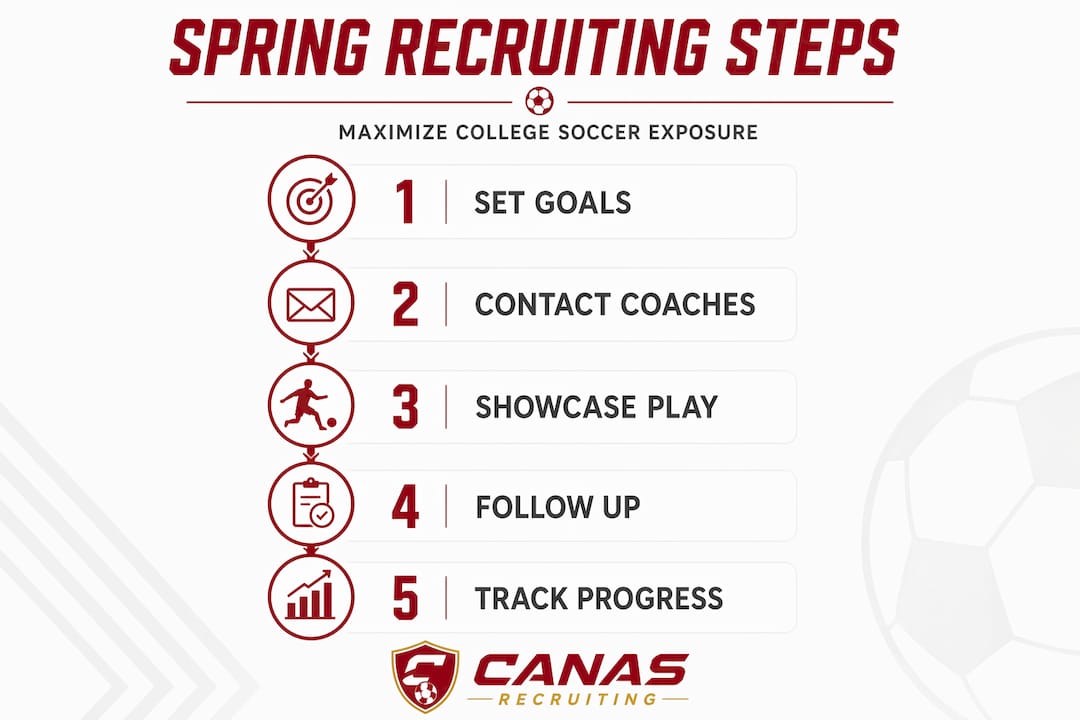
Spring recruiting does not reward passive players. The athletes who gain traction during this window are the ones who treat it as a structured campaign, not a series of games to play and hope for the best. Here is how to approach it with intention.
-
Update your profile and film before April. Your highlight video should include footage from the past three months. Coaches evaluating spring prospects want to see current form, not a reel from 18 months ago. A dated video signals a disengaged recruit.
-
Build a communication schedule. Contact each program on your priority list at least once every two to three weeks during spring. Share your upcoming tournament schedule, new film clips, and any academic updates. Consistent coach communication is one of the clearest predictors of recruiting advancement.
-
Interpret coach feedback with precision. When a coach says “we’re evaluating your position group,” that means you are not the top target yet. When a coach asks to visit a specific tournament, you are a priority. Read those signals accurately and prioritize your energy accordingly.
-
Involve your family in the process. Coaches who call your parents in spring are signaling serious interest. Families who engage actively in communication and campus visits during this period contribute meaningfully to offer acceptance and commitment outcomes.
-
Set a decision timeline. Know which programs you want to visit before June, and communicate that timeline to coaches. This creates urgency on their end and helps you manage multiple conversations without letting them drift.
Pro Tip: After each spring showcase, send a follow-up email to every coach who watched you play. A brief, specific message referencing the match and your continued interest in the program demonstrates both awareness and professionalism.
Your college soccer recruiting process is most effective when every step in spring connects to a documented plan. Track your outreach, log responses, and revisit your target school list monthly as you gather new feedback from coaches.
My perspective on what players actually get wrong about spring
I’ve worked with hundreds of players and families through spring evaluation periods, and the most consistent mistake I see is treating spring as a waiting room. Players finish a strong fall showcase, receive a few coach emails in October, and then coast through spring expecting those conversations to naturally convert into offers.
That is not how it works. In my experience, spring is where recruiting relationships either solidify or dissolve. The coaches who showed genuine fall interest are watching to see if you maintain engagement, improve your film, and continue performing. The ones who drift are typically the players who stopped sending updates in January.
What I’ve found is that mid-major programs specifically reward players who stay consistent through spring. These programs have real scholarship money and real roster spots. They are not dabbling. They are trying to identify committed, self-directed players. If you disappear in February and reappear in May, you have communicated something to that coach, and it is not what you want.
The NCAA’s shift to a two-semester model reinforces what I’ve always believed: spring is not secondary. It is a co-equal evaluation window, and the programs that understand this earliest will recruit better. Players and families who align their behavior with that reality will have a measurable advantage over those who are still running a fall-only playbook.
Stay visible. Stay communicative. Treat every spring match as an evaluation. That discipline is what separates the players who receive offers in May from the ones who scramble in August.
— Canas
How Canasrecruiting supports your spring recruiting goals
Spring recruiting requires a specific set of skills: targeted outreach, updated film, precise communication, and a clear understanding of where each program stands in your pipeline. Most families build this out on their own, which means they also make the most common and costly mistakes during the highest-leverage evaluation window of the year.
Canasrecruiting works directly with players and families throughout the spring season to handle coach outreach, profile optimization, and evaluation calendar planning. Our Scholarship Positioning System is designed to place your player in front of the right programs at the right moments during spring. We manage communication timelines, help interpret coach feedback, and prepare families for campus visits and scholarship conversations. The result is a structured, confident approach to the spring window rather than a reactive one. Schedule a call with our team or start with a free recruiting assessment to understand exactly where your player stands and what spring can realistically deliver.
FAQ
What is the spring evaluation period in college soccer?
The spring evaluation period runs primarily from April through May and is a designated window when college coaches attend club and high school matches to assess recruits. Mid-major programs in particular use this period to narrow their boards and extend scholarship offers.
How does the NCAA two-semester model affect spring recruiting?
The NCAA’s two-semester model formalizes spring competition with up to 10 contests, which increases the weight coaches place on spring evaluation when assessing both current roster players and incoming recruits.
Do college coaches attend spring rec league games?
Rarely. Standard developmental spring leagues do not attract college coaches. Recruiting exposure during spring comes from targeted showcases, state cups, and college ID camps where coaches deliberately attend.
When should players start outreach during spring recruiting?
Outreach should begin no later than late February or early March. Players need to send updated schedules, film, and introductory emails to target programs before the April evaluation window opens so coaches are already tracking them when they arrive at spring events.
Are spring offers from mid-major programs worth taking seriously?
Yes. Spring offers carry a 38% acceptance rate versus 22% for summer offers, reflecting the stronger relationships and clearer role definitions that develop through spring evaluation. These offers often represent the most defined and financially structured opportunities in the recruiting cycle.