

Many soccer players and families invest months building highlight reels and sending coach emails, yet completely overlook one of the most influential factors in the soccer recruiting process: references. The role of references in soccer recruiting is not a formality. It is a verification mechanism that directly shapes how coaches perceive your character, coachability, and scholarship potential. This guide breaks down exactly who provides references, how coaches use them, and what you can do right now to make yours work in your favor.
Table of Contents
- Key takeaways
- The role of references in the soccer recruiting process
- How to include references in your profile and outreach
- Athletic vs. academic and personal references
- How references shape coach perceptions and scholarship offers
- Steps to prepare your references for recruiting season
- My perspective on references: the most underused tool in recruiting
- Build your reference strategy with Canasrecruiting
- FAQ
Key takeaways
| Point | Details |
|---|---|
| References are verification tools | Coaches use references to confirm what they see on film and in stats before committing scholarships. |
| Club coach references matter most | Your club coach is the primary reference who validates your on-field performance and work ethic. |
| Pre-briefing references is critical | Tell your references your goals, target programs, and key film clips before coaches call them. |
| Athlete-led communication stays primary | References support your outreach but never replace direct, consistent contact from the player. |
| Reference quality affects scholarship decisions | In competitive recruiting, references often tip final scholarship decisions between equally skilled athletes. |
The role of references in the soccer recruiting process
References in soccer recruiting are the coaches, mentors, and educators who speak on your behalf when college programs conduct player evaluations. The most common and most valued reference is your club coach. Academic teachers, school counselors, and personal mentors can also serve as references depending on the program and the level of recruiting.
Coaches do not simply watch film and make offers. References serve as risk-reduction tools that allow coaching staff to verify what they observe before committing scholarship money. A strong performance in a highlight reel raises interest. A reference call that confirms consistent training habits, positive coachability, and strong character converts that interest into a genuine offer.
Programs want to understand the full picture of a recruit. As one recruiting staff perspective highlights, programs want to know the type of player and person a recruit is, and references help close that information gap. That is especially true at competitive NCAA Division I and Division II programs where the stakes are high and roster spots are limited.
Here is what coaches specifically look for when they contact a reference:
- Consistency in practice and game performance
- Response to coaching corrections and constructive feedback
- Communication style and attitude within a team environment
- Leadership qualities and off-field behavior
- Reliability and commitment to training schedules
“A reference call takes five minutes, but it can confirm or completely change a coach’s confidence in a recruit. What a club coach says about a player’s attitude often carries more weight than their stats.”
Understanding this shifts how you should think about references. They are not paperwork. They are active parts of your recruiting evaluation.
How to include references in your profile and outreach
The most practical place to start is your recruiting profile. Club coach contact information is a critical element of any complete recruiting profile, alongside your video, academic records, and competition schedule. Coaches expect to find it there. If it is missing, your profile reads as incomplete.
Beyond listing contact information, you need to coordinate with your reference before coaches reach out. Players should pre-brief their club coach on recruiting priorities, key film clips, and the player narrative they want coaches to hear. This is one of the most overlooked steps in the entire process, and it makes a measurable difference.
Pro Tip: Send your club coach a short message before you begin outreach to a specific program. Include the school name, why you are interested, two or three highlights from recent games, and what you want them to emphasize if a coach calls.
When writing initial emails to college coaches, your reference integration should be clean and direct. Do not paste a paragraph of praise from your club coach into a cold email. Instead, include your reference’s name, title, and contact information in your profile or as a brief note at the end of your email. Let the coach decide when to reach out.
Common mistakes that reduce the impact of your references:
- Using a reference who does not know your current playing level well
- Failing to notify your reference that you are in active recruiting communication
- Listing a reference without providing clear contact details
- Choosing generic references who cannot speak specifically to your performance or character
- Selecting a reference simply because they have an impressive title
Proactive athlete-led communication paired with well-prepared references consistently generates more coach responses. The reference supports your credibility. You drive the relationship.
Athletic vs. academic and personal references
Not all references carry equal weight, and the type of reference a coach prioritizes depends on the program level and what they need to confirm. Understanding these differences helps you select the right people and prepare them effectively.
| Reference Type | Primary Purpose | Best For | Weight in Recruiting |
|---|---|---|---|
| Club coach | Validates on-field performance, habits, coachability | All program levels | Highest |
| High school coach | Confirms competition experience and leadership | Lower-level programs, NAIA, JUCO | Moderate |
| Academic teacher or counselor | Demonstrates scholarship readiness and classroom character | Programs with academic standards | Moderate to high at DI/DII |
| Personal mentor or community leader | Affirms off-field leadership and communication | Holistic evaluations, character-focused programs | Supplementary |
Athletic references verify on-field performance while academic and personal references build the character and scholarship-readiness picture. At the NCAA Division I level, academic references carry real weight because programs must justify athletic scholarship investments to academic institutions. A faculty member who confirms a player’s discipline and intellectual engagement adds credibility that film alone cannot.
Personal references are best used sparingly. A community coach or youth program director who watched you lead a team or mentor younger players can speak to traits that no statistics capture. That said, these references work best as supplements to strong athletic and academic references, not replacements.
The decision of who to ask should come down to one question: who can speak most specifically and confidently about the qualities this program cares about most?
How references shape coach perceptions and scholarship offers
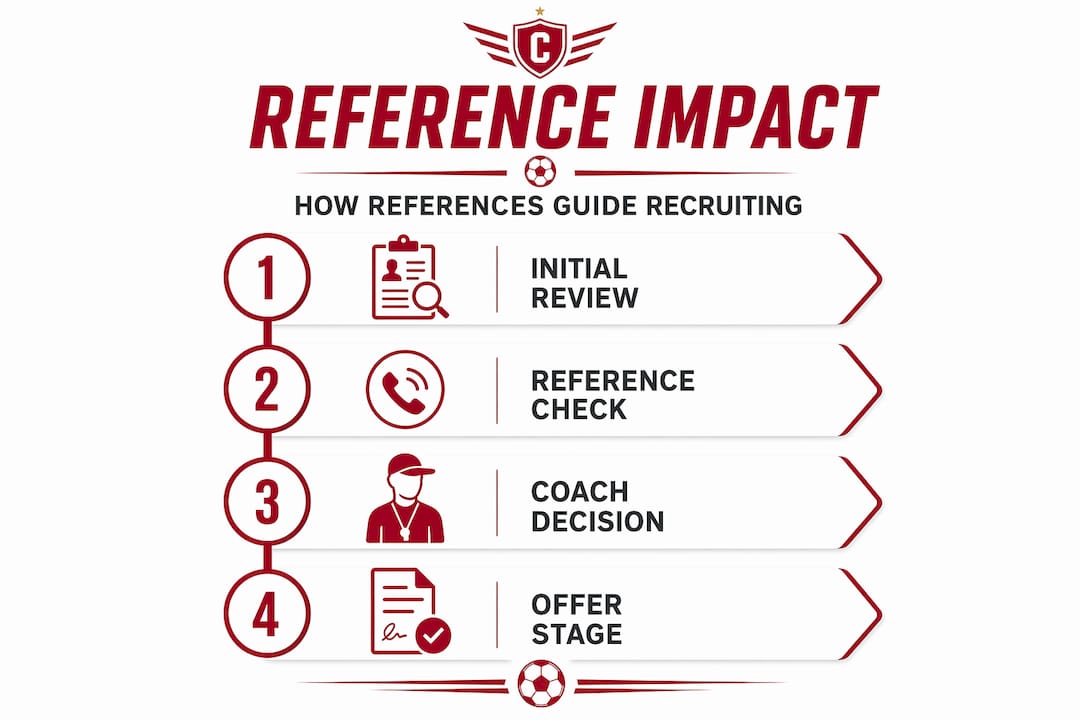
References are most influential at two specific points in the recruiting process: the initial evaluation stage and the final scholarship decision. At both moments, references help coaches confirm film and stats while forming a fuller player evaluation that includes character and fit.

At the evaluation stage, a coach reviewing twenty prospects may narrow their list based on reference quality alone. If your film is comparable to another recruit’s but your club coach communicates your consistency and attitude clearly, you advance. If your reference is vague, unresponsive, or unprepared, you may not.
At the scholarship decision stage, the gap between athletes often comes down to perceived risk. References weigh heavily in final scholarship decisions, especially in competitive recruiting environments where multiple players have similar skill profiles. A coach choosing between two equally talented midfielders will favor the one whose references confirmed character, communication, and coachability.
Pro Tip: Ask your club coach what they typically say when a college coach calls. This conversation alone often reveals gaps between how your coach perceives you and how you want to be perceived. Address those gaps before recruiting season begins.
A strong reference also aligns the narrative across all your recruiting materials. A strong reference reinforces your player narrative across video, stats, and communications, giving coaches a consistent, confident picture of who you are. Inconsistency between what coaches see on film and what a reference describes creates doubt. Coaches do not invest scholarships when there is doubt.
Steps to prepare your references for recruiting season
Preparation is what separates players who get responses from coaches and players who do not. Follow these steps to build a reference strategy that actively supports your recruiting goals.
-
Identify your strongest references. Select one or two athletic references and at least one academic reference. Prioritize people who know your current performance level and can speak with specifics, not generalities.
-
Have a direct conversation with each reference. Do not send a text asking them to be a reference and leave it at that. Schedule a call or meet in person. Explain your recruiting goals, the programs you are targeting, and the qualities you want coaches to hear about.
-
Share your highlight film and recruiting profile with them. Your reference should know what a coach will see before they call. This alignment prevents contradictions and strengthens your overall evaluation.
-
Give them a clear point of contact. Provide each reference with your current recruiting profile link and a list of the programs actively evaluating you. Update this list as your recruiting progresses.
-
Follow up regularly. Check in with your references every four to six weeks during active recruiting. Ask if any coaches have reached out and whether they need any updated information from you.
Pro Tip: Keep a simple shared document with your club coach that includes your latest highlight clip links, academic stats, and the top ten programs you are targeting. Update it monthly. This makes reference calls faster and more effective for everyone involved.
Coaches call references to confirm player strengths and training habits, so the more prepared your reference is, the stronger your evaluation becomes. This is also why league affiliation and position in your outreach emails matter. Context in your communications helps coaches ask better, more targeted questions when they do call your reference.
My perspective on references: the most underused tool in recruiting
I have worked with hundreds of athletes and families navigating the college soccer recruiting process, and the pattern I see again and again is this: players spend 90% of their preparation on film and nearly nothing on references. That is a significant strategic error.
What I have learned is that references do not just support an evaluation. In many cases, they complete it. I have seen players with Division I quality film get passed over because a reference call revealed inconsistent training habits or a difficult team dynamic. And I have seen players with solid but unspectacular film land meaningful scholarship offers because their club coach communicated their character and work ethic with conviction and specificity.
The misconception I hear most often is that references only matter if a coach asks for them directly. That is not how it works. Coaches contact club coaches and mentors throughout the evaluation process, often without telling the athlete. If your reference is unprepared, that conversation happens anyway. It just does not go in your favor.
My advice to every family reading this: treat your references as members of your recruiting team. Brief them, update them, and respect their time. The families who do this consistently are the ones who close offers faster and with better scholarship packages.
— Canas
Build your reference strategy with Canasrecruiting
At Canasrecruiting, we help athletes and families treat references as a deliberate part of their college soccer recruiting strategy, not an afterthought. Our team works directly with players to identify the right references, prepare personalized briefing materials, and coordinate timing so that every coach call reinforces your recruiting narrative. We know how to position your complete profile, including your references, to maximize scholarship consideration at NCAA, NAIA, and junior college programs across the country. If you are ready to build a recruiting approach that gives you a real advantage, start with a free recruiting assessment and let us show you exactly where your reference strategy stands today.
FAQ
What is the role of references in soccer recruiting?
References in soccer recruiting are individuals, most often your club coach, who verify your athletic performance, character, and coachability to college programs. Coaches use reference calls to reduce uncertainty before committing scholarship offers.
How do references affect scholarship decisions?
References often decide final scholarship offers between equally skilled athletes by confirming character, consistency, and fit with the program’s culture and expectations.
Who should I list as a reference in my soccer recruiting profile?
Your primary reference should be your club coach, who can speak to your on-field performance and habits. Academic or personal references can supplement your profile, particularly for programs with high academic standards.
When do coaches typically contact references?
Coaches contact references at multiple points in the evaluation process, including during initial screening and before finalizing scholarship decisions. Many players do not realize reference calls happen without prior notice, making preparation critical.
How do I prepare my club coach to be a strong reference?
Share your recruiting profile, highlight film, and a list of target programs with your club coach before active outreach begins. A pre-briefing conversation that aligns your narrative with what coaches are likely to ask makes every reference call significantly more effective.