

Most athletes and parents assume the athletic director is the person calling coaches, reviewing highlight reels, and deciding who gets a scholarship offer. That assumption is wrong, and it costs families real time and strategic positioning during the athletic recruitment process. The role of athletic director in recruiting is far more structural than personal. ADs control the budgets, hire the coaches, approve scholarship allotments, and build the facilities that either attract top talent or push it elsewhere. Understanding that distinction changes how you evaluate programs and where you focus your energy.
Table of Contents
- Key takeaways
- The role of athletic director in recruiting: core responsibilities
- How the recruiting structure actually works
- How facilities and NIL shape recruiting decisions
- Coaching hires and their effect on recruiting success
- What coaches, athletes, and parents should actually do
- My perspective on what families consistently get wrong
- How Canasrecruiting helps you read the full picture
- FAQ
Key takeaways
| Point | Details |
|---|---|
| ADs set the recruiting budget | Athletic directors approve scholarship allotments and travel budgets that determine which athletes programs can realistically pursue. |
| Coaches do the direct outreach | Position coaches build personal relationships with athletes while ADs provide the structural and financial support behind the scenes. |
| Facilities and NIL matter | AD-led capital projects and NIL partnerships directly shape how attractive a program appears to prospective athletes. |
| Coaching hires define recruiting outcomes | An AD’s decision to hire or retain a coach has a direct effect on recruiting trust, pipeline continuity, and scholarship availability. |
| Program stability signals recruiting reliability | Families should assess an AD’s track record on budget priorities and coaching stability before committing to a program. |
The role of athletic director in recruiting: core responsibilities
Athletic directors serve as chief executives of their athletic departments, overseeing coaching hires, budget development, compliance management, and facility coordination. They do not conduct athlete scouting or make initial contact with recruits. That distinction matters enormously when you are trying to understand how decisions actually get made.
The AD’s authority over scholarship budgets and recruiting travel allowances means their priorities directly shape which athletes a program can pursue. If a soccer program has a limited scholarship pool, that is often a reflection of how the AD has allocated resources across all sports, not a reflection of how much the coach values your athlete.
Modern athletic administration demands significant expertise in sports law, finance, and personnel leadership. ADs must balance NCAA compliance requirements, Title IX obligations, and institutional financial constraints simultaneously. Every one of those factors touches recruiting in some way.
Here is what falls directly under AD authority in the recruiting context:
- Approval of scholarship budgets for each sport
- Recruiting travel and expense authorizations
- NCAA and Title IX compliance oversight
- Head coach hiring and contract terms
- Facility development and capital project approvals
Pro Tip: When evaluating a college soccer program, look up the AD’s public record on facility investments and coaching tenure. That data tells you more about recruiting stability than any highlight video response will.
How the recruiting structure actually works
The tripartite recruiting model in modern college sports divides responsibilities across three layers: AD strategic oversight, recruiting personnel logistics, and position coaches’ personal outreach. Families who understand this structure stop wasting energy trying to contact the wrong people.
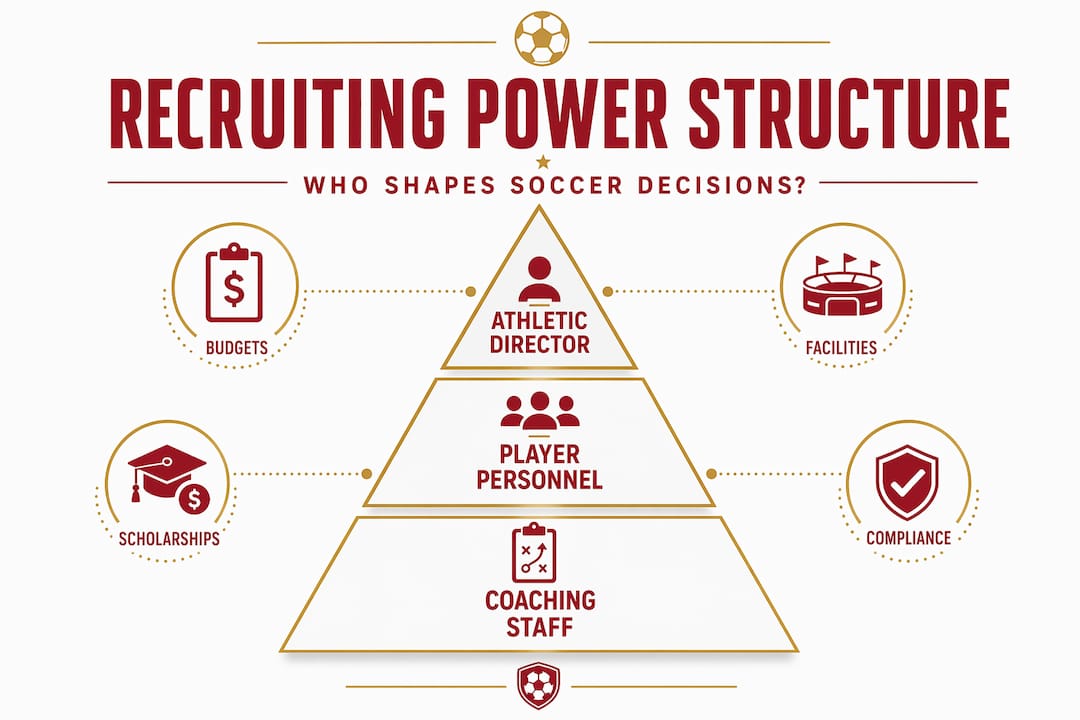
At well-resourced programs, Directors of Player Personnel handle the daily logistics of recruiting. They manage timelines, coordinate official visits, track eligibility documentation, and communicate with prospects at the operational level. Position coaches focus on relationship-building and evaluation. The AD provides the budget and the strategic direction that makes all of it possible.
| Layer | Role | Direct contact with athletes? |
|---|---|---|
| Athletic Director | Budget, compliance, staff hiring | Rarely, only during official visits |
| Director of Player Personnel | Logistics, eligibility, visit coordination | Yes, administrative communication |
| Position Coach | Evaluation, relationship-building, offers | Yes, primary contact |
Dedicated recruiting personnel create smoother, more transparent processes that reduce eligibility and enrollment risks for both programs and athletes. Programs that invest in this staffing structure signal organizational maturity. Programs that rely entirely on a single coach to manage all recruiting tasks are more vulnerable to disruption when that coach leaves.
This division of labor also protects compliance. When the AD sets clear protocols and the recruiting staff manages documentation, the risk of NCAA violations drops considerably. That protection benefits athletes just as much as it benefits the institution.
How facilities and NIL shape recruiting decisions
The AD’s influence on recruiting is nowhere more visible than in facilities and revenue generation. Athletic directors increasingly act as CEOs of revenue, approving major capital projects and managing NIL partnerships that directly affect how attractive a program is to prospective athletes.

When a soccer program builds a new training complex, installs video analysis technology, or upgrades locker rooms, that decision started with the AD. Prospective athletes touring a facility during an official visit are, in effect, evaluating the AD’s investment priorities. A well-maintained, modern facility communicates that the institution values its athletes and is willing to fund their development.
NIL opportunities have added a new dimension to this equation. An AD who actively cultivates NIL partnerships and connects athletes with local business networks gives their program a recruiting advantage that no amount of coaching charisma can fully replace. Evaluating an AD’s ability to generate revenue and fund NIL initiatives is now a legitimate part of assessing a program’s recruiting potential.
Key areas where AD-driven investment influences athlete decisions:
- Training facility quality and technology access
- Academic support center resources
- NIL partnership networks and athlete earning potential
- Program visibility through media and public relations efforts
- Travel accommodations and competition schedule quality
Pro Tip: Ask programs directly about their most recent facility investment and their current NIL infrastructure. The specificity of their answer tells you a great deal about how the AD prioritizes athlete experience.
Coaching hires and their effect on recruiting success
The single most consequential recruiting decision an AD makes is who coaches the team. The AD’s hiring and retention of coaching staff directly affects recruitment effectiveness and scholarship availability. A well-chosen head coach brings a recruiting network, a development philosophy, and the personal credibility to close scholarship offers with top athletes.
Coaching instability, on the other hand, disrupts everything. When an AD makes a poor hire or mismanages a coaching transition, the consequences follow a predictable sequence:
- Committed recruits reopen their options or decommit entirely.
- Existing players enter the transfer portal, reducing roster depth.
- Prospective athletes delay decisions or avoid the program altogether.
- Scholarship offers already extended become uncertain as the new staff reassesses roster needs.
- The program loses one to two full recruiting cycles before stabilizing.
Botched coaching transitions cause recruiting stalls and loss of athlete trust that can take years to rebuild. Families evaluating programs should look at how many head coaches a program has had in the last six years. Frequent turnover is a direct reflection of AD decision-making, not just coaching performance.
The AD also sets the compensation structure that determines whether a program can attract and retain quality coaches. A coach who feels undervalued or underpaid relative to peer programs will eventually leave, and the recruiting pipeline they built leaves with them. Scholarship sign-off authority ultimately rests with the AD, which means the sincerity and sustainability of any scholarship offer depends on that administrative relationship being functional.
What coaches, athletes, and parents should actually do
Understanding the role of AD in recruitment changes your evaluation process. You stop asking the wrong questions and start gathering information that actually predicts your experience at a program.
For athletes and parents, the most useful approach is to assess the AD’s track record before committing to a program. Review public records on facility investments, coaching tenure, and any compliance issues. ADs are the chief strategists building the environment that enables recruitment success. Their decisions are visible in the public record if you know where to look.
For coaches reading this, understanding the AD’s budget priorities helps you frame scholarship conversations with recruits honestly. If your scholarship pool is constrained, communicating that context to a family builds more trust than vague promises.
Practical steps for families navigating the athletic recruitment process:
- Research the AD’s tenure and any public statements about program investment priorities
- Ask the coaching staff directly how long the current AD has been in the role
- Check whether the program has faced NCAA compliance issues in the last four years
- During official visits, ask about the recruiting staff structure and who your primary contact will be
- Evaluate whether the program’s recruiting process is organized and responsive, since that reflects the AD’s operational culture
Pro Tip: If a program cannot clearly explain who manages recruiting logistics and who makes scholarship decisions, that organizational gap is a warning sign, not an oversight.
My perspective on what families consistently get wrong
I’ve worked with hundreds of athletes and families through the college soccer recruiting process, and the same misconception surfaces repeatedly. Families spend significant energy trying to get in front of the athletic director, believing that a direct conversation with the AD will accelerate their scholarship offer. It almost never works that way, and it can actually signal to the coaching staff that the family does not understand how the process functions.
What I’ve learned is that the AD’s influence is real, but it operates on a longer timeline than most families realize. The training facility you walk through on an official visit was approved two or three years ago. The coach who is recruiting your athlete was hired under a contract structure the AD negotiated. The scholarship being offered exists within a budget the AD built at the start of the academic year. You are experiencing the results of AD decisions made long before you arrived on campus.
The families who make the best decisions are the ones who look at institutional signals rather than individual conversations. An AD who has held the role for five or more years, invested in facilities, maintained coaching staff continuity, and kept the program clean from compliance issues has created a genuinely stable recruiting environment. That stability protects your athlete’s scholarship, their development, and their college experience.
What I tell every family: stop trying to meet the AD and start studying what the AD has already built. That record is the most honest recruiting pitch you will ever receive.
— Canas
How Canasrecruiting helps you read the full picture
Understanding the AD’s structural role is one part of a larger recruiting strategy. At Canasrecruiting, we help athletes and families evaluate programs at the NCAA, NAIA, and junior college levels with exactly this kind of depth.
Our Scholarship Positioning System™ is built around the reality that scholarship decisions are administrative as much as they are athletic. We guide you through program evaluation, direct coach outreach, and scholarship negotiation with a clear understanding of how athletic departments actually make decisions. If you are ready to approach recruiting with a structured, informed strategy, start with a free assessment or schedule a call with our team today.
FAQ
What is the role of athletic director in recruiting?
The athletic director does not conduct direct athlete scouting or make scholarship offers. Instead, the AD controls the budgets, hires the coaches, approves scholarship allotments, and manages compliance, all of which shape the recruiting environment that coaches operate within.
Do athletic directors contact recruits directly?
ADs may meet key recruits during official campus visits, but they handle no initial scouting or direct outreach. All primary contact with prospective athletes is managed by position coaches and recruiting staff.
How does an AD’s coaching hire affect scholarship opportunities?
When an AD makes a strong, stable coaching hire, it preserves recruiting pipelines and scholarship continuity. Poor hires or frequent coaching transitions disrupt committed recruits and can reduce the scholarship offers available to incoming athletes for one to two full recruiting cycles.
Why do facilities matter in college soccer recruiting?
Facilities reflect the AD’s investment priorities and signal how much the institution values its athletes. Prospective athletes evaluate training environments, academic support resources, and NIL opportunities during official visits, all of which are funded and approved by the AD.
How should families evaluate an athletic director’s impact on a program?
Review the AD’s tenure length, facility investment history, coaching staff stability, and any NCAA compliance record. An AD’s public record of long-term budget commitments and facility enhancements serves as a reliable indicator of recruiting environment quality and scholarship availability.
Recommended
- Cañas Recruiting Agency | College Soccer Scholarship Experts
- College Soccer Recruiting Services | Scholarship Positioning System™ | Cañas Recruiting
- How Our College Soccer Recruiting Process Works | Cañas Recruiting
- Free Soccer Recruiting Assessment | Evaluate Your College Potential | Cañas Recruiting