

A soccer scholarship renewal is the annual evaluation and extension of an athlete’s financial aid, contingent on meeting specific academic, conduct, and team participation standards set by the college. Most families assume a scholarship offer is a four-year guarantee. It is not. Understanding what is a soccer scholarship renewal, how it works under current NCAA rules, and what you can do to protect your aid is the most important financial literacy step a college-bound soccer player can take.
What is a soccer scholarship renewal, and how does it work?
A soccer scholarship renewal is the formal process by which a college athletic department reviews an athlete’s eligibility each year and decides whether to extend financial aid for the next academic term. This process applies across NCAA Division I, Division II, NAIA, and junior college programs. The renewal is not automatic. Each year, the institution evaluates whether the athlete has met the conditions outlined in the original written scholarship agreement.
Athletic scholarships in soccer often function as equivalency awards, meaning programs divide a limited scholarship pool among multiple players rather than offering full rides to each. NCAA Division I women’s soccer programs hold 14 scholarship equivalencies, while men’s programs hold 9.9. That structure means your aid amount and renewal terms can vary significantly from one teammate to the next.

The renewal decision typically happens each spring, before the next academic year begins. Coaches and athletic directors review academic records, conduct history, and team standing before submitting renewal paperwork to the financial aid office. You and your family will receive written notification of the decision, along with the terms for the following year.
What criteria affect the renewal of a soccer scholarship?
Renewal decisions rest on three primary categories: academic performance, conduct, and team participation. Each category carries real weight, and a failure in any one of them can result in non-renewal.
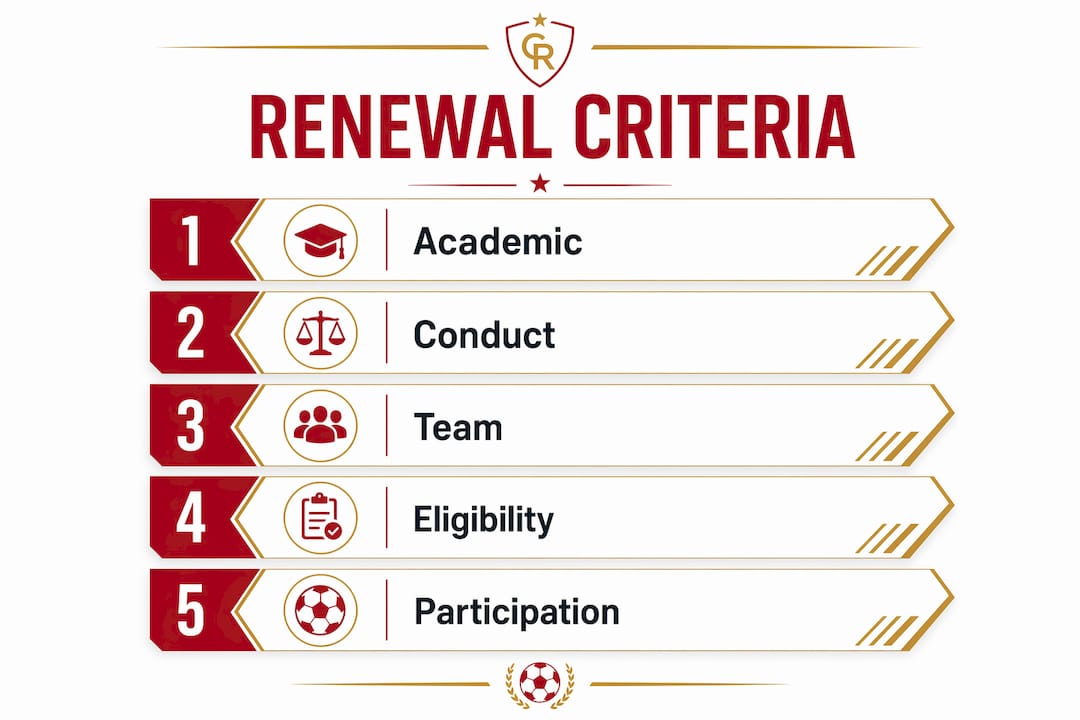
Academic eligibility is the most consistent factor across all programs and divisions. Most schools require athletes to maintain a minimum GPA, often between 2.0 and 2.5, and to complete a minimum number of credit hours per semester. NCAA eligibility rules also require athletes to make satisfactory progress toward a degree. Falling below these thresholds can trigger automatic ineligibility, regardless of your performance on the field.
Conduct and behavioral standards are equally non-negotiable. Serious violations, including academic dishonesty, criminal charges, or violations of team rules, are legitimate grounds for non-renewal. Programs document these incidents carefully, and a pattern of behavioral issues gives a coaching staff clear justification to decline renewal.
Team participation expectations include attendance at practices, games, and team activities. Voluntary withdrawal from the team is one of the few grounds that allows a program to cancel aid even mid-year. Injuries, by contrast, are protected under current NCAA rules and cannot be used as a basis for reducing or canceling a scholarship during the contract term.
- Maintain a GPA at or above your program’s stated minimum every semester
- Complete the required credit hours to stay on track for degree progress
- Attend all mandatory team activities and communicate absences in advance
- Avoid conduct violations, both on and off campus
- Report injuries immediately and follow the program’s medical protocols
Pro Tip: Ask your coach at the start of each academic year for a written list of the specific renewal criteria your program uses. Programs differ, and having it in writing removes ambiguity.
How do one-year and multi-year soccer scholarships differ in renewal guarantees?
The distinction between a one-year renewable scholarship and a multi-year agreement is one of the most misunderstood areas of college soccer recruiting. Getting this wrong can cost a family tens of thousands of dollars.
| Feature | One-year renewable | Multi-year agreement |
|---|---|---|
| Duration | One academic year at a time | Covers multiple years in a single contract |
| Renewal requirement | Annual review and re-offer required | Guaranteed unless specific conditions are violated |
| Protection from injury | Limited; renewal not guaranteed | Protected under NCAA rules effective August 1, 2024 |
| Protection from performance cuts | No mid-year cuts, but renewal can be declined | Cannot be reduced or canceled for athletic performance |
| Risk of coaching change | High; new coaches may restructure offers | Lower; written contract terms remain binding |
A one-year renewable scholarship requires the program to re-offer aid each spring. The coach has discretion to reduce or not renew the offer, as long as the decision is not based on injury, illness, or athletic performance during the contract term. That last point matters. NCAA Division I rules prohibit canceling or failing to renew athletic scholarships during the contract term for reasons such as injury, illness, or athletic performance. Non-renewal for the following year, however, is a different matter.
Multi-year agreements changed significantly in 2026 following NCAA core guarantees that took effect August 1, 2024. These guarantees protect athletes against reduction or cancellation for injury, illness, or athletic performance during the contract term. Legitimate grounds for cancellation under a multi-year deal include academic ineligibility, fraud, serious misconduct, or voluntary withdrawal from the team.
The National Letter of Intent, which previously bound athletes to programs, has been eliminated. Written scholarship offers are now the binding document. Verbal scholarship offers carry no legal enforceability. Only the signed written athletic aid agreement defines your rights and obligations.
Pro Tip: Before signing any offer, ask directly: “Is this a one-year renewable scholarship or a multi-year agreement?” Then request that the answer be reflected clearly in the written document.
What steps should athletes and families take to secure renewal?
Protecting your scholarship requires active management throughout the academic year, not just attention during the spring renewal window.
-
Request written renewal criteria before you commit. Families should clarify scholarship renewal terms before committing, including whether the scholarship is multi-year or renewed annually. Ask for a detailed financial summary each year to understand exactly what is covered and what conditions apply.
-
Document every communication with your coaching staff. Follow up verbal conversations with a brief email summarizing what was discussed. This creates a paper trail that protects you if a coaching change or budget shift affects your aid. Documenting all communications and obtaining written agreements is the primary protection against unexpected revocations.
-
Stay ahead of academic requirements. Meet with your academic advisor each semester to confirm you are on track for degree progress and meeting the GPA minimums your program requires. Do not wait for a warning from the athletic department.
-
Communicate injuries immediately and in writing. NCAA rules protect injured athletes from mid-year scholarship cancellation, but you must follow your program’s medical reporting protocols. An undocumented injury creates ambiguity that can work against you.
-
Understand your full financial aid package. Soccer athletes often underestimate the complexity of their financial aid packages, which may combine partial athletic scholarships with merit and need-based aid. Know which components are athletic aid and which are academic, because each has different renewal conditions.
-
Ask about the transfer portal before you enter it. Entering the NCAA transfer portal can trigger cancellation of future scholarship years at the end of the current term. Aid usually continues for the current term, but future guaranteed years may be lost. Understand the financial consequences before you make that move.
Pro Tip: Review your scholarship negotiation options each spring before the renewal window closes. Programs sometimes have flexibility that families never ask about.
What common misconceptions arise around soccer scholarship renewals?
The biggest misconception families carry into college soccer is that a scholarship offer equals four years of guaranteed funding. That belief leads to real financial hardship when renewal is declined.
- Scholarships are not automatically guaranteed beyond one academic year unless the written contract explicitly states otherwise. A coach’s verbal promise of “four years” holds no legal weight. Only the written agreement is enforceable.
- Poor athletic performance cannot cancel your aid mid-year. Coaches cannot reduce or cancel a soccer scholarship mid-year for poor performance or injury. However, poor performance can and does influence the decision not to renew for the following year.
- Most revocations are not disciplinary. Most scholarship revocations result from the annual renewal cycle and budget or staff changes, not actual misconduct. A coaching change or program restructuring can legally result in non-renewal at the end of a one-year term.
- Budget cuts are a real and legal reason for non-renewal. Programs facing financial pressure can reduce scholarship amounts at renewal time. This is not a violation of NCAA rules if it occurs between contract terms.
- The transfer portal has financial consequences. Many athletes enter the portal expecting their scholarship to transfer cleanly. It does not work that way. Your current-year aid is protected, but future years under a multi-year agreement can be voided once you enter the portal.
Understanding these realities does not make the process more difficult. It makes you better prepared to ask the right questions and protect your financial position throughout your college career. Families who review NCAA scholarship rules before signing are far less likely to face unexpected disruptions.
Key Takeaways
A soccer scholarship renewal is an annual, conditional process governed by academic eligibility, conduct standards, and written contract terms, not by athletic performance alone.
| Point | Details |
|---|---|
| Renewal is annual and conditional | Scholarships are reviewed each year; meeting academic and conduct standards is required for continuation. |
| Written agreements control everything | Verbal offers and promises carry no legal weight; only the signed athletic aid agreement is enforceable. |
| NCAA protects against mid-year cuts | Coaches cannot cancel or reduce aid during the contract term for injury, illness, or poor performance. |
| Multi-year deals offer stronger protection | Post-2024 NCAA guarantees protect multi-year scholarship holders from performance-based cancellation. |
| Transfer portal affects future aid | Entering the portal can void future guaranteed scholarship years, even if current-year aid remains active. |
What I have learned about soccer scholarship renewals after years in recruiting
After working with hundreds of soccer families through the recruiting and scholarship process, the pattern I see most often is this: families focus intensely on getting the offer and almost never on keeping it. That imbalance is costly.
The athletes who maintain their scholarships without disruption are not always the best players on the roster. They are the ones who show up academically, communicate proactively with their coaches, and treat every semester as a fresh evaluation. Academic commitment is the single factor that coaches and athletic directors cite most consistently when explaining renewal decisions. A player who struggles on the field but maintains a 3.2 GPA and a clean conduct record almost always gets renewed. A player who performs well athletically but falls below academic thresholds does not.
My strongest advice to any family entering this process: read the written offer carefully, ask every question you have before you sign, and treat the renewal conversation each spring as a professional meeting, not a formality. The families who approach it that way rarely face surprises.
— Canas
How Canasrecruiting helps athletes protect their scholarship standing
Securing a scholarship offer is only the beginning. Keeping it requires understanding the terms, meeting the conditions, and knowing how to communicate with your program throughout each academic year.
Canasrecruiting works directly with athletes and families to review scholarship agreements, clarify renewal conditions, and prepare for the conversations that determine whether aid continues. Our team has guided players through NCAA Division I, Division II, NAIA, and junior college programs, and we know where families most often get caught off guard. If you want to avoid the most common recruiting mistakes that put scholarships at risk, or if you are ready to start the recruiting process with a clear financial strategy, our college soccer recruiting services are built for exactly that purpose.
FAQ
What is a soccer scholarship renewal?
A soccer scholarship renewal is the annual process by which a college evaluates an athlete’s academic standing, conduct, and team participation to decide whether to extend athletic financial aid for the next academic year. It is not automatic and requires the athlete to meet specific written conditions.
Can a coach cancel my soccer scholarship for poor performance?
No. NCAA Division I rules prohibit canceling or reducing a scholarship during the contract term for athletic performance or injury. However, poor performance can influence the decision not to renew aid for the following academic year.
Is a verbal scholarship offer binding?
No. Verbal scholarship offers carry no legal enforceability. Only the signed written athletic aid agreement defines your rights, renewal conditions, and the program’s obligations to you.
Does entering the transfer portal affect my scholarship?
Yes. Entering the NCAA transfer portal can trigger cancellation of future scholarship years under a multi-year agreement, even while your current-year aid remains active. Understand the financial implications before submitting your name to the portal.
How do I know if my scholarship is one-year or multi-year?
Ask your coach directly before signing any offer, and confirm the answer in the written athletic aid agreement. A multi-year agreement will specify the number of years covered and the conditions under which it can be reduced or canceled.