

Soccer scholarship negotiation is defined as the process by which a student-athlete and their family discuss, clarify, and refine the terms of an athletic financial aid offer with a college coach or athletic department before making a commitment. Most families accept the first number a coach presents without realizing that number is often a starting point, not a final decision. Understanding how to negotiate a soccer scholarship separates athletes who maximize their college funding from those who leave money on the table. The NCAA, NAIA, and junior college programs each operate under different rules, and knowing those distinctions gives you real leverage.
What is a soccer scholarship negotiation and when does it happen?
Soccer scholarship negotiation occurs after a coach extends a formal offer and before the athlete signs any written agreement or commits to the program. The NCAA recruiting process typically begins around ages 13 to 17, but the actual negotiation window opens only once an offer is on the table. That window is shorter than most families expect, which is why preparation before the offer arrives determines how well you perform when it counts.
The recruitment timeline follows a clear sequence:
- Evaluation phase. Coaches assess athletic film, academic transcripts, and tournament performance. Your visibility during this stage directly shapes the offer amount you receive later.
- Initial contact and conversations. Coaches reach out, ask questions, and gauge your interest level. Every interaction here builds the relationship capital you will draw on during negotiation.
- Formal offer. The coach presents a scholarship figure, either verbally or in writing. Post-October 2024, Division I and II programs replaced the traditional National Letter of Intent with written athletics-aid agreements, making the offer document more detailed and more binding than before.
- Negotiation window. This is your moment. You have received the offer but have not yet committed. Ask questions, present competing offers, and request adjustments.
- Commitment and signing. Once you sign a written aid agreement, the terms are set for that award period.
Recruiting specialists recommend beginning exploration and communication between ages 15 and 17 for the best negotiation outcomes. Athletes who enter conversations already known to multiple programs have far more flexibility than those who approach a single coach with no alternatives.
Pro Tip: Start building your recruiting profile and contacting coaches no later than your sophomore year of high school. The earlier coaches know your name, the stronger your position when an offer arrives.

What types of soccer scholarships exist and how do they affect negotiation?
Understanding scholarship structures is the foundation of any negotiation strategy. Not all offers are built the same way, and the type of scholarship a program can award directly shapes how much flexibility a coach has when you push back.
Full-ride vs. partial scholarships
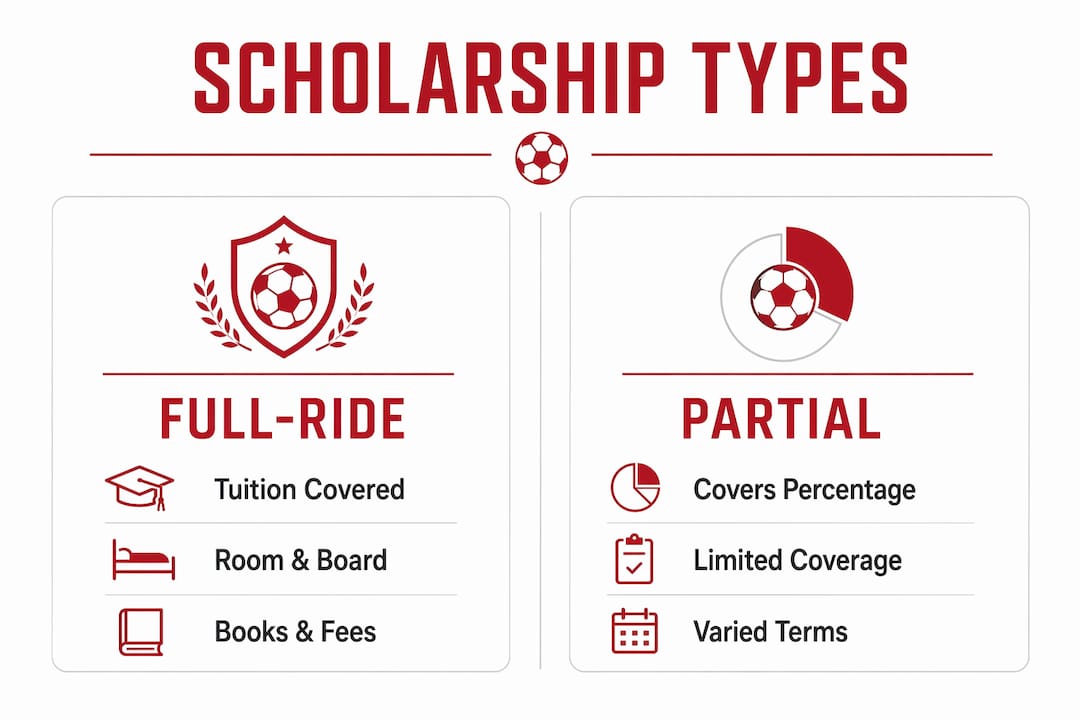
A full-ride scholarship covers tuition, room and board, books, and fees. Partial scholarships cover a percentage of those costs. In college soccer, partial scholarships are far more common than full rides, particularly in men’s programs. Families who assume any offer is all-or-nothing often miss the opportunity to negotiate the partial amount upward.
Equivalency vs. head-count models
The NCAA divides scholarship programs into two models that directly affect your negotiation options:
- Head-count sports award scholarships as full rides only. Women’s Division I soccer operates under this model, with programs allowed up to 14 scholarships. Each scholarship is a complete package, leaving less room to split or adjust individual awards.
- Equivalency sports allow coaches to divide a scholarship pool among multiple athletes. Men’s Division I soccer is capped at 9.9 equivalency scholarships across a roster. This means a coach might offer one athlete 40% and another 60%, and those percentages can be negotiated.
- NAIA programs operate with their own scholarship limits and often provide more flexibility in award structure than NCAA Division I. NAIA scholarship opportunities deserve serious consideration, especially for athletes who want more playing time alongside financial support.
- Junior college programs offer athletic aid under different frameworks and can serve as a strong negotiation starting point for athletes building their profile before transferring to a four-year school.
Academic and need-based aid as leverage
Athletic scholarships rarely cover every cost. Families should request itemized financials before accepting any offer to understand the true out-of-pocket expense. Combining an athletic award with institutional merit aid, need-based grants, and FAFSA-based federal aid can close significant funding gaps. FAFSA deadlines and requirements affect the overall aid package annually, so coordinating both sources is a negotiation move in itself.
| Scholarship Type | Negotiation Flexibility |
|---|---|
| Women’s D1 (head-count, up to 14) | Low. Full rides only; limited room to adjust individual amounts. |
| Men’s D1 (equivalency, capped at 9.9) | Moderate. Percentages can be negotiated across the roster. |
| NAIA (equivalency model) | Higher. Coaches often have more discretion in award distribution. |
| Junior college | Variable. Structures differ by institution; direct conversation is key. |
What are the best practices for negotiating a soccer scholarship?
Effective negotiation involves clear communication, value demonstration, and a thorough understanding of offer conditions. It is not about demanding more money. It is about showing a coach why investing more in you is the right decision for the program.
The following practices consistently produce better outcomes for athletes and families:
- Demonstrate fit, not just skill. Coaches negotiate with athletes they believe will contribute to team culture and stay enrolled. Frame your conversation around what you bring to the program academically, socially, and athletically.
- Use competing offers as leverage, carefully. Athletes with competing offers may negotiate by presenting alternatives, but the approach requires care. Mentioning another offer as a genuine factor in your decision is professional. Treating it as a threat damages the relationship and can result in the original offer being withdrawn.
- Request a full financial breakdown. Ask the coach or athletic department to itemize what the scholarship covers and what it does not. This gives you a clear picture of the real value and identifies specific gaps you can address through negotiation or supplemental aid.
- Bring strong academics to the table. Coaches prioritize athletes who combine athletic ability with academic eligibility and team fit. A strong GPA and test scores increase your scholarship options and give you more programs to choose from, which directly improves your negotiating position.
- Work with a recruiting agency or adviser. Canasrecruiting works directly with athletes and families to prepare negotiation talking points, identify competing programs, and communicate with coaches professionally. Having an experienced advocate in your corner changes the dynamic of the conversation.
Pro Tip: Never negotiate over text or social media. Phone calls and video meetings give you tone, context, and the ability to build rapport. Written follow-ups after those conversations create a clear record of what was discussed.
Avoid aggressive tactics. Coaches talk to each other, and a reputation for being difficult to work with travels fast in the college soccer community. The goal is a better offer from a program that still wants you.
How to interpret and respond to a soccer scholarship offer
Receiving an offer is exciting. Acting on it without fully understanding the terms is one of the most common and costly mistakes families make during the recruiting process.
Here is how to evaluate any offer before responding:
- Distinguish verbal from written commitments. Verbal offers carry no binding obligation for either party. Post-2024 NCAA policy places greater emphasis on written athletics-aid agreements, which do carry formal obligations. Do not treat a verbal offer as secured funding.
- Review renewal conditions. Most scholarships are awarded on a year-to-year basis. Ask specifically what academic GPA, athletic performance benchmarks, and conduct standards are required for renewal. A scholarship that disappears after your freshman year is not the deal it appeared to be.
- Understand what the offer actually covers. Tuition is often listed, but room and board, fees, and course materials may not be included. Request a written breakdown of every line item before making any decisions.
- Consult a recruiting expert before signing. The spring recruiting season generates a surge of offers, and families often feel pressure to decide quickly. Taking 48 to 72 hours to review terms with an adviser is always appropriate and rarely jeopardizes a legitimate offer.
- Coordinate with FAFSA and institutional aid. Athletic scholarships and federal financial aid are calculated together. Submitting your FAFSA early and sharing your aid package with the coach gives both sides a clearer picture of the total funding available and opens the door to additional institutional support.
| Offer Element | What to Ask |
|---|---|
| Scholarship amount | What percentage of total cost does this cover? |
| Renewal terms | What GPA and performance standards are required each year? |
| Coverage details | Does this include room, board, fees, and books? |
| Verbal vs. written | When will I receive a written athletics-aid agreement? |
| Additional aid | Can institutional or need-based aid be stacked with this offer? |
Key takeaways
Soccer scholarship negotiation requires preparation before the offer, clarity about scholarship structures, and professional communication throughout the process to produce the best possible outcome.
| Point | Details |
|---|---|
| Negotiate before commitment | The window between receiving an offer and signing is your only real leverage point. |
| Know your scholarship model | Men’s D1 equivalency and women’s D1 head-count models create different negotiation conditions. |
| Request itemized financials | Always ask for a written breakdown of what the scholarship covers before accepting. |
| Use competing offers carefully | Multiple offers improve your position but must be presented professionally to protect coach relationships. |
| Combine aid sources | Coordinate athletic scholarships with FAFSA and institutional aid to maximize total funding. |
What I have learned from watching families negotiate soccer scholarships
The families who get the best outcomes are not the ones who push hardest. They are the ones who prepared earliest. At Canasrecruiting, we have worked with athletes across NCAA Division I, Division II, NAIA, and junior college programs, and the pattern is consistent: athletes who began building their profile and communicating with coaches at 15 or 16 enter negotiation with real options. Athletes who waited until senior year often negotiate from a single offer with no alternatives.
The emotional weight of this process is real. Parents want the best for their child, and that urgency can lead to rushed decisions or, conversely, to hesitation when a firm response is needed. Both extremes cost money. The families who fare best treat this like a professional process, not a personal one.
One thing that surprises many families is how much the academic component matters in negotiation. A player with a 3.8 GPA and solid film is not just a better athlete to a coach. They are a safer investment. Coaches know that academically strong athletes are more likely to stay enrolled, maintain eligibility, and graduate. That reduces risk for the program and gives you real leverage at the table.
The shift away from the NLI to written athletics-aid agreements post-2024 has also changed the stakes. Families now need to read those documents carefully. The terms are more detailed, and the obligations are clearer. That is actually good news for athletes who know what to look for. It creates a more transparent negotiation environment.
My honest recommendation: do not walk into this process alone. The difference between a 30% scholarship offer and a 60% offer often comes down to how well the athlete was positioned before the conversation started.
— Canas
How Canasrecruiting helps you negotiate with confidence
Canasrecruiting works with soccer players and families at every stage of the recruiting process, from initial evaluation through scholarship acceptance. Our Scholarship Positioning System™ is built specifically to prepare athletes for the negotiation conversations that determine how much of their college education gets funded.
We identify the right programs for your profile, build direct relationships with coaches, and give you the talking points and documentation you need to negotiate from a position of knowledge. Whether you are targeting NCAA Division I, Division II, NAIA, or junior college programs, our team has experience across all levels. Schedule a call with a Canasrecruiting expert today and find out exactly where you stand and what your scholarship potential looks like.
FAQ
What is a soccer scholarship negotiation?
Soccer scholarship negotiation is the process of discussing and refining the terms of an athletic financial aid offer with a college coach before committing to a program. It involves reviewing scholarship amounts, renewal conditions, and coverage details to secure the best possible package.
Can you negotiate a soccer scholarship after receiving an offer?
Yes. The period between receiving an offer and signing a written athletics-aid agreement is the primary window for negotiation. Coaches have some flexibility during this stage, particularly in equivalency sports like men’s Division I soccer.
How do competing offers help in scholarship negotiations?
Competing offers give you documented alternatives that demonstrate your value to multiple programs. Presenting them professionally, as a genuine factor in your decision rather than a pressure tactic, can prompt a coach to improve their offer without damaging the relationship.
What should you ask when reviewing a soccer scholarship offer?
Ask for a written breakdown of what the scholarship covers, the GPA and performance standards required for renewal, and whether institutional or need-based aid can be combined with the athletic award. These questions clarify the real value of the offer.
Does academic performance affect soccer scholarship negotiations?
Strong academic performance directly increases your negotiation leverage. Coaches view academically eligible athletes as lower-risk investments, and a high GPA expands the number of programs willing to offer you aid, which creates more options at the negotiating table.