

A full athletic scholarship covers tuition, fees, room, board, and required course-related books, while a partial scholarship covers only a portion of these costs. Understanding the difference between a partial vs full soccer scholarship is not just a financial exercise. It directly shapes which schools are realistic options, how much debt your family takes on, and whether a college offer is genuinely competitive. Most families enter the recruiting process assuming full rides are the standard. They are not. Soccer operates under equivalency scholarship rules that make true full rides rare across nearly every division. This guide breaks down exactly what each scholarship type covers, how NCAA and NAIA rules shape what coaches can offer, and how to build a funding strategy that closes the gap.
What does a partial vs full soccer scholarship actually cover?
A full athletic scholarship pays for all core college costs: tuition, mandatory fees, on-campus housing, meal plans, and required textbooks. A partial scholarship covers some of these expenses but leaves the athlete responsible for the remainder. The difference between the two is not just a matter of degree. It determines whether your family writes a check every semester or not.
The framework colleges use to define total costs is the Cost of Attendance, or COA. COA is a federally defined estimate that includes tuition, fees, housing, food, books, transportation, and personal expenses, and it sets the maximum amount of aid a student can receive from all sources combined. No scholarship or aid package can legally exceed the COA. This ceiling matters because it limits how much stacking of multiple aid sources is possible.
What makes COA calculations complex is that schools calculate COA differently depending on whether a student lives on campus, off campus, or with family, the program of study, and state residency status. A scholarship covering 70% of tuition at a $55,000-per-year private university leaves a much larger gap than the same percentage at a $22,000-per-year public school. Always evaluate scholarship offers against the specific COA of each institution, not just the percentage figure a coach mentions.
The components most commonly covered by full scholarships are:
- Tuition and mandatory fees: The base academic cost of enrollment
- Room and board: On-campus housing and a standard meal plan
- Books and course materials: Required academic supplies, not elective purchases
- Transportation allowance: A modest stipend included in some COA calculations
- Personal expenses: A small discretionary allowance built into the federal COA formula
Pro Tip: Ask each college’s financial aid office for the current-year COA breakdown before comparing offers. Two scholarships at the same percentage can represent very different dollar amounts depending on the school’s total cost.
How do NCAA divisions and other associations differ in soccer scholarships?
The type of scholarship you can receive depends heavily on which division or association governs the program. NCAA Division I, Division II, Division III, NAIA, and NJCAA each operate under distinct rules that directly affect how many scholarships exist and how they are distributed.
| Association | Scholarship type | Men’s soccer limit | Women’s soccer limit | Full rides available? |
|---|---|---|---|---|
| NCAA Division I | Equivalency | 9.9 | 14 | Rare |
| NCAA Division II | Equivalency | 9 | 9.9 | Very rare |
| NCAA Division III | None (athletic) | 0 | 0 | No |
| NAIA | Equivalency | 12 | 12 | More common |
| NJCAA | Varies by division | Up to 18 | Up to 18 | Possible at D1 NJCAA |
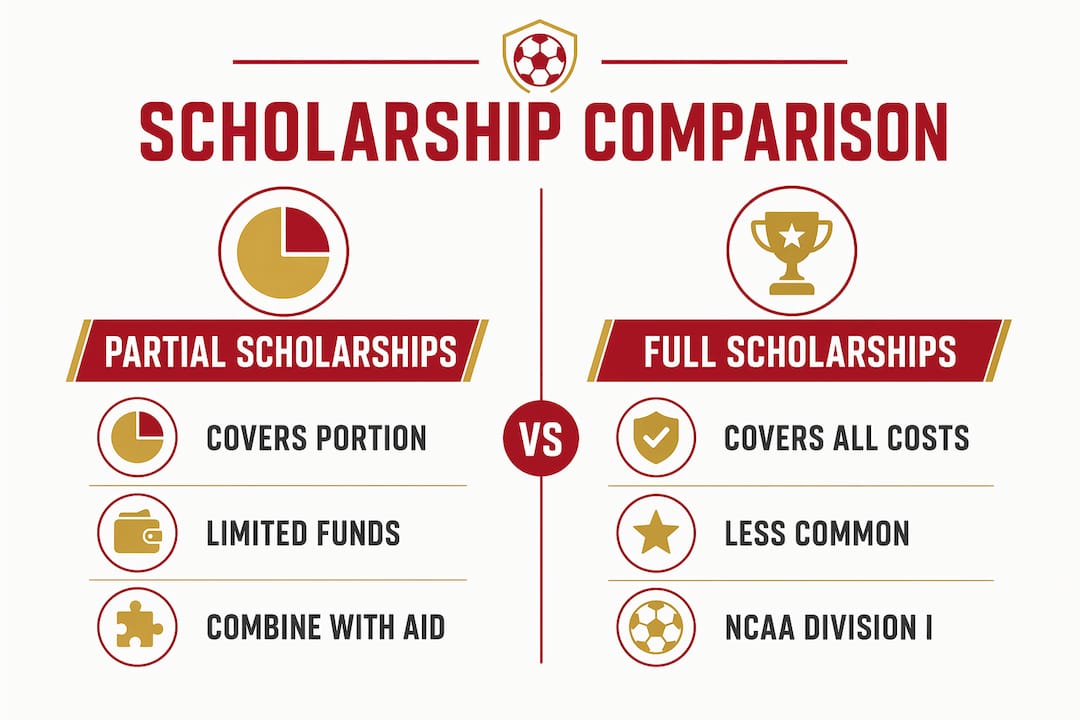
NCAA Division I men’s soccer is an equivalency sport with a maximum of 9.9 scholarships to distribute across an entire roster. Coaches typically spread those funds across 20 to 30 players, which means the average award per player is well under a full ride. Women’s soccer at the D1 level allows up to 14 scholarships, giving coaches slightly more flexibility, though full rides remain uncommon outside of elite programs.
NCAA Division II soccer scholarships are predominantly partial, with coaches distributing limited funds among players while balancing athletic and academic priorities. Division II programs often combine athletic aid with institutional merit awards to build competitive packages. Understanding the NCAA scholarship rules that govern these limits is the first step toward setting realistic expectations.

NCAA Division III programs offer no athletic scholarships at all. Athletes at D3 schools can still receive substantial financial aid through academic merit grants, need-based aid, and institutional awards, but none of it is tied to athletic performance. NAIA programs operate with equivalency limits as well, but their rules are generally more flexible and full-ride packages are more achievable, particularly at smaller private institutions. NAIA soccer scholarship opportunities deserve serious consideration from families who want maximum funding without the intense competition of D1 recruiting.
What are the real financial implications of a partial scholarship offer?
True full-ride scholarships are rare in soccer due to equivalency limits and roster management strategies. Most players receive partial aid, which means families must plan for out-of-pocket costs from day one. Here is how the math typically plays out in practice:
- Scenario A: 50% scholarship at a $30,000 COA school. The athletic award covers $15,000. The family is responsible for the remaining $15,000 per year, or $60,000 over four years before any additional aid is applied.
- Scenario B: 30% scholarship at a $55,000 COA school. The athletic award covers $16,500. The family owes $38,500 annually. Despite a similar dollar award, the gap is dramatically larger.
- Scenario C: 80% scholarship at a $28,000 COA school. The athletic award covers $22,400. The family owes $5,600 per year, making this the most affordable option despite the lower-profile program.
Partial scholarships can vary widely, from covering a small percentage to nearly all costs. A partial award might pay 60% of room and board while leaving tuition entirely uncovered, or it might cover full tuition while leaving housing costs to the family. The specific structure of the award matters as much as the total dollar amount. Always request a written breakdown of exactly which cost categories the athletic scholarship addresses.
The net price, meaning what your family actually pays after all aid is applied, is the only number that matters when comparing offers. A 40% scholarship at a school with a $20,000 COA is a better deal than a 60% scholarship at a school with a $50,000 COA. Families who focus only on scholarship percentages without anchoring them to actual COA figures routinely underestimate their true financial commitment.
How can families combine partial scholarships with other aid?
Scholarship stacking is the practice of combining partial athletic scholarships with academic merit awards, need-based grants, and institutional aid to approach a full-ride total package. This strategy is the primary tool available to families navigating equivalency sport limits, and it works across NCAA, NAIA, and NJCAA programs.
The most effective stacking sources to pursue alongside an athletic award include:
- Institutional merit scholarships: Many colleges award these automatically based on GPA and test scores. A student with a 3.8 GPA and a 1200 SAT score may qualify for $8,000 to $15,000 in annual merit aid at schools where they are athletically recruited.
- Federal Pell Grants: Need-based federal aid that does not require repayment. Families with an Expected Family Contribution below a certain threshold qualify automatically through the FAFSA.
- State grants: Many states offer grant programs for residents attending in-state colleges. These awards stack on top of athletic and federal aid up to the COA cap.
- Institutional need-based aid: Separate from federal programs, many private colleges offer their own need-based grants that can significantly reduce net price.
Combining academic and need-based aid with an athletic award requires proactive communication with both the coaching staff and the financial aid office. Coaches control athletic scholarship funds. Financial aid offices control everything else. These two offices do not always coordinate automatically, so you need to initiate the conversation at both ends.
Net Price Calculators on college websites are a useful starting point, but NPCs vary in accuracy and update frequency, meaning families should verify all offers directly with financial aid offices before making any decisions. Treat NPC results as a rough filter, not a final number.
Pro Tip: Submit the FAFSA as early as October 1st of your senior year. Earlier submission gives financial aid offices more flexibility to build a competitive package around your athletic offer.
Key takeaways
Understanding the difference between partial and full soccer scholarships requires evaluating COA, division rules, and stacking potential together, not any single factor in isolation.
| Point | Details |
|---|---|
| Full vs partial definition | Full scholarships cover all core costs; partial awards leave families responsible for the remainder. |
| Equivalency limits make full rides rare | NCAA D1 men’s soccer has only 9.9 scholarships to split across an entire roster. |
| COA anchors every comparison | Always evaluate scholarship percentages against the school’s specific Cost of Attendance figure. |
| Stacking closes the gap | Combining athletic, merit, and need-based aid is the standard path to affordability in soccer. |
| Net price is the only number that matters | Two offers at the same percentage can differ by tens of thousands of dollars depending on the school. |
What I’ve learned from years of soccer scholarship negotiations
Most families I work with at Canasrecruiting arrive with the same assumption: a scholarship offer from a college soccer program means the costs are handled. That assumption costs families real money. In my experience, the gap between what a coach offers and what a family actually pays is where the most important decisions get made, and most families are not prepared for that conversation.
The families who navigate this process best are the ones who treat every offer as a starting point, not a final number. They ask coaches directly what the scholarship covers, they call the financial aid office before committing, and they compare net prices across multiple schools rather than ranking programs by athletic prestige alone. A 25% scholarship at a D1 program can leave a family paying $40,000 per year. A 70% award at a well-funded NAIA school might leave them paying $8,000. The D1 name does not justify that gap for most families.
The other thing I tell every athlete and parent: your academic profile is a financial asset. A strong GPA and test scores open merit scholarship doors that athletic awards alone cannot. The athletes who maximize their total aid packages are almost always the ones who invested in their academics alongside their soccer development. Recruiting is not just about getting noticed by coaches. It is about building the strongest possible financial case at the right schools.
— Canas
How Canasrecruiting helps you secure the right scholarship
Canasrecruiting works directly with soccer players and their families to build a targeted recruiting strategy that accounts for both athletic fit and financial outcome. Our process includes direct coach outreach, scholarship positioning, and guidance on combining athletic awards with academic and need-based aid to maximize total funding.

We help you evaluate every offer against the actual COA, identify schools where your academic and athletic profile qualifies for the strongest combined packages, and prepare you for financial aid conversations that most families do not know to have. Whether you are targeting NCAA, NAIA, or junior college programs, our scholarship placement services are built to give you a clear, structured path from evaluation to commitment. Visit Canasrecruiting to learn how we can help your family make the most informed decision possible.
FAQ
What is the difference between a partial and full soccer scholarship?
A full athletic scholarship covers tuition, fees, room, board, and required books, while a partial scholarship covers only a portion of those costs. The athlete and family are responsible for any expenses the partial award does not address.
Are full soccer scholarships common at the NCAA level?
Full rides are rare in college soccer because NCAA equivalency rules limit Division I men’s programs to 9.9 total scholarships split across an entire roster. Most players receive partial awards.
Can a partial soccer scholarship be combined with other financial aid?
Yes. Scholarship stacking allows athletes to combine partial athletic awards with academic merit scholarships, federal Pell Grants, state grants, and institutional need-based aid up to the COA cap.
How accurate are Net Price Calculators for estimating soccer scholarship value?
Net Price Calculators vary in accuracy and are often outdated. Use them as an initial filter, then confirm actual costs and aid packages directly with each school’s financial aid office.
Does NCAA Division III offer soccer scholarships?
NCAA Division III programs do not offer athletic scholarships. Athletes can still receive academic merit awards and need-based aid, but no funding is tied to athletic participation or performance.