

NCAA soccer roster limits are the maximum number of players a college program can officially carry on its team, and starting in the 2025–26 academic year, those limits changed dramatically under the House v. NCAA settlement. For any family navigating the college soccer recruiting process, understanding these new rules is not optional. The limits directly control how many scholarships a program can distribute, who makes the roster, and how much funding your athlete can realistically expect. This article breaks down NCAA soccer roster limits explained clearly, so you can recruit with accurate expectations.
What are the current NCAA soccer roster limits?
NCAA Division I men’s and women’s soccer programs are now capped at a maximum of 28 players on the roster, effective the 2025–26 academic year. This is a hard cap, meaning no exceptions for walk-ons or additional recruits beyond that number. The change replaced the old scholarship equivalency system, which had governed college soccer team sizes for decades.
Under the previous NCAA soccer roster rules, men’s programs were limited to 9.9 equivalency scholarships and women’s programs to 14. Those limits controlled funding, not headcount. Rosters could be much larger because coaches could carry unfunded walk-ons freely. The average men’s soccer roster before the new limits was 41.9 players. Women’s programs averaged about 31.2 players. The new 28-player cap cuts those numbers significantly, especially on the men’s side.
The table below shows exactly how the rules shifted:
| Category | Old Rule | New Rule (2025–26) |
|---|---|---|
| Men’s D1 Scholarship Limit | 9.9 equivalency scholarships | Up to 28 equivalency scholarships |
| Women’s D1 Scholarship Limit | 14 equivalency scholarships | Up to 28 equivalency scholarships |
| Men’s Average Roster Size | 41.9 players | 28 players maximum |
| Women’s Average Roster Size | 31.2 players | 28 players maximum |
| Roster Type | Scholarship cap, open headcount | Hard roster cap |
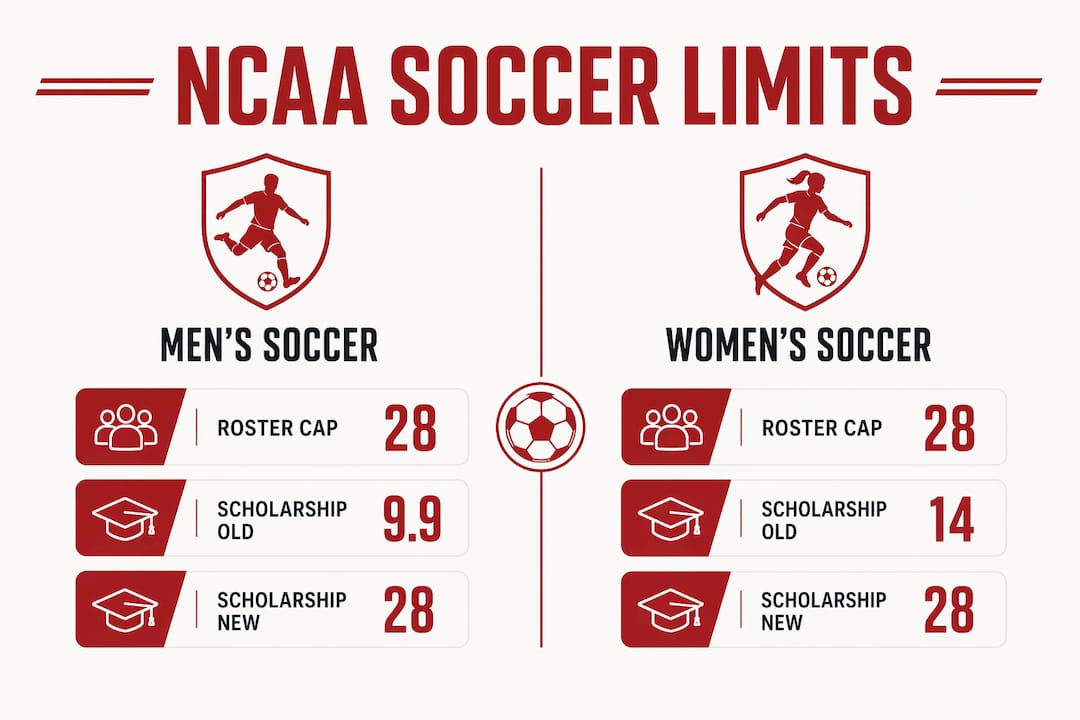
The most important distinction here is that a roster cap and a scholarship cap are not the same thing. A scholarship cap limits funding. A roster cap limits bodies. Under the new model, every player on the 28-man or 28-woman roster could theoretically receive some level of athletic aid, which was structurally impossible before.
How do roster limits affect scholarships and recruiting?
NCAA Division I soccer is an equivalency sport, meaning coaches split a scholarship budget across multiple players rather than awarding a set number of full rides. Full scholarships in college soccer are rare. Most players receive partial awards that cover a portion of tuition, room, board, or fees.

Under the new roster cap model, men’s soccer scholarship limits technically tripled in potential ceiling, moving from 9.9 equivalency scholarships to a possible 28. That sounds like a major win for players. The reality is more complicated. Programs still operate within athletic department budgets, and most mid-major schools will not fund all 28 roster spots at meaningful levels.
Coaches distribute scholarship budgets based on team needs and position priorities. Starters and key contributors typically receive larger shares. Younger players often receive smaller partial awards that can grow as they earn playing time. This means a freshman offer of 20% tuition coverage is not necessarily the ceiling of what you will receive over four years.
Here are the key questions every family should ask a coach during the recruiting process:
- How many roster spots does your program currently have available?
- What is your typical scholarship offer for my position?
- Does your program operate at the full 28-player roster or below?
- How does your scholarship budget change from year to year?
- Can athletic aid be combined with academic or need-based financial aid?
Walk-on opportunities have also decreased under the new model. Smaller rosters mean fewer open spots for non-funded players. Coaches are more selective about every roster position because each one counts against the hard cap. If your athlete was counting on walking on to a program and earning a scholarship later, that path is narrower now.
Pro Tip: Combine your athletic scholarship offer with institutional academic aid. Many families leave money on the table by evaluating athletic offers in isolation. A 25% athletic scholarship at a school offering strong merit aid can outperform a 40% athletic offer at a school with no academic funding.
How should players and families navigate roster limits during recruiting?
Understanding the rules is the first step. Applying that knowledge during the college soccer recruiting process is where families gain a real advantage. Follow this sequence when evaluating programs:
-
Confirm the program’s roster status. Ask coaches directly whether they are operating under the new 28-player cap and how many spots are currently committed. A program with 26 committed players has very different flexibility than one with 20.
-
Separate the roster offer from the scholarship offer. A coach can offer you a roster spot without offering scholarship funding. Get clarity on both in writing before making any commitment decisions.
-
Request the full financial aid picture. Ask the financial aid office for a net price estimate that includes athletic aid, academic scholarships, and need-based grants. The total cost of attendance matters more than the athletic offer alone.
-
Understand your eligibility window. NCAA Division I soccer requirements include academic eligibility standards that must be maintained each year. Losing eligibility does not free up your roster spot automatically. Know the rules before you sign.
-
Track your official visits and communication timelines. Under NCAA recruiting rules, contact periods and official visit limits still apply. Missing a key communication window can cost you a roster spot even if a coach is interested.
-
Plan for partial scholarship scenarios. Partial vs. full scholarships are the norm in college soccer. Build a financial plan that works at 25%, 50%, and 75% athletic aid levels so you are not caught off guard by a real offer.
The families who recruit most effectively treat this process as a structured evaluation, not a passive waiting game. Proactive communication with coaching staff, combined with clear financial planning, produces better outcomes than talent alone.
How do NCAA soccer limits compare across divisions?
Division I is not the only path to college soccer. Understanding how roster and scholarship rules differ across divisions helps families make informed decisions about where to focus recruiting energy.
Division II men’s soccer programs carry a 9-scholarship limit. Division III programs do not offer athletic scholarships at all, though they can offer strong academic and need-based aid packages. NAIA schools operate under their own governing body with separate roster and scholarship structures that can be highly competitive for the right player profile.
The table below compares roster and scholarship limits across the major college soccer divisions:
| Division | Men’s Scholarship Limit | Women’s Scholarship Limit | Roster Cap |
|---|---|---|---|
| NCAA Division I | Up to 28 equivalency | Up to 28 equivalency | 28 players |
| NCAA Division II | 9 equivalency | 9.9 equivalency | No hard cap |
| NCAA Division III | None (athletic) | None (athletic) | No hard cap |
| NAIA | 12 equivalency | 12 equivalency | No hard cap |
Division III programs attract serious players who prioritize academic fit and playing time over scholarship dollars. NAIA programs often offer more scholarship funding per player than Division II, and the NAIA scholarship opportunities are frequently overlooked by families focused exclusively on NCAA programs.
For club soccer players transitioning to college, the division choice matters beyond prestige. A player who receives a 60% scholarship at a Division II program may be better positioned financially and athletically than one who accepts a 10% offer at a Division I school to sit on the bench. The types of NCAA soccer programs vary widely in culture, budget, and playing philosophy. Evaluating fit across all divisions produces better long-term outcomes.
Understanding how athletic admissions slots work alongside roster limits adds another layer of context. Coaches at selective schools manage both roster caps and admissions influence simultaneously, which affects how and when they extend offers.
Key takeaways
NCAA soccer roster limits now function as hard player caps, not scholarship caps, making every roster spot a funded decision that directly shapes your recruiting leverage and financial aid outcome.
| Point | Details |
|---|---|
| New 28-player hard cap | Division I men’s and women’s soccer programs cannot exceed 28 players starting 2025–26. |
| Scholarship ceiling tripled | Men’s programs moved from 9.9 equivalency scholarships to a potential 28 under the new model. |
| Full rides are rare | Soccer is an equivalency sport; expect partial awards combined with academic and need-based aid. |
| Walk-on paths narrowed | Smaller rosters mean fewer non-funded spots; every position now counts against the cap. |
| Division choice matters | NAIA and Division II programs often offer more funding per player than lower-tier Division I programs. |
What families usually get wrong about roster limits
Most families I work with come into the recruiting process focused on the wrong number. They ask, “How many scholarships does this program have?” when the better question is, “How many funded spots are actually available this cycle, and what is the realistic offer for my athlete’s position?”
The new 28-player roster model is a more significant structural change than most families realize. On paper, tripling the scholarship ceiling sounds like more money for players. In practice, mid-major programs still operate within tight athletic budgets. A program that previously spread 9.9 scholarships across 42 players now spreads a similar dollar amount across 28. The per-player average may not change much at all.
The other misconception I see constantly is the belief that a roster spot equals a scholarship. It does not. A coach can offer your athlete a position on the team with zero athletic funding attached. Families who do not ask the right questions during official visits often discover this reality after committing.
My strongest advice: treat every offer as a financial document, not just an athletic invitation. Ask for the full cost of attendance, the exact scholarship amount, and whether that amount is renewable annually or subject to performance review. Recent changes in college admissions have made the financial picture more complex, not less. Families who approach recruiting with that level of preparation consistently make better decisions.
— Canas
How Canasrecruiting helps you navigate these rules
Canasrecruiting works directly with soccer players and families to cut through the complexity of NCAA roster limits, scholarship offers, and recruiting timelines. Understanding the rules is one thing. Applying them to your athlete’s specific profile, position, and target programs is where expert guidance makes a measurable difference.
Our recruiting services include direct coach outreach, scholarship positioning, and personalized guidance through every stage of the process. We help families evaluate offers accurately, ask the right questions, and avoid the misinformation that costs athletes real opportunities. If you want to understand exactly how the new roster rules affect your athlete’s chances, explore how Canasrecruiting builds a targeted recruitment plan around your goals.
FAQ
What is the NCAA soccer roster limit for division i in 2026?
NCAA Division I men’s and women’s soccer programs are capped at 28 players on the roster starting in the 2025–26 academic year. This is a hard cap that replaced the previous scholarship equivalency limits under the House v. NCAA settlement.
How many scholarships can a division i soccer program award?
Under the new model, Division I soccer programs can award up to 28 equivalency scholarships, one per roster spot. Most programs will not fund all 28 spots at significant levels due to budget constraints.
Is a roster spot the same as a scholarship offer?
No. A coach can offer a player a roster spot without any athletic scholarship funding attached. Always ask for the specific scholarship amount and whether it is renewable before committing to a program.
How do NCAA women’s soccer limits differ from men’s?
Both men’s and women’s Division I soccer programs now share the same 28-player roster cap. Before the 2025–26 changes, women’s programs had a 14-scholarship equivalency limit and men’s had 9.9, so the new rules affect both divisions but changed the men’s side more dramatically.
Can a player combine athletic and academic scholarships in college soccer?
Yes. Because soccer is an equivalency sport, partial athletic scholarships are standard and can be stacked with academic merit aid and need-based grants. Families should always request a complete financial aid package to evaluate the true cost of attendance.