

Many families of soccer players first encounter the phrase “understand NCAA scholarship rules families” when their athlete starts receiving attention from college coaches, and the rules feel anything but straightforward. The NCAA’s eligibility and scholarship framework involves academic certification, amateurism standards, scholarship allocation limits, and recruiting calendar restrictions, all of which carry real consequences for your student-athlete’s college opportunities. This guide breaks down the NCAA scholarship process explained in plain terms, covering everything from eligibility prep to verifying scholarship offers, so your family can act with confidence at every stage.
Table of Contents
- Key takeaways
- Understanding NCAA scholarship rules as a family
- How NCAA soccer scholarships are structured
- The college soccer recruiting timeline
- Verifying certification and evaluating scholarship offers
- My take on what families consistently get wrong
- How Canasrecruiting helps families secure soccer scholarships
- FAQ
Key takeaways
| Point | Details |
|---|---|
| Register early with the Eligibility Center | Junior year registration prevents timeline compression and protects scholarship opportunities. |
| Soccer uses equivalency scholarships | Coaches split scholarship funds across rosters, so most players receive partial awards, not full rides. |
| Scholarships renew annually | Most NCAA soccer scholarships are one-year grants subject to institutional renewal conditions. |
| Recruiting contacts start early | Coaches can initiate some contact as early as freshman year, but formal offers follow later timelines. |
| Verify your certification status online | Families can confirm qualifier, nonqualifier, or academic redshirt status through the NCAA Eligibility Center portal. |
Understanding NCAA scholarship rules as a family
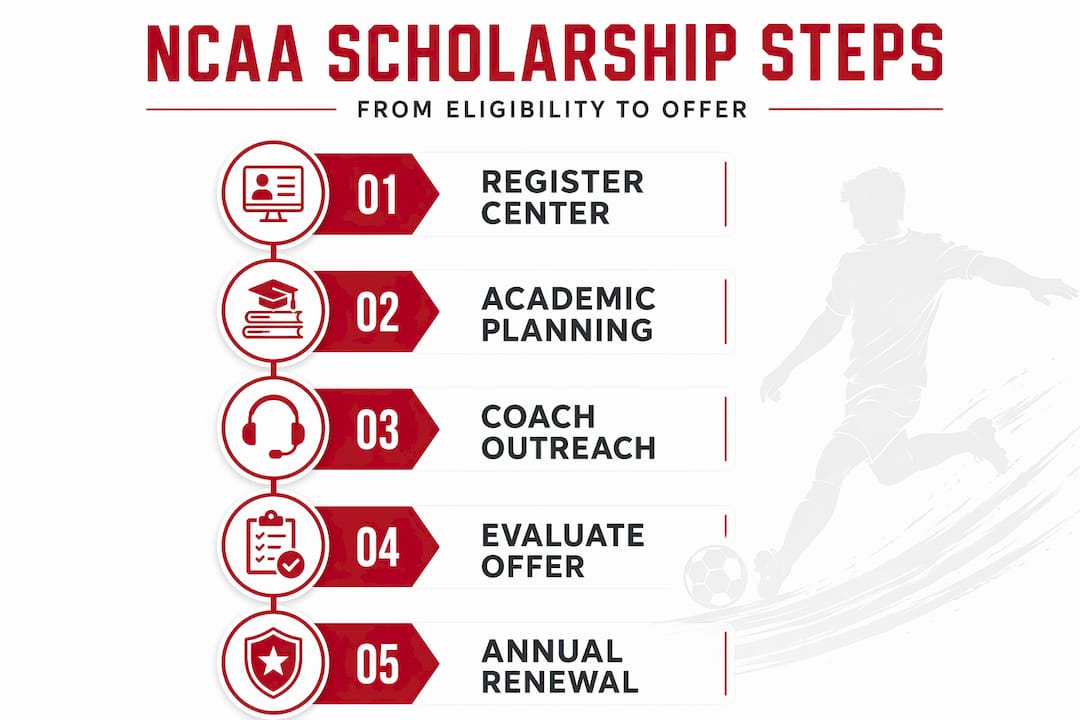
To help families understand NCAA scholarship rules, the right starting point is the NCAA Eligibility Center. This is the centralized body that certifies academic and amateurism eligibility for every Division I and II athlete before they can compete or receive athletic aid. Without clearance from the Eligibility Center, no scholarship offer becomes official.
For Division I and II programs, the academic standard centers on 16 NCAA core courses completed in specific subject areas including English, math, science, and social studies. Your athlete’s GPA in those core courses is measured against a sliding scale tied to standardized test scores. A higher GPA allows for a lower test score threshold, and vice versa. Soccer families should map out their athlete’s four-year course plan no later than freshman year to confirm every required course is scheduled correctly.
Amateurism is equally critical, and it catches many families off guard. Accepting payment for playing, training with a professional club under certain arrangements, or signing with an agent can jeopardize amateur status. The Eligibility Center reviews these situations case by case, so any gray-area activity should be disclosed early rather than discovered late.
- Complete 16 NCAA core courses across required subject areas
- Maintain a qualifying GPA on the NCAA sliding scale
- Submit standardized test scores (SAT or ACT) to the Eligibility Center
- Certify amateurism status, including any club or academy history
- Register with the Eligibility Center during junior year of high school
Early registration and proper academic planning are among the most decisive factors in securing scholarship opportunities. Families who wait until senior year often face compressed timelines that limit their options significantly.
Pro Tip: Register your athlete with the NCAA Eligibility Center at the start of junior year, not the end. This gives you time to identify and resolve any course deficiencies or amateurism questions before coaches need a certification decision.
How NCAA soccer scholarships are structured
This is where families understanding scholarships often have the biggest misconceptions. Soccer is classified as an equivalency sport, which means coaches split scholarship funds across their entire roster rather than awarding a set number of full scholarships. This is fundamentally different from headcount sports like football or basketball, where each scholarship is a full grant.
Here is how the scholarship limits break down by division and gender:
| Program | Total Equivalencies | Typical Roster Size | Average Award per Player |
|---|---|---|---|
| NCAA DI Women’s Soccer | 14.0 | 28 to 32 players | 40% to 60% of full cost |
| NCAA DI Men’s Soccer | 9.9 | 28 to 32 players | 25% to 40% of full cost |
| NCAA DII Women’s Soccer | 9.9 | 22 to 28 players | 35% to 55% of full cost |
| NCAA DII Men’s Soccer | 9.0 | 22 to 28 players | 30% to 50% of full cost |
What this means practically is that a full scholarship covering tuition, fees, room and board, books, and a cost-of-attendance stipend is rare in soccer. Most athletes receive partial grants that cover a percentage of total costs. Families should budget for the gap between the athletic scholarship and the full cost of attendance, using academic merit aid, need-based aid, and institutional grants to fill it.

Another point that surprises many families is scholarship duration. Scholarships are awarded on a one-year basis and renewed annually based on institutional conditions. While NCAA rules prohibit canceling a scholarship solely for athletic performance reasons, renewal is not automatic. Understanding the specific renewal language in your athlete’s scholarship letter is non-negotiable before signing.
Pro Tip: When evaluating offers, ask each coach directly what percentage of the equivalency your athlete is being offered and what the renewal criteria are. A 40% scholarship with clear, achievable renewal conditions is often more valuable than a 60% offer with vague performance language.
The college soccer recruiting timeline
Scholarship rules for student-athletes do not exist in isolation. They connect directly to the recruiting calendar, and missing key windows has real consequences. The NCAA recruiting calendar restricts when coaches can initiate contact, make official offers, and host campus visits, with rules varying between Division I and Division II.
Here is a practical sequence for families to follow:
- Freshman year: Focus entirely on academics and competitive club soccer. Begin researching programs and building a target list of schools by academic profile, location, and soccer level.
- Sophomore year: Create a highlight video and an athletic resume. Attend regional showcases where college coaches evaluate prospects. Some Division I coaches can begin limited contact during this period.
- Junior year: Register with the NCAA Eligibility Center. Increase outreach to coaching staffs with personalized emails, updated highlight videos, and tournament schedules. Unofficial campus visits are appropriate at this stage.
- Summer before senior year: This is the peak evaluation period. Attend national showcases and ID camps. Coaches are actively building their recruiting classes. Official visits, which are paid for by the school, typically occur during this window.
- Senior year: Finalize visits, evaluate scholarship offers, and make a commitment. Submit the National Letter of Intent during the appropriate signing period.
Staying organized through this sequence is what separates families who secure strong offers from those who scramble at the end. Build a tracking spreadsheet for every school your athlete contacts, including dates of communication, scholarship conversations, and visit schedules.
Pro Tip: Do not wait for coaches to contact you. Proactive outreach to coaching staffs, backed by a strong highlight video and academic profile, is the single most effective way to generate scholarship interest at the Division I and II levels.
Verifying certification and evaluating scholarship offers
Once your athlete has submitted materials to the NCAA Eligibility Center, you can check certification status online through the Eligibility Center portal. The three possible outcomes are qualifier, nonqualifier, and academic redshirt, and each carries different implications.
A qualifier is cleared to compete, practice, and receive athletic aid from day one. A nonqualifier cannot compete or receive athletic aid during their first year. An academic redshirt can receive aid and practice but cannot compete in year one. Knowing your athlete’s status well before the signing period allows time to address any issues.
When a scholarship offer arrives, review these elements carefully:
- The exact dollar amount or percentage of the equivalency being offered
- Whether the scholarship is a one-year grant or a multi-year agreement
- Specific renewal conditions, including GPA minimums and conduct standards
- What expenses the scholarship covers and what it does not
- How the athletic aid interacts with other financial aid packages
Ethical recruiting demands full transparency from both coaches and families. If a coach pressures your athlete to commit before a campus visit, withholds scholarship details, or makes verbal promises that do not appear in writing, these are warning signs. The NCAA has reporting mechanisms for families who encounter questionable recruiting practices, and using them protects your athlete’s eligibility.
Pro Tip: If you are uncertain about any aspect of an offer or your athlete’s eligibility status, consult a certified recruiting advisor before signing anything. One overlooked clause can affect four years of scholarship funding.
My take on what families consistently get wrong
I have worked with hundreds of soccer families across every stage of the recruiting process, and the pattern I see most often is this: families understand the concept of NCAA scholarships but underestimate how early the decisions that determine those scholarships actually happen.
By the time a coach makes a formal offer, your athlete’s academic record is largely set. Their highlight video has already been watched. Their reputation in club soccer is established. The families who secure the best outcomes are the ones who treated freshman and sophomore year as preparation years, not waiting years.
The other thing I see consistently is families conflating a verbal offer with a guaranteed scholarship. Verbal commitments are not binding under NCAA rules. Nothing is real until it is in writing. I have seen athletes turn down other programs based on a verbal promise, only to have the offer change significantly by signing day. Get everything documented.
What actually works is a combination of early academic planning, proactive coach outreach, and a clear understanding of how equivalency allocation decisions are made at each program. Coaches are managing a budget across 25 to 30 players. Your job is to make your athlete’s value so clear that allocating a meaningful portion of that budget to them becomes an obvious decision.
— Canas
How Canasrecruiting helps families secure soccer scholarships
Canasrecruiting works directly with soccer families to build a structured recruiting strategy that addresses every stage of the NCAA scholarship process.
From academic eligibility planning and Eligibility Center registration to direct coach outreach and scholarship negotiation support, the Scholarship Positioning System at Canasrecruiting is designed to maximize your athlete’s scholarship potential at NCAA, NAIA, and junior college programs. Families who want to understand exactly where their athlete stands today can start with a free recruiting assessment to evaluate college potential and identify the right programs to target. The process is structured, transparent, and built around your athlete’s specific profile.
FAQ
What is the NCAA Eligibility Center?
The NCAA Eligibility Center is the organization that certifies academic and amateurism eligibility for Division I and II athletes. It evaluates core course completion, GPA, test scores, and amateur status before athletes can compete or receive scholarships.
How many soccer scholarships does a Division I program offer?
Division I women’s soccer programs have 14.0 scholarship equivalencies to distribute across their roster, while Division I men’s programs have 9.9. Most players receive partial awards rather than full scholarships.
When should my athlete register with the NCAA Eligibility Center?
Junior year of high school is the recommended registration window. Late registration compresses the certification timeline and can limit scholarship opportunities during the peak recruiting period.
Are NCAA soccer scholarships guaranteed for four years?
No. NCAA soccer scholarships are typically awarded on a one-year basis and renewed annually based on institutional conditions. Families should review renewal criteria carefully before signing any scholarship agreement.
What does an NCAA athletic scholarship actually cover?
Athletic scholarships can cover tuition, fees, room and board, course-related books, and a cost-of-attendance stipend. They do not cover all expenses, so families should plan for additional costs beyond what the athletic award provides.
Recommended
- Cañas Recruiting Agency | College Soccer Scholarship Experts
- Free Soccer Recruiting Assessment | Evaluate Your College Potential | Cañas Recruiting
- College Soccer Recruiting Services | Scholarship Positioning System™ | Cañas Recruiting
- How Our College Soccer Recruiting Process Works | Cañas Recruiting