

NCAA Division I soccer requirements define the academic credentials, athletic ability, and amateurism certification that every prospective student-athlete must satisfy before competing at the highest level of college soccer. Meeting these standards is not optional. Every player who wants to wear a D1 jersey must register with the NCAA Eligibility Center, submit transcripts, and clear amateurism screening before a single college coach can offer a scholarship. This guide breaks down each requirement, explains what coaches actually look for, and gives you a clear timeline for making it happen.
What are the NCAA Division I soccer requirements for academic eligibility?
Academic eligibility is the foundation of D1 qualification. The NCAA requires every prospective Division I athlete to complete 16 NCAA-approved core courses and earn a minimum core GPA of 2.3 to qualify to play and receive athletic aid. That GPA threshold is non-negotiable for full qualifier status, and it applies only to those 16 approved courses, not your overall high school transcript.
The NCAA 10/7 rule adds another layer of structure. Ten of your 16 core courses must be completed before the start of your seventh semester (the first semester of junior year), and seven of those ten must come from English, math, or natural or physical science. This rule exists to prevent athletes from cramming academics into senior year. Missing it can delay your eligibility or reduce you to Academic Redshirt status, which allows scholarship and practice but blocks competition during your freshman year.
One of the most common mistakes families make is confusing transcript GPA with NCAA core GPA. Many high school courses labeled “college prep” are not on the NCAA-approved list for your school. The NCAA core GPA calculation excludes those courses entirely, which means a student with a 3.5 transcript GPA can end up with a 2.6 core GPA. Check your school’s approved course list on the NCAA Eligibility Center website early, ideally in 8th or 9th grade.
Standardized test scores (SAT or ACT) remain optional for D1 eligibility in 2026, but submitting strong scores can still work in your favor through the sliding scale. A higher test score can offset a lower core GPA, giving borderline qualifiers a path to full eligibility. Coaches also use academic performance as a recruitment filter, with many D1 programs preferring players who carry a 3.2 GPA or higher.
Pro Tip: Use the NCAA Eligibility Center’s core-course worksheet, available on their official site, at the start of freshman year. Map out all 16 required courses across four years so you never face a scheduling gap in junior or senior year.
- Complete 16 NCAA-approved core courses across four years of high school
- Maintain a minimum 2.3 core GPA (not overall GPA) in those courses
- Satisfy the 10/7 rule before the start of 11th grade
- Register with the NCAA Eligibility Center and pay the $110 domestic fee
- Submit official transcripts and amateurism information through the Eligibility Center portal
- Understand the difference between Academic Redshirt and Nonqualifier status before signing day
For guidance on identifying the right academic fit alongside athletic goals, the process starts well before senior year.
What athletic standards do D1 soccer programs actually expect?
Division I soccer programs recruit from the top 1 to 2 percent of high school players in the country. That is not an estimate. It reflects the reality that fewer than 7 percent of high school athletes compete in college at any level, and D1 soccer sits at the top of that pyramid. Coaches evaluate athletic ability through measurable benchmarks and in-game performance simultaneously.
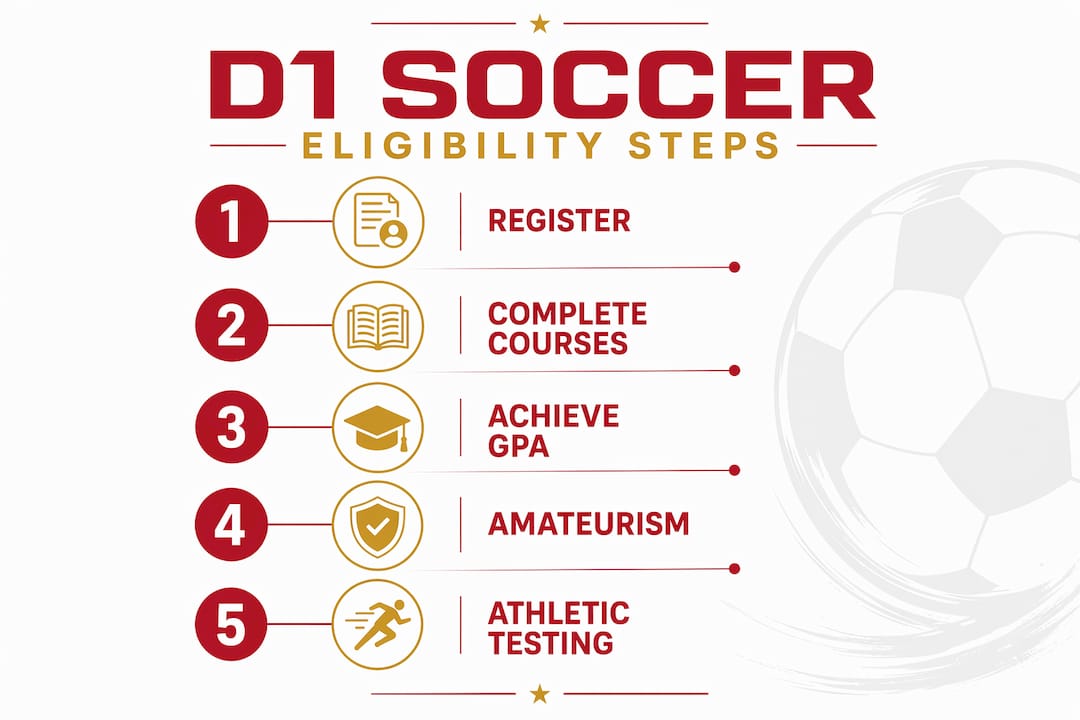
Fitness benchmarks matter more than most families realize. D1 coaches expect players to demonstrate 40-yard dash times between 4.4 and 4.8 seconds and beep test scores at level 17 or higher, with elite prospects reaching level 20 and above. These numbers signal the aerobic capacity and explosive speed required to compete at a 90-minute D1 pace. A player who cannot meet these benchmarks will struggle to hold a roster spot regardless of technical skill.
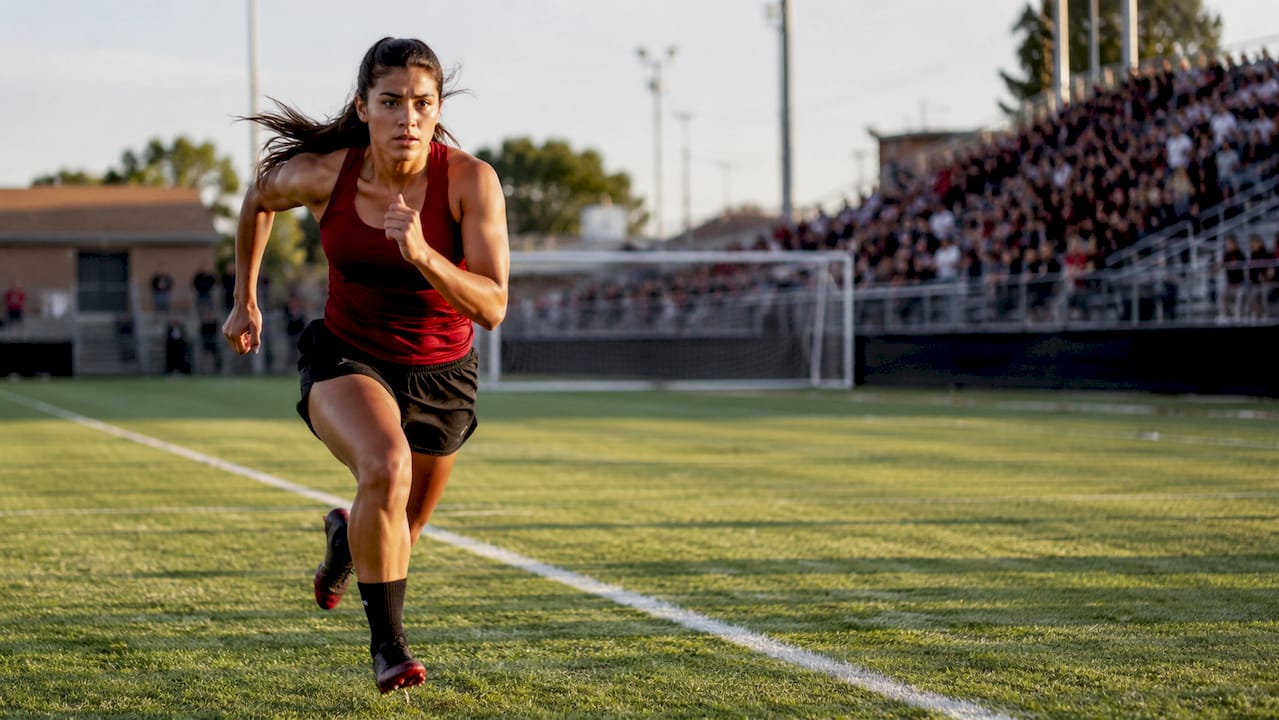
Technical and tactical quality separates good players from recruited players. Coaches prioritize first touch under pressure, passing accuracy at game speed, and the ability to read space before receiving the ball. Soccer IQ, meaning decision-making in tight situations, is weighted heavily because D1 systems are complex and players must process information faster than at any lower level.
Club pedigree signals readiness. Most D1 players come from elite club programs such as ECNL, MLS NEXT, or national team pools. Playing at that level does not guarantee recruitment, but it places you in front of the coaches who attend those events. Showcase tournaments like the ECNL National Championships, Jefferson Cup, and MLS NEXT Playoffs are primary scouting venues for D1 programs.
Pro Tip: Record highlight videos that show tactical intelligence, not just goals. Coaches want to see your positioning off the ball, your pressing triggers, and your decision-making in transition. A five-minute video with ten tactical moments outperforms a ten-minute reel of highlights.
- Train to meet D1 fitness benchmarks: 40-yard dash under 4.8 seconds and beep test level 17 or above
- Compete at ECNL, MLS NEXT, or equivalent elite club level to gain exposure
- Develop technical consistency: first touch, passing accuracy, and 1v1 defending
- Build tactical awareness through structured training and film review
- Attend D1-level showcase tournaments where target program coaches scout directly
How do D1 soccer scholarships and roster limits affect your chances?
The scholarship reality in D1 soccer is more complex than most families expect. D1 soccer roster limits are set at 28 players per team following the House v. NCAA settlement, which reshaped how programs manage their rosters. The old equivalency cap of 9.9 scholarships for men’s programs has been restructured, but budget constraints at most schools mean full-ride scholarships remain rare.
The majority of D1 soccer scholarships are partial, distributed across the roster to maximize the number of players receiving some form of aid. A program might split the equivalent of 12 to 15 full scholarships across 20 or more players. This means a “scholarship offer” could represent 25 percent of tuition, not a full package. Understanding NCAA scholarship distribution rules before evaluating offers protects families from financial surprises.
Rosters fill early. D1 coaches begin identifying targets in sophomore year and often extend verbal commitments to juniors. By the time a player starts their senior year without a commitment, the majority of available roster spots at target programs are already spoken for. Proactive outreach and early positioning are not optional strategies. They are requirements.
| Division | Roster limit | Scholarship structure | Scholarship type |
|---|---|---|---|
| NCAA Division I | 28 players | Budget-dependent post-settlement | Mostly partial |
| NCAA Division II | 25 players | 9.9 equivalency (men), 14 (women) | Partial equivalency |
| NAIA | No set cap | 12 equivalency (men), 12 (women) | Partial, sometimes full |
| Junior College (NJCAA) | Varies | Varies by school | Full scholarships available |
Pro Tip: When evaluating a D1 offer, ask the coach for the exact scholarship percentage and whether it renews annually. Combine that figure with merit-based academic aid from the university to build a complete financial picture before committing.
What is amateurism certification and why does it matter for D1 eligibility?
Amateurism certification is a mandatory screening process conducted through the NCAA Eligibility Center that determines whether a prospective student-athlete has maintained amateur status. Amateurism certification evaluates prior professional contracts, agent involvement, and receipt of impermissible benefits. A failure to disclose any of these can result in lost eligibility before a player ever steps on a college field.
The complexity of amateurism rules has grown significantly with the introduction of NIL (Name, Image, and Likeness) rights. NIL allows college athletes to earn money from endorsements and appearances, but the baseline amateurism rules governing pre-enrollment activity remain strict. Playing in a professional environment, accepting payment beyond allowable expenses, or signing with an agent before enrollment can all trigger eligibility issues. Amateurism complexity is growing with NIL rules, and prior participation in professional academies or paid competitions requires careful documentation.
Elite youth players from MLS academies, international clubs, or paid development programs face the highest risk. Many families assume that training with a professional club’s youth team is automatically permissible. It is not always the case. The NCAA evaluates the nature of the relationship, any compensation received, and whether the player signed any form of agreement with the club.
- Disclose all club affiliations, including professional academy participation, during Eligibility Center registration
- Document every tournament, competition, and prize money received throughout your playing career
- Avoid signing any representation agreement with an agent before completing college eligibility
- Contact the compliance office at your target university for guidance on ambiguous situations
- Submit amateurism certification as early as possible to identify and resolve issues before the recruiting process accelerates
Pro Tip: Keep a written record of every club you have played for, every tournament you have entered, and any compensation or benefits you received. Submitting complete and accurate information the first time prevents delays that can cost you scholarship offers.
How does the D1 soccer recruiting timeline affect your strategy?
Early self-marketing and coach outreach are critical, often starting in sophomore year for players targeting D1 programs. NCAA contact rules restrict when coaches can initiate communication, but athletes can reach out to coaches at any time. Most successful D1 commitments trace back to a player or family who sent the first email.
Building a recruiting profile requires three components working together: a strong academic record, a current athletic resume with club history and statistics, and a highlight video optimized for the specific programs you are targeting. Generic profiles sent to 50 programs produce fewer results than targeted outreach to 15 programs where the player is a genuine fit.
Realistic division evaluation is one of the most underused tools in the recruiting process. D2 and NAIA programs provide valuable scholarship and playing opportunities that families frequently overlook while pursuing a D1-only strategy. A player who commits to a strong D2 program with a 60 percent scholarship often has a better overall college experience than one who walks on at a D1 program with no aid. Exploring NAIA soccer scholarship opportunities alongside D1 targets gives families real leverage in the process.
- Begin coach outreach in sophomore year with a personalized email and highlight video
- Attend D1-level showcases and tournaments where target program coaches are present
- Register with the NCAA Eligibility Center no later than the start of junior year
- Build a recruiting profile that includes academic records, club history, and a current highlight video
- Maintain organized communication records with every coach contact, including dates and responses
- Evaluate D2 and NAIA programs alongside D1 targets to maximize scholarship value and playing time
Key takeaways
NCAA Division I soccer eligibility requires meeting academic, athletic, and amateurism standards simultaneously, with early preparation and proactive outreach determining which players secure roster spots and scholarship offers.
| Point | Details |
|---|---|
| Academic eligibility is foundational | Complete 16 NCAA-approved core courses with a minimum 2.3 core GPA before enrollment. |
| Athletic benchmarks are measurable | D1 programs expect 40-yard dash times of 4.4 to 4.8 seconds and beep test scores at level 17 or above. |
| Scholarships are mostly partial | D1 soccer aid is distributed across rosters; combine athletic and merit aid for a complete financial package. |
| Amateurism disclosure is mandatory | Disclose all club affiliations and compensation history to avoid eligibility loss before enrollment. |
| Early outreach determines outcomes | Proactive coach contact starting in sophomore year significantly increases commitment opportunities. |
What I have learned from working with D1 soccer families
The families who struggle most in this process share one pattern: they treat academic preparation as secondary to athletic development. Every year, talented players lose D1 scholarship offers because their core GPA falls below 2.3 or because they never completed the 10/7 course requirement. Coaches cannot offer aid to a player who is not certifiably eligible, regardless of how good they are on the field.
The amateurism piece catches families off guard more than any other requirement. A player who trained with an MLS academy at age 15 and received gear, travel stipends, or any form of compensation needs to disclose that fully. The NCAA does not penalize honest disclosure. It penalizes omission.
My strongest advice is this: do not build a D1-or-nothing strategy. The best college soccer experience is the one where you play meaningful minutes, receive real scholarship support, and graduate with a degree that opens doors. That experience exists at D1 programs, but it also exists at D2 schools and NAIA programs that many families never seriously consider. Evaluate fit across all divisions, start the Eligibility Center registration early, and treat coach communication as a professional responsibility from day one.
— Canas
How Canasrecruiting helps you meet every D1 standard
Canasrecruiting works directly with soccer players and families to build a structured path through the NCAA recruiting process, from Eligibility Center registration to scholarship negotiation. The Scholarship Positioning System at Canasrecruiting aligns your academic profile, athletic credentials, and recruiting timeline into a targeted blueprint that reaches the right coaches at the right programs.
Whether you are targeting D1 programs or want to evaluate the full range of collegiate options, Canasrecruiting provides personalized coach outreach, highlight video guidance, and compliance support at every stage. Families who engage early in the process consistently secure stronger offers and more program options. Connect with Canasrecruiting at canasrecruiting.com to start your evaluation today.
FAQ
What GPA do you need for NCAA Division I soccer?
NCAA Division I soccer requires a minimum core GPA of 2.3 in 16 NCAA-approved high school courses. Most D1 coaches prefer players with a 3.2 GPA or higher as part of their recruitment evaluation.
When should a soccer player register with the NCAA Eligibility Center?
Players should register with the NCAA Eligibility Center no later than the start of junior year. Registration costs $110 for domestic students in 2026 and requires transcript submission and amateurism certification.
How many scholarships does a D1 soccer program offer?
D1 soccer programs operate with a 28-player roster limit, but most scholarships are partial and distributed across the roster due to budget constraints. Players should evaluate the exact scholarship percentage and combine it with academic merit aid.
Does playing in an MLS academy affect NCAA eligibility?
Participation in an MLS academy or any professional youth environment requires full disclosure during amateurism certification. Receiving compensation, gear, or travel benefits may affect eligibility if not properly disclosed to the NCAA Eligibility Center.
How many years of eligibility does a D1 soccer player receive?
NCAA rules grant four seasons of eligibility within a five-year enrollment window. Redshirt years and approved waivers can extend that window under specific circumstances.