

Pursuing a college soccer scholarship is one of the most competitive processes a young athlete and their family will face. If you have been focused solely on NCAA programs, you may be overlooking one of the most accessible and flexible scholarship pathways available. This NAIA soccer scholarship opportunities guide covers everything you need to know, from how scholarship equivalents work to the exact steps for getting coaches to notice you. The NAIA offers real funding, real playing time, and recruiting rules that genuinely favor proactive athletes and families who start early.
Table of Contents
- Key takeaways
- NAIA soccer scholarship landscape and funding options
- How the NAIA soccer recruitment process works
- Building your profile for NAIA scholarship candidacy
- Evaluating and comparing NAIA scholarship offers
- Common mistakes that cost athletes NAIA scholarships
- My perspective on NAIA as a scholarship pathway
- How Canasrecruiting helps you secure NAIA scholarships
- FAQ
Key takeaways
| Point | Details |
|---|---|
| NAIA allows 12 scholarship equivalents | Teams can split awards across multiple players, giving more athletes partial funding than NCAA D2 programs. |
| Contact rules favor early movers | NAIA coaches can reach out anytime during high school, so starting outreach in 9th or 10th grade is a real advantage. |
| Stacking aid maximizes funding | Combining athletic scholarships with academic and institutional aid often covers more than athletic money alone. |
| Profile quality drives offers | A strong highlight video, solid GPA, and tailored coach communication directly determine scholarship size. |
| Evaluating offers requires detail | Ask about renewability, coverage gaps, and out-of-pocket costs before committing to any scholarship package. |
NAIA soccer scholarship landscape and funding options
The NAIA is frequently misunderstood as a lesser alternative to the NCAA. In practice, it operates as a distinct and often more athlete-friendly system, particularly for soccer players who want genuine scholarship support and significant playing time. Understanding how NAIA soccer funding options are structured is the first step toward using them strategically.
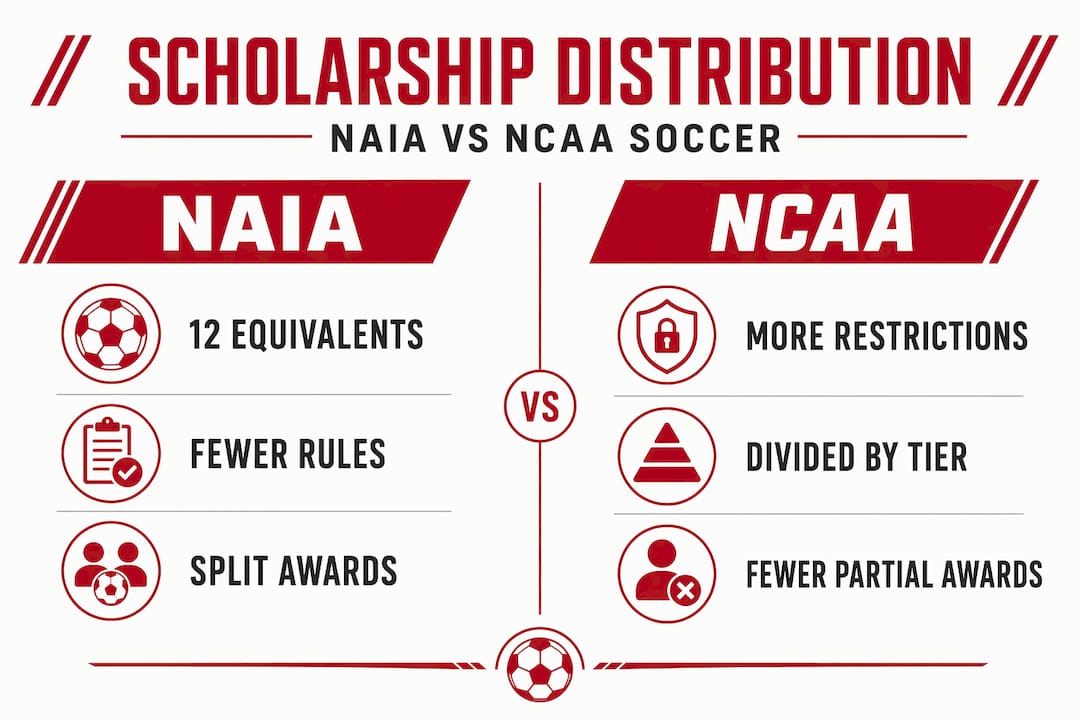
NAIA soccer programs award up to 12 scholarship equivalents per team. An equivalency model means the total scholarship value can be divided among as many players as the coaching staff decides. One player might receive a full scholarship worth 1.0 equivalents, while five others each receive 0.4. This flexibility is a significant advantage over NCAA Division II, which caps women’s soccer at 9.9 equivalents and men’s soccer at 9.0.
Here is a direct comparison of soccer scholarship limits across divisions:
| Division | Max scholarship equivalents | Contact restrictions |
|---|---|---|
| NCAA Division I | 14 (women), 9.9 (men) | Strict calendar rules |
| NCAA Division II | 9.9 (women), 9.0 (men) | Restricted contact periods |
| NAIA | 12 (both) | Contact allowed anytime |
What this means for you is that more athletes receive partial awards at NAIA schools than at comparable NCAA programs. The key is knowing how to stack those awards.
Academic merit scholarships provide more consistent support over four years than athletic aid alone. NAIA schools, many of which are small private institutions with strong academic reputations, often offer institutional grants and merit awards that can be combined with athletic scholarships. A player receiving a 40% athletic scholarship who also qualifies for a merit award and need-based institutional grant may end up with a package that covers 80% or more of total costs.
Key NAIA soccer funding options to understand:
- Athletic scholarship equivalents: Awarded by the coaching staff based on roster needs and player evaluation
- Academic merit awards: Based on GPA and standardized test scores, renewable annually with academic performance
- Institutional grants: Awarded by the financial aid office, often based on demonstrated financial need
- Need-based federal aid: FAFSA-eligible students can layer Pell Grants and subsidized loans on top of all other awards
Pro Tip: Submit your FAFSA as early as possible, even before you receive scholarship offers. Knowing your Expected Family Contribution number gives you a clearer picture of what each offer actually costs your family out of pocket.
How the NAIA soccer recruitment process works
One of the most significant NAIA soccer scholarship benefits is the open recruiting calendar. NAIA coaches can contact student-athletes at any point during high school, unlike NCAA programs that restrict contact until after July 1 of a prospect’s junior year. This means a sophomore who reaches out to an NAIA coach today can receive a response, build a relationship, and potentially receive an offer well before their NCAA-eligible peers even begin official conversations.
Here is a step-by-step approach to the NAIA soccer recruitment process:
- Build your target school list. Research NAIA programs by geographic preference, academic major, campus size, and competitive level. Aim for 20 to 30 schools across realistic, target, and reach categories based on your athletic and academic profile.
- Create your recruiting profile. This includes a one-page soccer CV, your academic transcript and GPA, a highlight video of 3 to 5 minutes, and contact information for coaches who can provide references.
- Send your first email to coaches. Address the coach by name. Mention a specific detail about their program. State your graduation year, position, GPA, and link to your highlight video. Keep it under 200 words.
- Follow up consistently. If you do not hear back within two weeks, send a brief follow-up. Coaches receive hundreds of emails. Persistence, done professionally, is respected.
- Attend official and unofficial visits. Campus visits are where relationships are built and offers are made concrete. Prioritize schools where coaches have expressed genuine interest.
- Evaluate offers carefully before committing. Do not accept the first offer out of excitement. Compare packages, ask detailed questions, and give yourself time to assess fit.
NAIA coaches fill rosters earlier than NCAA programs because they face fewer recruiting restrictions. A junior who waits until spring to begin outreach may find that several target programs have already committed their scholarship dollars for the incoming class.
Pro Tip: Send your initial recruiting emails in August or September of your sophomore year. This positions you ahead of the majority of prospects who wait until junior year, and it gives coaches time to evaluate you across multiple seasons.

Building your profile for NAIA scholarship candidacy
Your recruiting profile is the document that determines whether a coach responds to your email or ignores it. NAIA coaches seek student-athletes who contribute both on the field and in the classroom, and your profile needs to demonstrate both dimensions clearly.
The academic component matters more than most players realize. A GPA above 3.0 opens access to merit scholarships that can significantly increase your total funding package. International players should also address language proficiency early. Many NAIA schools require TOEFL or IELTS scores for non-native English speakers, and submitting those scores proactively signals readiness and seriousness.
Key elements of a strong NAIA scholarship profile:
- Highlight video: 3 to 5 minutes, organized by skill category (defending, attacking, set pieces). Lead with your three best moments. Coaches decide in the first 60 seconds whether to keep watching.
- Soccer CV: One page covering your club team history, positions played, tournament results, and any representative honors such as regional or national team call-ups.
- Academic transcript: Include your current GPA, class rank if available, and a list of AP or honors courses. Coaches want to see that you can handle college coursework.
- Coach references: Two references from current or former coaches who can speak to your technical ability, work ethic, and character. Ask permission before listing anyone.
- Position awareness: Goalkeepers and certain positional profiles are in higher demand at NAIA programs, which creates leverage for players in those roles. If you play goalkeeper, lead with that fact in your outreach.
Character and coachability are factors that coaches weigh heavily at the NAIA level. Smaller programs mean tighter team cultures, and coaches at best NAIA soccer colleges are not just looking for talent. They are looking for players who will represent the program well and commit fully to the team environment.
Evaluating and comparing NAIA scholarship offers
Receiving a scholarship offer is exciting. Accepting the wrong one without understanding its terms can create serious financial stress. Before you commit to any NAIA athletic scholarship, you need to ask the right questions and understand exactly what the offer covers.
NAIA scholarships generally cover tuition, fees, books, room and board, but they do not cover ancillary costs such as visa fees, international travel, or daily personal expenses. For domestic players, transportation costs and health insurance premiums are common gaps. Build a realistic annual budget before comparing offers.
Here is a comparison framework for evaluating scholarship packages:
| Factor | Questions to ask |
|---|---|
| Coverage scope | Does the award cover tuition only, or also room and board? |
| Renewability | What GPA or playing conditions are required to renew annually? |
| Total aid package | What additional academic or institutional grants are available? |
| Out-of-pocket estimate | What is the net cost after all aid is applied? |
| Scholarship percentage | What percentage of the athletic equivalency are you being offered? |
Combining different aid types is critical when NAIA athletic dollars alone do not cover your full cost of attendance. Ask the financial aid office directly what institutional grants you qualify for, and ask the coach whether your academic profile makes you eligible for merit awards that can be stacked on top of your athletic offer.
Pro Tip: Request a Net Price Calculator estimate from each school’s financial aid office before your campus visit. This gives you a baseline cost figure that makes comparing offers across different schools far more accurate.
Common mistakes that cost athletes NAIA scholarships
Avoiding these errors is as important as executing the right steps. Many athletes lose scholarship opportunities not because they lacked ability, but because they made avoidable strategic mistakes.
- Waiting too long for NCAA interest. Many players hold out for NCAA Division I or II offers and miss the NAIA recruiting window entirely. NAIA programs fill spots earlier due to fewer restrictions, and delay is costly.
- Sending generic mass emails. Coaches recognize template emails immediately. A message that does not reference the school, the coach’s name, or a specific detail about the program goes straight to the deleted folder.
- Overestimating scholarship coverage. Assuming a scholarship covers everything leads to financial surprises. Always calculate your net cost, not just the scholarship headline number.
- Neglecting academic preparation. A low GPA eliminates access to merit scholarships and can disqualify you from institutional grants, reducing your total funding significantly.
- Ignoring coach feedback. When a coach responds with interest but asks for updated footage or a visit, act on it quickly. Slow responses signal low commitment and coaches move on.
“Starting early and being proactive with coach communication significantly increases chances of securing scholarships at NAIA schools.” — socceredu.com
My perspective on NAIA as a scholarship pathway
I have worked with athletes and families across every level of the college recruiting process, and the pattern I see most often is this: players who overlook NAIA do so based on assumptions, not facts.
In my experience, NAIA is one of the most underutilized pathways in college soccer recruiting. The open recruiting calendar genuinely benefits late-developing players and international athletes who miss NCAA contact windows. I have seen players receive strong partial offers from NAIA programs in 10th grade, then use those offers as leverage when evaluating other schools later. That kind of positioning is nearly impossible in the NCAA system at the same age.
What I have learned is that scholarship stacking is where most families leave money on the table. They focus entirely on the athletic award and never ask about institutional grants or merit scholarships. At many NAIA schools, the academic money is more predictable and more renewable than the athletic money. A student with a 3.5 GPA applying to a small NAIA institution can often put together a package that rivals what a full athletic scholarship would cover at a larger program.
My honest take: if you are a player between 14 and 18 with a competitive club background and a solid academic record, NAIA should be on your list from day one. Not as a fallback. As a deliberate, strategic target.
— Canas
How Canasrecruiting helps you secure NAIA scholarships
At Canasrecruiting, we specialize in exactly this process. We know which NAIA programs have scholarship availability, which coaches are actively recruiting specific positions, and how to position your profile to generate real interest.
Our Scholarship Positioning System is built around your specific athletic and academic profile. We handle direct coach outreach, help you build a compelling recruiting package, and guide you through every stage from first contact to signed offer. We also help you evaluate and compare funding packages so you understand your true net cost before committing.
Start with a free recruiting assessment to understand where you stand and what NAIA programs are the right fit for your goals. If you are ready to move faster, schedule a call with our team and we will build a targeted recruitment plan around your timeline.
FAQ
How many scholarships does an NAIA soccer team offer?
NAIA soccer programs can award up to 12 scholarship equivalents per team, which can be divided among multiple players as partial awards. This gives coaches flexibility to fund more athletes than a single full-scholarship model would allow.
When should I start contacting NAIA soccer coaches?
You can begin contacting NAIA coaches as early as freshman or sophomore year of high school, since NAIA has no restrictions on when coaches can respond. Starting in 9th or 10th grade gives you a significant advantage over athletes who wait until junior year.
Can I combine an NAIA athletic scholarship with academic aid?
Yes. NAIA athletic scholarships can be stacked with academic merit awards, institutional grants, and federal need-based aid. This combination often results in a more complete funding package than the athletic scholarship alone would provide.
What do NAIA soccer scholarships actually cover?
NAIA scholarships typically cover tuition, fees, books, and room and board based on the school’s official allowances. They generally do not cover visa fees, international travel, or personal living expenses, so budgeting for those costs separately is necessary.
What makes a strong NAIA soccer recruiting profile?
A strong profile combines a focused 3 to 5 minute highlight video, a one-page soccer CV, a GPA above 3.0, and personalized outreach emails that reference specific details about each program. Coach references and position-specific information also strengthen your candidacy.