

JUCO soccer transfer rules are the academic, athletic, and compliance requirements junior college players must satisfy to transfer to NCAA or NAIA four-year programs and compete immediately. These rules are governed by three primary bodies: the NCAA, the NAIA, and the NJCAA. Each organization sets distinct standards for credit hours, GPA, and eligibility certification. The NCAA Eligibility Center sits at the center of this process, certifying both academic and amateur status before any transfer can proceed. Understanding these requirements early gives players and families a clear path to scholarship opportunities and competitive eligibility at the four-year level.
What are the juco soccer transfer rules for NCAA and NAIA programs?
JUCO soccer transfer rules require players to meet specific academic thresholds before they can compete at the NCAA Division I, Division II, or NAIA level. These thresholds are not suggestions. They are gating requirements that determine whether a player can practice, receive a scholarship, and compete from day one at the new school.
For NCAA Division I, 48 semester hours and a 2.5 GPA are the minimum academic standards a JUCO transfer must meet. That means two full years of college-level coursework with a strong grade record. NCAA Division II requires fewer credit hours but still demands satisfactory academic progress toward a degree. Division III operates with more flexibility and does not restrict athletic scholarships in the same way, making it a viable path for players who need more time to build their academic profile.
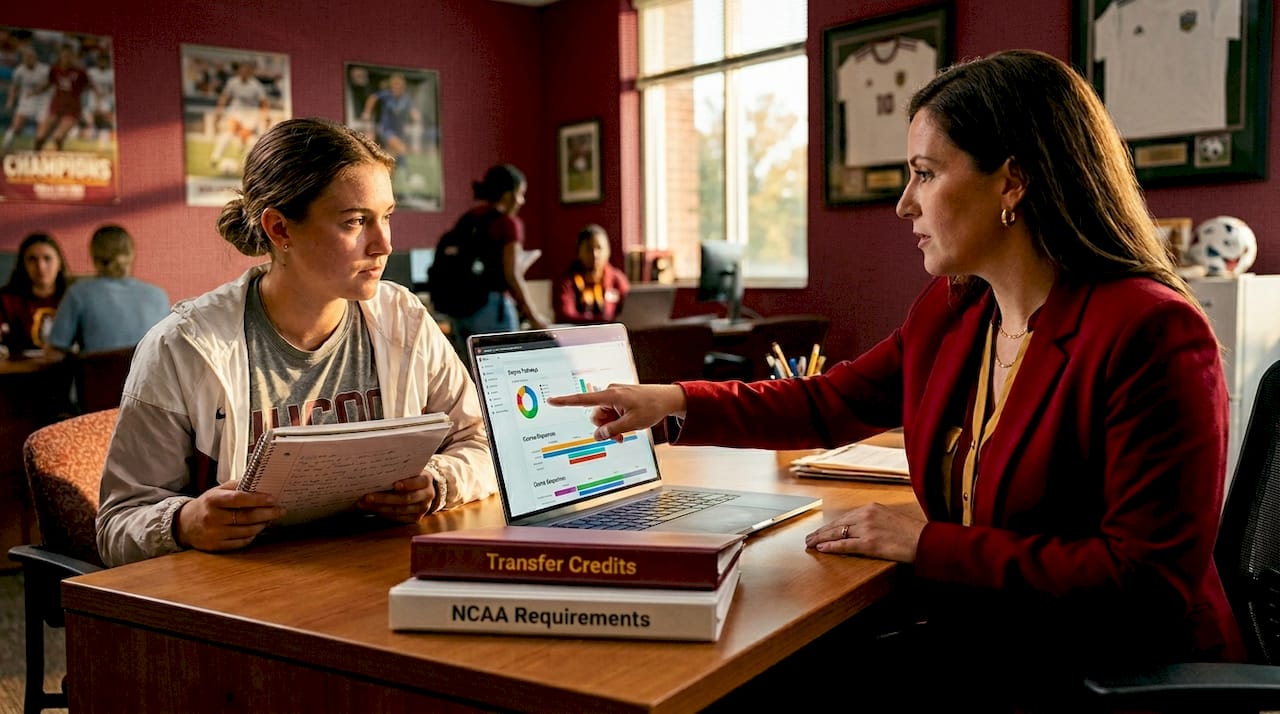
NAIA programs follow a separate set of junior college soccer regulations. NAIA eligibility requires a player to meet two of three standards: a minimum GPA, a minimum ACT or SAT score, or graduation in the top half of their high school class. NAIA schools also require players to be enrolled full-time and making measurable progress toward a degree. Families should confirm NAIA-specific requirements directly with the receiving school’s compliance office, as individual institutions may apply additional standards.
The table below compares the core academic transfer requirements across NCAA Division I, Division II, and NAIA programs.
| Division | Minimum credit hours | Minimum GPA | Key notes |
|---|---|---|---|
| NCAA Division I | 48 semester hours | 2.5 | Must be certified by NCAA Eligibility Center |
| NCAA Division II | 24 semester hours | 2.2 | Progress toward degree required |
| NCAA Division III | Good academic standing | Varies | No athletic scholarship restrictions |
| NAIA | Full-time enrollment | Meets 2 of 3 standards | ACT/SAT or class rank may substitute |
Pro Tip: Start academic advising in your first JUCO semester, not your second year. Mapping your coursework to NCAA transfer requirements from the start prevents credit shortfalls that can delay eligibility by a full academic term.
How do NCAA transfer rules and exceptions apply to JUCO players?
The NCAA two-year transfer rules require JUCO athletes transferring to Division I or Division II programs to satisfy both academic and residency requirements before competing. Without a transfer exception, a player may need to sit out one academic term or even one full year at the new school before becoming eligible to play. That waiting period can cost a player a full season of development and scholarship leverage.
The transfer exception changes that outcome. The transfer exception allows a JUCO player to practice, compete, and receive financial aid immediately at the new school if the receiving school’s compliance office determines the player qualifies. This is not automatic. The compliance office at the four-year institution holds the authority to grant or deny the exception based on the player’s academic record, enrollment status, and certification history.
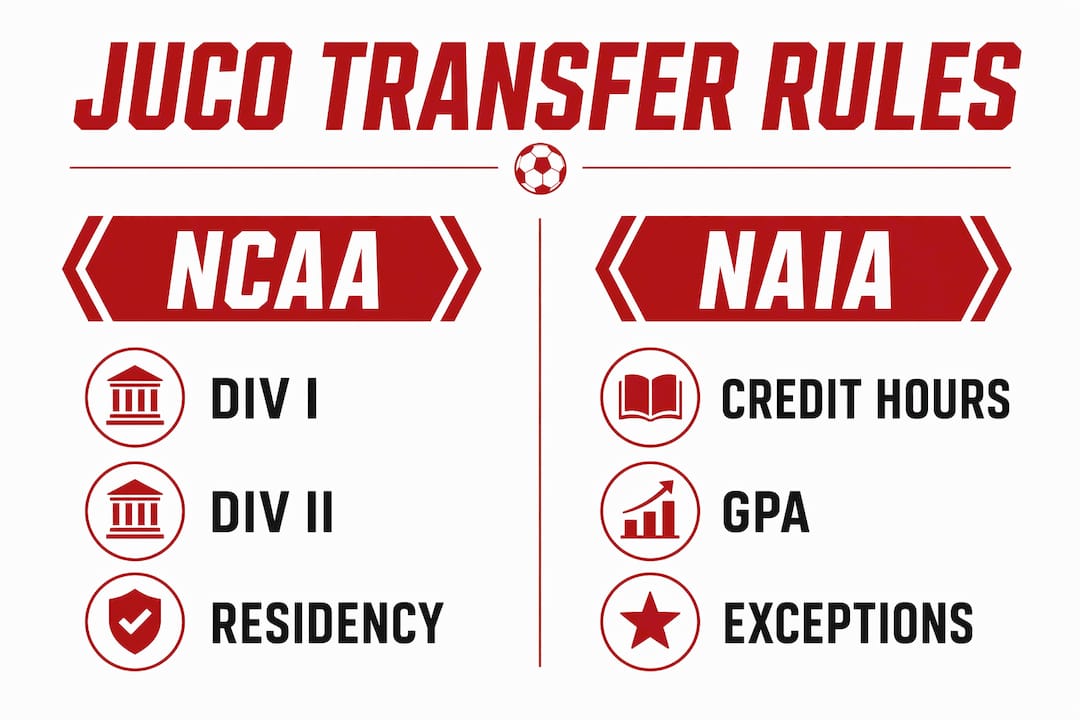
Residency periods are the most misunderstood element of transfer eligibility for JUCO soccer players. A residency requirement means the player must be enrolled at the new school for a set period before competing. Meeting the transfer exception eliminates this requirement entirely. Missing it means the player sits out. Receiving school compliance offices have discretion over these exceptions, and families should seek their criteria and required documentation early in the transfer process.
The five-year clock is another factor families often overlook. NCAA athletes have five calendar years from their first enrollment in college to use four seasons of competition. Time spent at a JUCO counts toward this clock. A player who spends two years at a junior college arrives at a four-year program with three years of eligibility remaining, not four.
Key transfer eligibility considerations for JUCO soccer players include:
- Confirming the number of transferable credit hours with the receiving school’s registrar
- Verifying GPA meets the division-specific minimum before applying
- Registering with the NCAA Eligibility Center before contacting four-year coaches
- Asking the compliance office directly whether a transfer exception applies to your situation
- Tracking your five-year eligibility clock from your first college enrollment date
- Checking whether NCAA scholarship rules at the target division affect your financial aid package
Pro Tip: Contact the compliance office at your target school before committing. Ask specifically: “Does my academic record qualify me for a transfer exception?” That one conversation can determine whether you play your first semester or sit it out.
What is the NCAA Eligibility Center and why does registration matter?
The NCAA Eligibility Center is the official body that certifies a player’s academic qualifications and amateur status before they can compete at an NCAA Division I or Division II school. Without certification, a JUCO player’s transfer eligibility cannot be verified by the receiving institution. Without Eligibility Center registration, a player’s initial status defaults to “nonqualifier” or “partial qualifier,” which severely limits their ability to compete, practice, or receive athletic aid.
Many families assume that completing JUCO coursework automatically satisfies NCAA eligibility. It does not. JUCO academic credits must be formally evaluated and certified by the Eligibility Center before they count toward transfer eligibility. This evaluation covers both the number of credits and the academic content of the courses completed.
The registration process for JUCO players transferring to NCAA programs follows a clear sequence:
- Create an account at the NCAA Eligibility Center website (eligibilitycenter.org).
- Select the correct account type: Academic and Athletics Certification for Division I or II transfers.
- Submit official transcripts from all colleges attended, including your JUCO institution.
- Provide documentation of amateur status, including any prior competition history.
- Pay the registration fee or request a fee waiver if eligible.
- Monitor your certification status through your online account and respond promptly to any requests for additional documentation.
Eligibility Center certification can prevent residency requirements if all criteria are met, which means the difference between playing immediately and waiting a full term. Division III transfers do not require Eligibility Center certification, which is one reason Division III programs are a practical option for players with incomplete certification histories. NAIA programs use a separate eligibility process managed through the NAIA Eligibility Center, which operates independently from the NCAA system.
How does the JUCO transfer process differ from the NCAA Transfer Portal?
The NCAA Transfer Portal is a database used exclusively for transfers between NCAA member institutions. JUCO players do not use the portal. They transfer directly by contacting four-year college coaches, presenting academic transcripts, and submitting highlight videos. This distinction matters because families sometimes expect the portal to be part of the process and waste time waiting for access that will never come.
The NCAA Transfer Portal has specific timing windows for Division I men’s and women’s soccer, but JUCO transfers bypass these windows entirely. A JUCO player can initiate contact with a four-year coach at any point in the calendar year. This flexibility is an advantage, but it also means the player must be proactive. No portal listing means no passive visibility. The player must build their own recruiting exposure.
Recruiting platforms like Internespo help JUCO players gain visibility with four-year coaches by hosting athletic profiles and highlight reels. Understanding how athletic directors influence recruiting at the target school also helps players direct their outreach to the right contacts. Direct communication with coaches, combined with a certified academic record and a strong video portfolio, forms the foundation of a successful JUCO transfer recruitment.
The table below compares the JUCO transfer process with the NCAA Transfer Portal process side by side.
| Factor | JUCO transfer process | NCAA Transfer Portal process |
|---|---|---|
| Access | Open to all JUCO players | NCAA athletes only |
| Timing | Any time of year | Defined transfer windows |
| Visibility | Player-driven outreach | Portal listing visible to all coaches |
| Eligibility check | NCAA Eligibility Center | NCAA Transfer Portal and compliance |
| Scholarship negotiation | Direct with coach | Through portal and compliance office |
Pro Tip: Build your recruiting profile and highlight video before reaching out to coaches. A coach who receives a direct message with a complete academic record and a well-edited video is far more likely to respond than one who receives a generic inquiry with no supporting materials.
Key takeaways
JUCO soccer transfer eligibility requires NCAA Eligibility Center certification, division-specific academic standards, and direct coach outreach since JUCO players do not use the NCAA Transfer Portal.
| Point | Details |
|---|---|
| Academic thresholds are fixed | NCAA Division I requires 48 semester hours and a 2.5 GPA minimum to qualify for immediate eligibility. |
| Eligibility Center registration is mandatory | Without registration, a player defaults to nonqualifier status and cannot compete at Division I or II. |
| Transfer exceptions unlock immediate play | The receiving school’s compliance office grants exceptions; contact them early to confirm your eligibility. |
| JUCO transfers bypass the portal | JUCO players recruit directly through coach outreach and highlight videos, not the NCAA Transfer Portal. |
| The five-year clock starts at first enrollment | Two years at a JUCO leaves three years of NCAA eligibility remaining, not four. |
What I’ve learned advising JUCO soccer players through the transfer process
The most consistent mistake I see families make is treating the transfer process as something to figure out in the final JUCO semester. By that point, credit shortfalls cannot be corrected, Eligibility Center registration is overdue, and transfer exception windows have narrowed. The players who transfer successfully are the ones who start the compliance conversation in their first JUCO semester, not their last.
I have also seen players lose immediate eligibility because they assumed their JUCO GPA and credits would automatically satisfy NCAA standards. They do not. The NCAA Eligibility Center evaluates the content and transferability of each course, not just the grade. A player who loads up on electives instead of core academic courses can meet the credit hour count but still fall short of certification requirements.
The other pattern worth naming is over-reliance on the head coach at the target school. Coaches want to recruit you. Compliance officers want to protect the institution. Those are different motivations. Families who engage the compliance office directly, ask specific questions about transfer exception criteria, and document every conversation are the ones who avoid last-minute eligibility surprises. The NAIA soccer scholarship pathway is also worth evaluating in parallel, particularly for players whose academic profile fits NAIA standards better than NCAA Division I or II thresholds.
The athletes who leverage JUCO transfers most effectively treat the process as a structured recruitment campaign. They build their academic record with transfer requirements in mind, register with the Eligibility Center early, and contact coaches with a complete profile ready. That preparation is the difference between competing in the fall and sitting out a full term.
— Canas
How Canasrecruiting helps JUCO players secure their transfer and scholarship
Canasrecruiting works directly with JUCO soccer players and their families to build a transfer strategy grounded in NCAA and NAIA eligibility requirements. We guide athletes through Eligibility Center registration, academic credit evaluation, and direct coach outreach so nothing falls through the gaps.
Our scholarship positioning services are designed specifically for players navigating the JUCO to four-year transfer process. We identify programs that match your academic profile and athletic level, communicate directly with coaches on your behalf, and help you engage compliance offices with the right documentation at the right time. If you are ready to turn your JUCO experience into a four-year scholarship opportunity, Canasrecruiting is the partner that makes that process structured and clear.
FAQ
What GPA do you need to transfer from JUCO to NCAA Division I?
NCAA Division I requires a minimum 2.5 GPA along with at least 48 transferable semester hours for a JUCO player to qualify for immediate eligibility. Both standards must be met before the NCAA Eligibility Center will certify the transfer.
Do JUCO soccer players use the NCAA Transfer Portal?
JUCO players do not use the NCAA Transfer Portal. The portal is reserved for transfers between NCAA member institutions, so JUCO players recruit directly by contacting coaches and submitting academic and athletic credentials.
What happens if a JUCO player does not register with the NCAA Eligibility Center?
A player who has not registered defaults to nonqualifier or partial qualifier status, which prevents them from competing at NCAA Division I or Division II programs. Registration is a mandatory step before any transfer eligibility can be confirmed.
Can a JUCO transfer play immediately at a four-year school?
Yes, if the receiving school’s compliance office grants a transfer exception. The exception allows the player to practice, compete, and receive scholarship aid from the first day of enrollment without serving a residency period.
How many years of eligibility does a JUCO player have left after transferring?
A player who spends two years at a JUCO institution arrives at a four-year program with three seasons of NCAA eligibility remaining. The five-year eligibility clock starts from the date of first college enrollment, regardless of institution type.