

Choosing a college soccer program requires more than finding a coach who likes your highlight reel. To identify best college soccer fit academically, you need to evaluate how well a school’s academic standards, support systems, and degree programs align with your goals as a student-athlete. This process, formally known as academic-athletic fit assessment, drives better outcomes on the field and in the classroom. Get it right, and you’ll have a college experience that sets you up for life. Get it wrong, and you risk losing eligibility, scholarship funding, or both.
Table of Contents
- Key takeaways
- Understanding academic fit for college soccer players
- Assessing athletic program fit alongside academic evaluation
- Steps to research and evaluate programs
- Common mistakes that undermine fit decisions
- What proper fit actually delivers
- My honest take on the recruiting process
- How Canasrecruiting helps you find the right fit
- FAQ
Key takeaways
| Point | Details |
|---|---|
| APR signals program quality | Use a program’s Academic Progress Rate as an early indicator of academic support, not just compliance. |
| Division affects scholarship type | D3 schools offer no athletic scholarships; academic merit and need-based aid carry the full financial load. |
| Eligibility has a floor | NCAA D1 requires a minimum 2.3 core GPA across 16 courses before coaches can sign you. |
| Build a balanced school list | Target 7 to 10 programs that match your competition level, admissions profile, and financial situation. |
| Athletic and academic fit connect | Programs where you can realistically play provide better time management, eligibility protection, and degree completion. |
Understanding academic fit for college soccer players
Academic-athletic fit assessment starts with two metrics every family should know: the Academic Progress Rate (APR) and the Graduation Success Rate (GSR). These are not just compliance numbers. They tell you how a program treats its athletes once they arrive.
The APR measures term-by-term progress and retention of scholarship athletes, scaled to 1,000 points. Each athlete earns points for staying eligible and staying enrolled each semester. Programs that consistently score below 930 face NCAA postseason penalties, including postseason bans. The national four-year APR reached 986 in 2026, so programs scoring well below that deserve a closer look before you commit.
GSR tells a different story. Where APR measures short-term progress, APR and graduation rates combined give you the most accurate picture of whether athletes actually earn their degrees. A program can have an acceptable APR but a low GSR if players transfer or lose eligibility before graduating.
Here are the specific academic criteria to evaluate when assessing college soccer academic fit:
- NCAA eligibility baseline: D1 requires a minimum 2.3 core GPA across 16 core courses; D2 requires a 2.2 minimum. These are eligibility center requirements, not admissions standards.
- Admissions competitiveness: A school’s eligibility requirements and admissions requirements are separate. You may qualify to play but not gain admission if the school’s academic standards are significantly higher than your profile.
- Major availability: Confirm that your intended area of study exists at each school and is accessible to athletes with demanding travel and practice schedules.
- Academic support resources: Look for programs with dedicated academic counselors, tutoring programs, and athlete study halls. These resources signal genuine investment in student-athlete success.
Pro Tip: Ask the soccer program directly what percentage of their roster uses the university’s academic support center. If the coaching staff doesn’t know the answer, that tells you something important about how integrated academics are within the program.
Assessing athletic program fit alongside academic evaluation
Athletic fit and college soccer academic fit are not separate conversations. Where you land athletically shapes how much time, energy, and stress you carry into the classroom.
The collegiate soccer landscape breaks into five levels: NCAA Division I, Division II, Division III, NAIA, and Junior College (NJCAA). Each level carries different academic and financial implications.
- NCAA Division I: The highest level of competition. D1 rosters carry a 28-player limit, and scholarship distribution varies widely. Top programs concentrate aid on a small number of players; mid-tier programs spread it more evenly. Academic expectations at many D1 schools are higher, and the time demands are significant.
- NCAA Division II: More scholarship availability relative to roster size than D1. Academic eligibility standards are slightly lower than D1, and the balance between competition and coursework is often more manageable.
- NCAA Division III: D3 schools offer no athletic scholarships. Financial support comes entirely through academic merit aid and need-based grants. For academically strong athletes, D3 can offer excellent education with meaningful soccer at a lower overall cost than a partial D1 scholarship.
- NAIA: A strong middle ground with NAIA scholarship opportunities that rival D2 in some cases. Smaller school environments often mean more personal academic support.
- NJCAA: Junior college soccer offers a two-year path to a four-year transfer. It is a practical reset for athletes who need to improve their academic profile or gain playing time before targeting higher-level programs.
Beyond division level, consider roster turnover, coaching tenure, and realistic playing time. An athlete who sits on a D1 bench for two years with a demanding practice schedule will struggle academically far more than a starting player at a well-resourced D2 or D3 school.
Pro Tip: When you visit a program, ask to speak with current players without the coaching staff present. Ask them specifically how the program handles missed class time for travel, and how much academic support they actually use.

Steps to research and evaluate programs
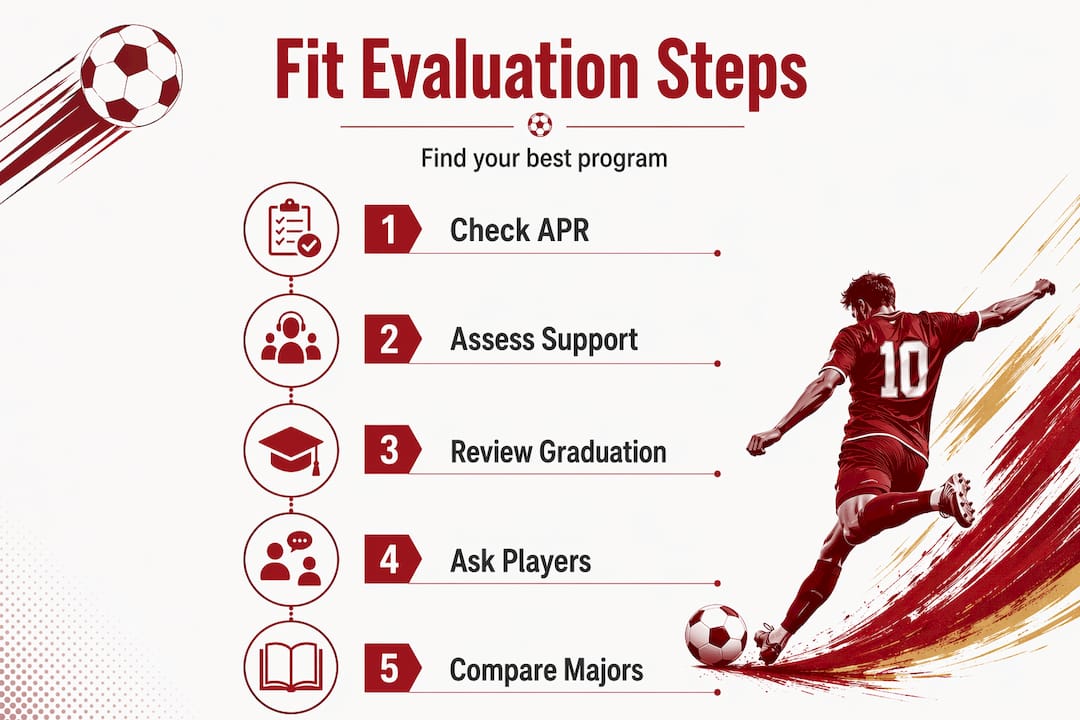
Building a credible recruiting list that balances athletic potential with academic reality is the most practical thing you can do early in this process. Here is a step-by-step approach:
-
Pull APR and GSR data. The NCAA’s public database lists APR scores by program and sport. Filter for programs where you have both athletic interest and APR scores above 970. Pair that with graduation rate data from the National Center for Education Statistics.
-
Map your academic profile to admissions requirements. Your current GPA, course rigor, and test scores should align with the realistic admissions band of each school. Reaching two grade points above your profile or targeting schools two grade points below both create problems.
-
Analyze scholarship distribution. For D1 and D2 schools, research how scholarships are distributed across the roster. Full scholarships at the D1 level are rare in soccer. Knowing scholarship distribution in top programs helps you evaluate whether a partial offer is genuinely competitive or a token gesture.
-
Build a tiered list of 7 to 10 schools. A realistic fit list includes reach programs (strong athletic fit, competitive admissions), fit programs (realistic athletic placement, admissions aligned), and safety programs (clear path to playing time and admission). Do not build a list of only reach schools.
-
Evaluate total cost of attendance. An athletic scholarship at a high-cost private school may net out worse than a merit aid package at a public school. Review scholarship value versus spending carefully before ranking offers.
-
Communicate directly with coaches and academic staff. Email or call the program’s athletic academic advisor. Ask about study hall requirements, tutoring access, and how the program has supported athletes in your intended major. Visit campus if geographically and financially feasible.
| Evaluation area | What to look for | Where to find it |
|---|---|---|
| APR score | Above 970 indicates strong academic support culture | NCAA public database |
| Graduation Success Rate | Compare to national average for the sport | NCAA research reports |
| Admissions band | Your GPA/test scores fall within the middle 50% | Common Data Set for each school |
| Scholarship type | Athletic vs. merit vs. need-based and total package | Financial aid office and coach |
| Playing time projection | Realistic spot on roster based on current ability | Roster analysis and coach conversation |
Pro Tip: Request the program’s graduation rate specifically for players in your intended major. A high GSR across all athletes can mask poor completion rates in competitive degree programs like engineering or business.
Common mistakes that undermine fit decisions
The recruiting process creates pressure that leads families toward predictable errors. Recognizing them in advance protects the athlete’s academic and athletic future.
- Chasing prestige over fit. Committing to a top-ranked program for name recognition, only to find the academic environment is unsupportive or the athletic opportunity is minimal, produces poor outcomes across every metric.
- Misreading scholarship offers. Partial scholarships require honest math. A 25% athletic scholarship at a school with high tuition can cost more out of pocket than a full academic merit award at a lower-cost institution.
- Overestimating recruiting interest. Players who receive a few camp invitations or social media contact from programs sometimes mistake that for serious recruiting interest. Genuine interest looks like consistent personal communication from the head coach and a formal campus visit invitation.
- Ignoring academic support culture. Low APR scores are a real warning. Over 22,400 former athletes have returned to earn degrees after eligibility ended, which speaks to how academic support should extend beyond your playing years.
- Skipping direct program communication. Families that rely entirely on third-party rankings or recruiting profiles without speaking to coaches and academic staff are making a significant decision with incomplete data.
“The players who struggle most in their first semester are usually those who chose a program for what it looked like on paper, not what it actually supported in practice.”
What proper fit actually delivers
Getting academic and athletic fit right produces measurable, lasting results. When the right match is made across academics, athletics, and finances, athletes experience:
- Stronger time management between practice, travel, and coursework because athletic demands are realistic for their ability level
- Higher likelihood of maintaining NCAA eligibility throughout their playing career, since academic support resources are genuinely used
- Better athletic development because appropriate playing time and quality coaching align with where the athlete is developmentally
- Financial clarity through a realistic combination of athletic, merit, and need-based aid that reduces family stress over four years
- A foundation for life after soccer, including alumni networks, internship access, and degree programs in fields that match the athlete’s long-term career goals
The college soccer experience is four years of high-stakes academic and athletic commitment. Programs that support both sides of that commitment produce athletes who graduate and go on to careers in coaching, sports business, and fields far outside soccer.
My honest take on the recruiting process
I’ve worked with enough athletes and families to say this clearly: the most common recruiting mistake is not a bad highlight video. It’s an honest self-assessment that never happened.
I’ve seen talented players pursue D1 programs that had no realistic spot for them. They sat the bench for two years, fell behind academically because the schedule was brutal and the academic support wasn’t there, and transferred without a degree. I’ve also seen athletes who chose a D2 or NAIA program that matched both their academic profile and athletic level graduate on time, earn meaningful playing experience, and walk into strong careers.
What I’ve learned is that families treat the division level like a status symbol when they should treat it like a data point. The question isn’t “can my athlete play D1?” The question is “which specific programs at every level offer the academic support, scholarship package, and realistic playing time that match this athlete’s full profile?”
For D3 evaluation specifically, I encourage families to lean hard on Ivy League recruiting standards as a model for how academic rigor and athletic participation can coexist without athletic scholarships. It shifts the entire framework productively.
My take: use APR as an early filter, not a final verdict. It signals where academic support is weak before you commit. Then verify with GSR, direct faculty contact, and candid conversations with current players. Build the list on data, not hope.
— Canas
How Canasrecruiting helps you find the right fit
Matching your academic profile to the right soccer program at the right level takes more than a database search. At Canasrecruiting, we guide athletes and families through a structured evaluation process that accounts for academic standing, athletic ability, scholarship eligibility, and long-term degree goals.
Our Scholarship Positioning System is built specifically to align each athlete’s academic and athletic profile with programs where they can compete, succeed in the classroom, and maximize scholarship and aid opportunities across NCAA, NAIA, and junior college levels. We handle direct coach outreach, recruiting list construction, and scholarship evaluation so families can make informed decisions with confidence. Schedule a consultation to start building your targeted recruiting blueprint today.
FAQ
What is academic-athletic fit in college soccer recruiting?
Academic-athletic fit refers to the alignment between a student-athlete’s academic profile, intended major, and a college program’s academic support, admissions requirements, and degree completion outcomes. It is the foundation of a successful college soccer decision.
How do I use APR to evaluate a soccer program academically?
APR scores above 970 indicate strong academic support and retention. Programs scoring below 930 face NCAA penalties, so use APR as an early screening tool alongside graduation rates for a complete picture.
Do D3 schools offer athletic scholarships for soccer?
No. D3 schools provide no athletic scholarships for soccer players. Financial support at the D3 level comes through academic merit awards and need-based grants, which can be substantial at academically selective institutions.
How many schools should be on a college soccer recruiting list?
Targeting 7 to 10 realistic programs across reach, fit, and safety tiers gives athletes the best balance of opportunity and admissions probability when building their recruiting list.
What GPA do I need to play college soccer at the D1 level?
NCAA D1 requires a minimum 2.3 core course GPA across 16 required core courses to meet eligibility standards. Individual school admissions requirements are separate and are often significantly higher than the NCAA minimum.