

Sending a college soccer recruitment email is the single most direct action you can take to put your name in front of a program before any official contact window opens. Most athletes wait to be discovered. The ones who get recruited send the first email. This guide covers exactly when to reach out, what every message must include, how to write subject lines that get opened, and how to follow up without losing momentum. Whether you are a freshman just starting out or a junior narrowing your list, this process is yours to control.
When should you email college soccer coaches?
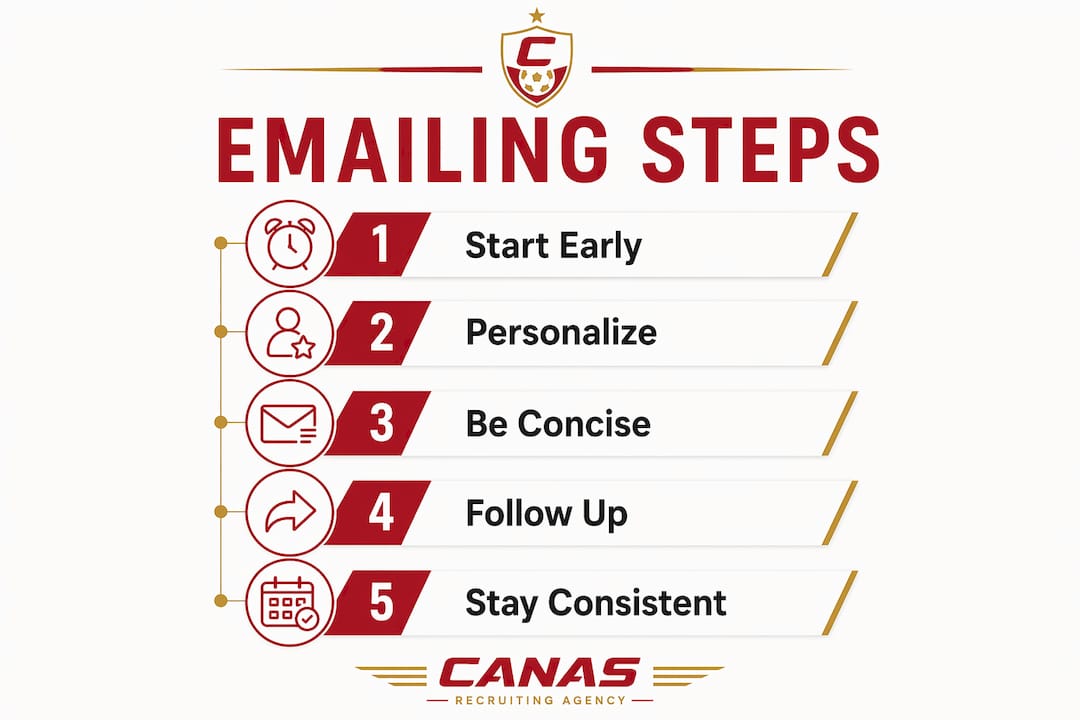
NCAA Division I rules allow athletes to email coaches at any time, even before coaches can initiate formal recruiting contact. Coaches cannot start that official outreach until June 15 following an athlete’s sophomore year. That gap is your advantage. Every email you send before that date builds name recognition and familiarity before the coach is even permitted to respond formally.

The recommended email frequency follows a clear progression by grade level. Proper follow-up timing balances persistence with respect for a coach’s workload. Freshmen should reach out once every six weeks, sophomores every four weeks, and juniors or seniors every two weeks. This cadence keeps you visible without overwhelming an inbox that receives hundreds of messages each month.
NCAA recruiting calendars also include dead periods, when coaches face restrictions on initiating contact. During dead periods, athletes can still send emails with updates, highlight video links, and schedule information. The restriction applies to coaches, not to you. Continuing to communicate during these windows keeps your profile active and demonstrates consistent interest.
Pro Tip: Set a recurring calendar reminder for each school on your list so you never miss a follow-up window. Consistency signals commitment, and coaches notice athletes who stay in contact throughout the year.
What every college soccer recruitment email must include
A well-structured recruiting email covers six core components. Each one serves a specific purpose, and leaving any out reduces the chance of a response.
-
Subject line with your identity. Include your name, graduation year, and position. Coaches scan dozens of emails quickly, and a clear subject line tells them immediately whether you fit their current recruiting needs.
-
Personalized greeting. Address the coach by name. “Dear Coach Martinez” outperforms “Dear Coach” every time. It signals that this email was written for them, not copied and pasted to fifty programs.
-
Brief introduction. State your name, position, graduation year, club team, and high school in two to three sentences. Coaches need context before they can evaluate interest.
-
Academic profile. Include your GPA, any honors or AP coursework, and standardized test scores if available. Coaches at NCAA programs recruit students first. A strong academic profile expands your scholarship options and makes you easier to admit. Reviewing Ivy League soccer recruiting standards shows how much academic weight coaches carry in their evaluations.
-
Athletic information and highlight reel link. List your club team, recent tournament results, and a direct link to your highlight video. The video is the most important attachment in any recruiting email. Keep the link visible and easy to click.
-
Program-specific research. Reference something specific about the program. Mention the coach’s playing style, a recent conference result, or the academic major you plan to pursue. This is the section that separates a genuine email from a mass blast.
-
A direct closing question. Emails ending with a single yes/no question increase coach engagement by reducing the effort required to respond. Ask something like: “Would it be possible to schedule a call to discuss your program?” or “Are you currently recruiting my position for the class of 2027?”
-
Professional closing with follow-up mention. Sign off with your full name, contact information, and a note that you will follow up in a few weeks if you have not heard back. This sets expectations and keeps the door open.
| Email component | Why it matters |
|---|---|
| Personalized subject line | Increases open rate and signals relevance to the coach |
| Academic stats | Demonstrates eligibility and scholarship viability |
| Highlight reel link | Gives coaches the fastest path to evaluating your ability |
| Program-specific detail | Proves genuine interest and separates you from mass emails |
| Direct closing question | Prompts a response and clarifies next steps |
Pro Tip: Keep your initial email under 250 words. Coaches read on mobile devices between practices and meetings. A concise email that respects their time gets read. A long one gets skipped.
How do subject lines and personalization affect open rates?
Personalized subject lines outperform generic ones by 31% for email opens and double response rates. That single data point explains why “2027 GK | Jordan Reyes | Interested in Your Program” will always outperform “Exciting Opportunity” or “Prospective Student Athlete.” The first tells a coach exactly who you are and what position they are evaluating. The second tells them nothing.
Subject lines should stay under 35 characters to display fully on mobile screens. Most coaches check email on their phones, and a subject line that gets cut off loses its impact. The format that works consistently is: graduation year, position, and athlete name. Some athletes add a tournament name or a GPA to stand out further.
Personalization inside the email body matters just as much as the subject line. Generic phrases like “I have always dreamed of playing college soccer” appear in thousands of emails. Specific phrases like “I watched your team’s 4-3-3 press at the ECNL Regional Championships and it matches how my club coach has trained me” demonstrate real research. Coaches can tell the difference in the first two sentences.
- Keep subject lines to 2-4 words or a short structured format (year, position, name)
- Avoid vague titles: “Prospective Athlete,” “Exciting Opportunity,” or “Hello Coach”
- Reference a specific program detail in the first paragraph of the body
- Use the coach’s name in both the subject line and the greeting when possible
- Match your tone to the program’s culture. A D3 liberal arts program and a D1 powerhouse have different environments
Reviewing how social media recruiting works alongside email outreach shows why a consistent personal brand across all channels reinforces the impression your emails create.
What are best practices for following up after a recruiting event?
Follow-up emails after ID camps, showcases, or official visits are among the most effective messages in the entire recruiting sequence. A coach who watched you play has a visual memory of your performance. Your follow-up email connects that memory to a name, a GPA, and a direct question.
Send the follow-up within 48 hours of the event. The sooner you write, the more specific and credible your reference to the event will be. Follow-up emails after ID camps should include a thank-you, a reminder of who you are with brief personal details, academic and athletic updates, and a link to your most recent highlight video.
-
Open with a specific thank-you. Reference the camp or showcase by name and date. “Thank you for the opportunity to train at the Future 500 ID Camp on June 14” is more professional than a generic thank-you.
-
Remind the coach who you are. Restate your name, position, graduation year, and club team. Coaches evaluate dozens of athletes at each event. A brief reminder removes any guesswork.
-
Update your academic and athletic profile. If your GPA improved or your club team advanced in a recent tournament, include that information. Coaches track progress over time, and updates show you are developing.
-
Include a current highlight video link. If you have footage from the event itself, even better. A video that shows the coach exactly what they saw in person reinforces their evaluation.
-
Close with a direct next step. Ask whether the coach has any questions about your profile or whether a campus visit would be possible. Ending with a clear question simplifies the coach’s response and moves the conversation forward.
Pro Tip: If a coach has not responded after two or three follow-ups, do not stop. Early outreach positions you well once official recruiting windows open, even when coaches cannot respond immediately. Silence is not rejection.
Key takeaways
Effective college soccer recruitment emails combine precise timing, structured content, and consistent follow-up to build coach recognition before official recruiting windows open.
| Point | Details |
|---|---|
| Start emailing early | Athletes can contact coaches at any time, even before coaches can initiate formal outreach. |
| Follow a grade-based cadence | Freshmen email every six weeks; juniors and seniors every two weeks to stay visible. |
| Personalize every message | Subject lines and body content referencing specific program details double response rates. |
| Structure emails with six core elements | Identity, academics, highlight reel, program research, and a direct question drive engagement. |
| Follow up after every event | Post-camp emails sent within 48 hours connect your performance to your profile in the coach’s memory. |
Why most athletes email coaches too late
At Canasrecruiting, we have worked with hundreds of families who came to us frustrated that coaches were not responding. In almost every case, the athlete had waited until junior year to send the first email. By then, many programs had already filled their recruiting classes for that graduation year.
The athletes who get recruited earliest are not always the most talented. They are the ones whose names coaches have seen in their inboxes for two years before the official contact window opens. Early emails build name recognition and familiarity that gives athletes a real recruiting advantage. When a coach can finally pick up the phone and call, they call the names they already know.
I also want to address a misconception I hear often: that emailing too many coaches looks desperate. It does not. Sending personalized, well-researched emails to 30 or 40 programs is not desperation. It is a targeted blueprint. The athletes who limit themselves to five schools because they fear rejection are the ones who run out of options. Cast wide, personalize deeply, and let the process narrow itself.
Recruiting is a long sequence of professional communications, not a single email. Treat every message as a relationship-building opportunity, not a transaction. Coaches remember athletes who communicate with consistency and professionalism over time. That reputation is built one email at a time.
— Canas
How Canasrecruiting supports your recruiting email strategy
Canasrecruiting works directly with athletes and families to build and execute a complete outreach strategy, from the first email to program commitment. Our team helps you craft personalized recruiting emails, identify the right programs at the NCAA, NAIA, and junior college levels, and manage follow-up communication so nothing falls through the cracks.
If you are ready to take control of your recruiting process, our college soccer recruiting services give you a structured system for coach outreach, scholarship positioning, and program evaluation. We also help families understand the full range of athletic scholarship options available across all division levels. Visit Canasrecruiting to learn how we can support your path to college soccer.
FAQ
When can athletes start emailing college soccer coaches?
Athletes can email college soccer coaches at any time, with no restrictions on when they initiate contact. NCAA rules only restrict when coaches can respond formally, which begins June 15 after an athlete’s sophomore year.
How long should a recruiting email to a coach be?
Keep your initial recruiting email under 250 words. Coaches read on mobile devices and respond faster to concise, well-organized messages that include your identity, academic profile, highlight reel link, and one direct question.
What subject line format works best for emailing a coach?
The most effective format includes your graduation year, position, and name, kept under 35 characters for full mobile display. Personalized subject lines outperform generic ones by 31% for open rates and double response rates.
How often should you follow up if a coach does not respond?
Follow up based on your grade level: every six weeks as a freshman, every four weeks as a sophomore, and every two weeks as a junior or senior. Silence from a coach does not mean disinterest. Consistent, professional follow-up keeps your profile visible until the official contact window opens.
What should a follow-up email after an ID camp include?
A post-camp follow-up should include a specific thank-you referencing the event, a reminder of your name and position, updated academic and athletic information, a current highlight video link, and a direct question about next steps. Send it within 48 hours of the event for maximum impact.