

Contacting D1 soccer coaches directly is defined as initiating personalized, NCAA-compliant communication with Division I coaching staff to establish your presence in their recruiting pipeline. Players can email coaches at any time, but coaches cannot initiate calls or texts before september 1 of a player’s junior year. That rule shapes everything about your outreach strategy. Proactive, personalized outreach, paired with a clean highlight video and accurate academic information, is the single most effective way to get on a D1 program’s radar before the official contact window opens.
What are the NCAA contact rules for D1 soccer recruiting?
NCAA Division I recruiting operates on a strict timeline. Coaches cannot initiate phone calls, texts, or direct messages before september 1 of a player’s junior year. Players, however, can email any D1 program at any time, including during freshman year.

The first major milestone is june 15 after sophomore year. That is the date when coaches can begin sending personalized responses to your emails. Before that date, they may only reply with camp information, questionnaire links, or general program materials. Receiving those responses is a positive signal. It means your email was read and filed.
A common misconception is that silence before the contact window means disinterest. Coaches log and review emails received before the window opens. Consistent early outreach can place you higher on a coach’s recruit list when the official window opens in september of junior year.
The NCAA recruiting calendar is updated annually. Always verify current contact dates directly on the NCAA website or through a trusted recruiting resource before planning your outreach schedule.
Pro Tip: Start emailing D1 programs at the beginning of sophomore year. Early emails build familiarity with coaching staff before they are legally permitted to respond personally.
Key communication types by phase:
- Before june 15 sophomore year: Players email freely; coaches reply only with general materials
- After june 15 sophomore year: Coaches can send personalized written responses
- After september 1 junior year: Coaches can initiate phone calls and texts
- Junior and senior year: Official visits, evaluations, and scholarship discussions begin
Who should you contact at a D1 soccer program?
The head coach is rarely the right first contact. Directing emails to recruiting coordinators assigned to your position or region significantly improves your response rate. Most D1 programs divide recruiting responsibilities by position group or geographic region, and assistant coaches handle the bulk of initial evaluation.
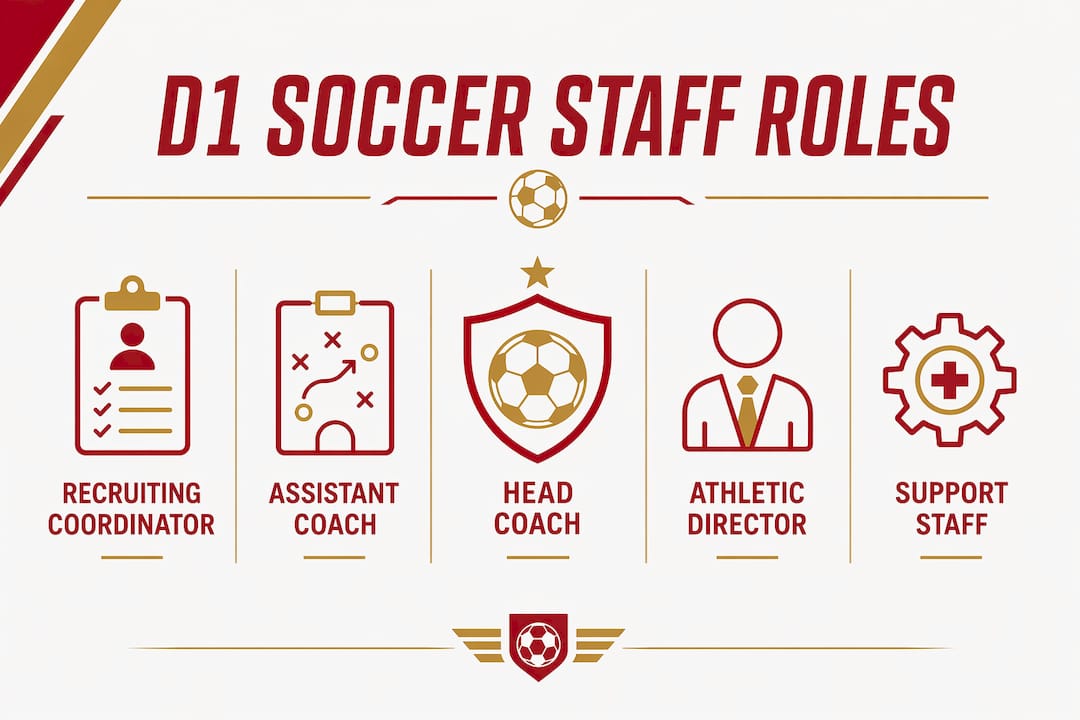
Understanding the staff structure at each program is critical before you send a single email. The table below outlines the typical roles and their responsiveness to initial outreach.
| Staff role | Recruiting responsibility | Responsiveness to initial email |
|---|---|---|
| Head coach | Final decisions, scholarship offers | Low for initial outreach |
| Assistant coach (by position) | Position-specific evaluation | High |
| Recruiting coordinator | Pipeline management, initial contact | Very high |
| Regional recruiter | Geographic area coverage | High |
Using official school athletic staff directories rather than guessing or sending to generic inboxes significantly improves your chances of a reply. Every D1 program publishes a staff page on its official athletics website. Cross-reference that page with the program’s listed recruiting coordinator before sending your first email.
Avoid emailing the entire coaching staff at once. Mass emails signal a lack of research and reduce your chances of a meaningful response. Coaches can tell when an email was copied and pasted. Personalization is not optional. It is the baseline expectation.
Pro Tip: Check the program’s official athletics website for a staff directory. Look for a title like “recruiting coordinator” or “assistant coach, forwards” to find your most relevant contact.
The role of the athletic director in the recruiting process is separate from day-to-day coach communication. Athletic directors set program policy but are not involved in individual player evaluation.
How to compose and send effective emails to D1 coaches
A strong recruiting email is concise, specific, and built around the coach’s program, not just your own accomplishments. Coaches appreciate emails that are personalized with specifics about their program and include all key player information in one place.
Every effective recruiting email must include these elements:
- Player name, graduation year, and position
- GPA and standardized test scores (if available)
- Club team name, league, and coach contact information
- A direct link to your highlight video (accessible within two minutes of viewing)
- Upcoming tournament or showcase schedule
- A specific reason you are interested in that program
The subject line determines whether your email gets opened. Use a clear, direct format: “2027 GK | 3.8 GPA | ECNL | Interested in [Program Name].” Coaches scan dozens of emails daily. A vague subject line gets skipped.
Proactive outreach leads to better visibility than relying on elite league play alone. Playing in ECNL or MLS NEXT helps, but it does not replace direct communication. A player in a lower-profile league who sends a well-crafted email with a strong highlight video will get more attention than a top-league player who never reaches out.
Use Grammarly or a similar writing tool to check your email before sending. Spelling errors and awkward phrasing undermine your credibility immediately.
Email workflow:
- Send your initial email to the recruiting coordinator or position-specific assistant coach
- Wait three to four weeks for a response
- If no reply, send one follow-up referencing your original email and any new updates
- Follow up every 2–3 months or after a significant update such as a new video, tournament result, or academic achievement
- After two follow-ups with no response, redirect your effort to other programs
Pro Tip: Never attach your highlight video as a file. Upload it to YouTube or Hudl and paste the link directly in the email body. Coaches will not download attachments from unknown senders.
Common email mistakes to avoid:
- Sending the same email to every program without personalization
- Writing more than 250 words in the initial email
- Failing to include a highlight video link
- Contacting only the head coach
- Emailing from an unprofessional email address
What to expect after reaching out to D1 coaches
Most early responses from coaches are not personal recruiting calls. Before the contact window opens, expect thank-you emails, questionnaire links, and camp invitations. These are positive signals. They confirm your email was received and that the program has some level of interest.
Once the official contact window opens after september 1 of junior year, coaches may call directly. Return missed calls within 24 hours. A delayed callback signals low interest and can remove you from active consideration. Treat every coach call as a formal interaction, even if the conversation feels casual.
Maintain ongoing communication throughout the recruiting process with these practices:
- Send updates after every major tournament or showcase
- Share new highlight video links as your footage improves
- Notify coaches of any academic achievements or GPA improvements
- Respond to questionnaires promptly and completely
- Keep a tracking spreadsheet with each program’s name, contact, date of last email, and response status
Maintaining a tracking spreadsheet is critical for managing outreach across multiple programs without duplicating messages or missing follow-up windows. A simple Google Sheets document with columns for program name, contact name, email date, response received, and next follow-up date is sufficient.
Attending ID camps and showcases during communication gaps serves two purposes. It gives coaches an in-person evaluation opportunity and gives you a natural reason to send a follow-up email referencing your attendance.
Common mistakes when contacting D1 soccer coaches directly
The most damaging errors in the college soccer recruiting process are avoidable. Most players make the same mistakes repeatedly, and each one reduces their chances of getting a response.
Frequent errors include:
- Emailing the head coach exclusively and ignoring assistant coaches
- Sending mass emails with no program-specific content
- Starting outreach too late, after junior year has already begun
- Expecting a personal reply before the official contact window opens
- Interpreting silence as rejection rather than a legal restriction
Silence before june 15 of sophomore year is not disinterest. It is an NCAA rule. Coaches who receive your emails are filing them. Your job is to keep sending updates so your name stays visible.
Misreading NCAA restrictions as disinterest is one of the most common reasons players stop outreach prematurely. A coach who cannot legally respond personally before june 15 may still be actively tracking your profile.
If a program consistently does not respond after two or three well-spaced follow-ups, redirect your energy. Not every program is the right fit, and pursuing unresponsive programs at the expense of engaged ones is a poor use of your recruiting time. Watch for recruiting scam warning signs as well. Legitimate D1 programs will never ask for payment to evaluate your profile.
Key Takeaways
Direct contact with D1 soccer coaches requires NCAA-compliant timing, targeted outreach to the right staff member, and consistent personalized follow-up throughout the recruiting window.
| Point | Details |
|---|---|
| Start outreach early | Email D1 programs at the start of sophomore year before the contact window opens. |
| Target the right contact | Email recruiting coordinators or position-specific assistants, not the head coach first. |
| Personalize every email | Mass emails reduce response rates; coaches prioritize sincere, program-specific messages. |
| Follow up consistently | Send updates every 2–3 months or after major athletic or academic milestones. |
| Track all communications | Use a spreadsheet to manage outreach status and avoid missed follow-up opportunities. |
What I have learned about reaching D1 coaches after years in recruiting
The players who get responses are not always the most talented. They are the most prepared. I have seen athletes from mid-level club programs earn D1 interest because they sent well-timed, well-written emails to the right assistant coach at the right moment. I have also seen highly talented players get overlooked because they waited for coaches to find them.
The biggest shift I see in families who succeed is the move from passive to active. They stop waiting for a showcase to produce results and start treating email outreach as a structured part of their weekly routine. They research staff directories. They personalize every message. They follow up without apology.
Patience matters too. The NCAA contact timeline feels slow, especially in freshman and sophomore year when coaches cannot respond personally. That silence is not a verdict. It is a legal constraint. The players who stay consistent through that period are the ones who get calls in september of junior year.
One thing I tell every family: the right contact matters more than the right program name. An email to the recruiting coordinator who covers your region and position will outperform an email to the head coach of a top-25 program every time. Know who you are writing to. Make it clear you know their program. That combination is what gets replies.
— Canas
How Canasrecruiting supports your coach outreach strategy
Canasrecruiting works directly with athletes and families to build structured, personalized outreach plans that align with NCAA contact rules and program-specific recruiting timelines.
Our team identifies the right coaching staff contacts at target programs, reviews your highlight video and player profile, and guides you through each phase of communication from your first email through official visits. We also help you avoid the most common recruiting mistakes that cost players real opportunities. If you want a clear, structured path to D1 programs, our college soccer recruiting services give you the framework and the support to execute it correctly.
FAQ
When can D1 coaches first contact players directly?
D1 coaches can send personalized written responses starting june 15 after a player’s sophomore year. Phone calls and texts from coaches are permitted beginning september 1 of junior year.
Who is the best coach to email at a D1 program?
The recruiting coordinator or the assistant coach assigned to your position or region is the most effective first contact. Head coaches rarely handle initial recruiting inquiries.
How often should you follow up with D1 coaches?
Follow up every 2–3 months or after a significant update such as a new highlight video, tournament result, or academic achievement. After two unanswered follow-ups, redirect your outreach to other programs.
What should a recruiting email to a D1 coach include?
Every email should include your name, graduation year, position, GPA, club team, a highlight video link, your upcoming schedule, and a specific reason you are interested in that program.
Does silence from a coach mean they are not interested?
Not necessarily. Before the official contact window opens, coaches are legally restricted from responding personally. Consistent early outreach keeps your name visible and builds familiarity before the window opens.