

A JUCO soccer player can get a D1 offer by meeting NCAA academic transfer requirements, demonstrating competitive performance, and executing a targeted outreach strategy to Division I coaches. The path from junior college to NCAA Division I is real and well-traveled. Strong NJCAA programs regularly produce players who contribute immediately at the D1 level, and the transfer pathway is structured enough that any player who prepares correctly can pursue it with confidence. The NCAA Eligibility Center, NJCAA division rules, and recruiting timelines are the three pillars every player and family must understand before starting this process.
How does a JUCO soccer player get a d1 offer?
The transfer from junior college to NCAA Division I is not automatic. It requires deliberate preparation across two areas: academic eligibility and recruiting visibility. Players who succeed at this transition treat both with equal seriousness.
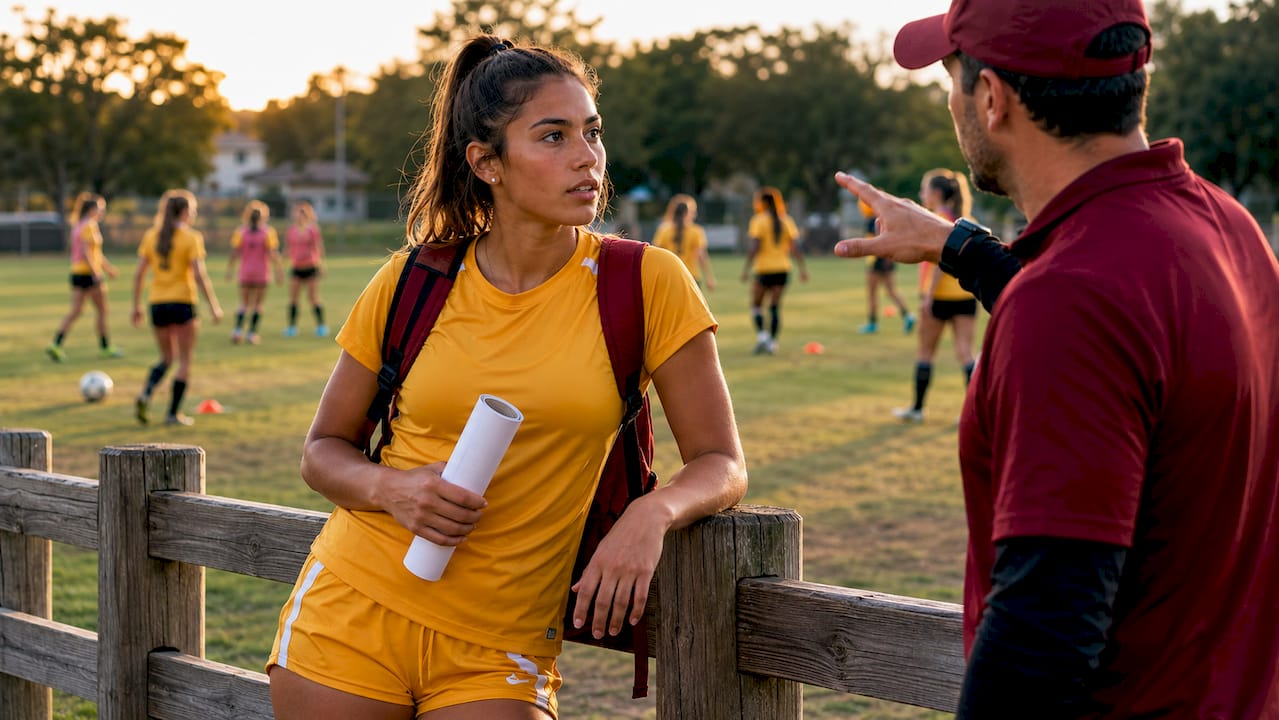
NJCAA programs offer competitive soccer, academic flexibility, and a structured two-year plan that feeds directly into NCAA D1, D2, D3, and NAIA programs. Real examples confirm this works. Players have transferred from Hawkeye Community College to Husson University, and a Lake Tahoe Community College player signed with Nevada after completing their JUCO eligibility. These are not exceptions. They are the expected outcome for players who follow the process.
The standard industry term for this pathway is the “JUCO-to-D1 transfer.” Understanding that term matters because NCAA compliance offices, coaches, and recruiting services all use it. Knowing the vocabulary helps you communicate clearly with every decision-maker in the process.
What academic requirements must JUCO players meet for d1?
NCAA academic transfer eligibility is the first gate every JUCO player must clear. Transfer eligibility must be cleared before classes begin at the NCAA school, including transcript reviews and core course alignments. Missing this window can delay competition eligibility and scholarship receipt by an entire year.
The NCAA Eligibility Center reviews your academic record and confirms whether your credits, GPA, and coursework meet D1 standards. Here is what you need to have in order:
- Credit hours: Most D1 programs require a minimum number of transferable credit hours completed at your JUCO. Confirm the exact number with your target school’s compliance office.
- GPA: A competitive GPA signals academic readiness. Low grades can disqualify you from immediate competition, even with strong athletic credentials.
- Core course completion: Your JUCO courses must align with NCAA-approved core course requirements. Not every class counts.
- Associate’s degree status: Completing your associate’s degree before transferring strengthens your eligibility case and demonstrates academic commitment.
- International students: If you studied abroad before your JUCO enrollment, official document translations and certified records are required. Late or incorrect submissions block eligibility approval.
Failure to clear these eligibility gates delays competition eligibility and scholarship receipt. That means you could arrive on campus, practice with the team, and still be ineligible to play in a single game your first season.
Pro Tip: Start your NCAA Eligibility Center account and submit transcripts at least six months before your intended transfer date. Delays in document processing are the most common reason players miss their eligibility window.
Is that coach email an offer or just interest?
Coach interest and an official D1 offer are not the same thing. Binding commitments occur only with finalized written athletics-aid paperwork, not earlier verbal statements. Families who confuse the two often make decisions based on expectations that never materialize.
The D1 soccer recruiting process follows a clear sequence:
- Film review: A coach watches your highlight video and decides whether to pursue further evaluation.
- Initial contact: The coach reaches out by email or phone to express interest. This is not an offer.
- Campus visit or ID camp: You attend a visit or camp where coaches evaluate you in person.
- Academic verification: The program confirms your eligibility status with the NCAA Eligibility Center.
- Official roster and aid offer: The program extends a formal offer with written scholarship aid paperwork.
“Families should value formal offers with aid paperwork over early verbal interest. A coach saying ‘we want you’ is the beginning of a conversation, not the end of one.” — College Soccer Recruiting Timeline
Keep every communication documented. Save emails, note phone call dates, and never make a verbal commitment to one program while another is still processing your paperwork. Professionalism at this stage directly affects how coaches perceive your maturity and readiness.
What steps should JUCO players take to secure a d1 offer?
A structured recruiting action plan separates players who earn D1 offers from those who wait and hope. Preparing a transfer-ready packet that includes highlight videos, stats, academic summaries, and clear eligibility status accelerates D1 recruitment significantly.
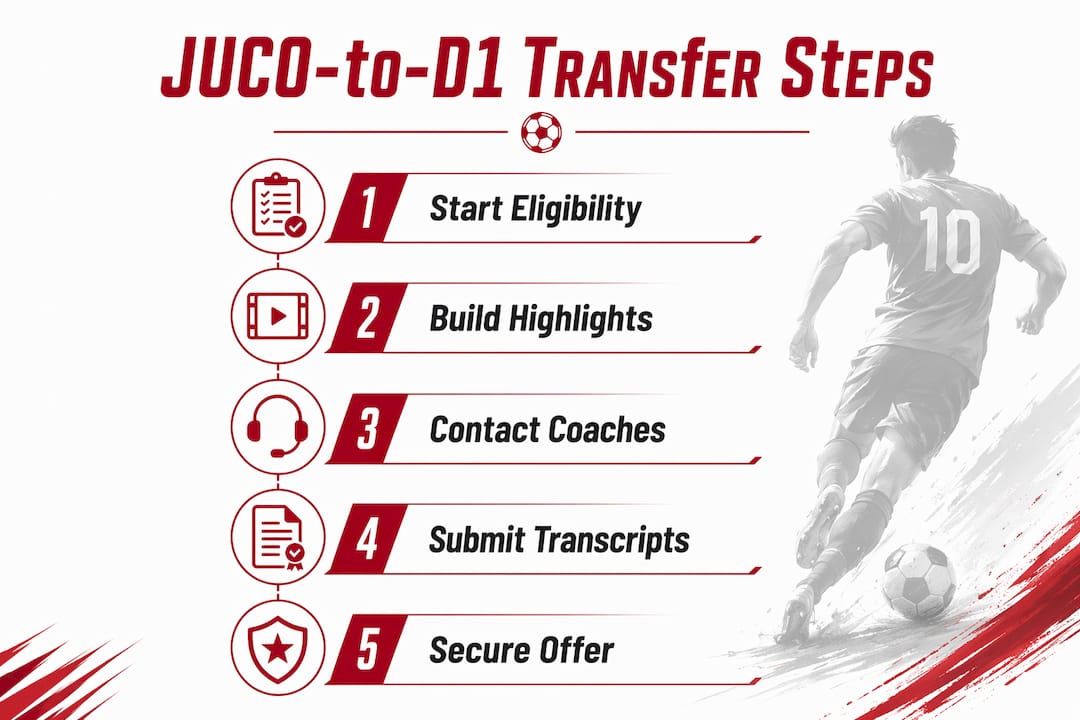
Follow these steps in order:
- Build your transfer-ready packet. Create an updated highlight film (8–12 minutes maximum), a one-page recruiting resume with stats and positions, and a one-page academic summary showing GPA, credit hours, and eligibility status.
- Confirm your NCAA eligibility status. Register with the NCAA Eligibility Center and verify your academic standing before contacting coaches. Coaches will ask.
- Identify target programs. Research D1 programs that fit your playing style, academic interests, and geographic preferences. Cast a wide net across 20–30 programs initially.
- Contact coaches directly. Send a personalized email to each program’s head coach and recruiting coordinator. Include your highlight film link, academic summary, and eligibility timeline.
- Attend ID camps and showcases. Events like D1 soccer showcases give coaches a live evaluation opportunity. These carry more weight than film alone.
- Follow up consistently. Coaches receive hundreds of emails. A professional follow-up every two to three weeks keeps you visible without being disruptive.
Here is a comparison of recruiting tactics by effectiveness for JUCO transfers:
| Tactic | Effectiveness | Notes |
|---|---|---|
| Personalized coach email with film | High | Direct and trackable; coaches respond to specificity |
| ID camp or showcase attendance | High | Live evaluation carries the most weight |
| Generic mass email blast | Low | Coaches recognize template emails immediately |
| Social media outreach only | Medium | Useful for visibility but not a substitute for direct contact |
| Recruiting platform profile | Medium | Supports outreach but rarely generates offers on its own |
Pro Tip: Address each coach email by name and reference one specific thing about their program. A coach at a school that runs a high-press system wants to know you understand their style and can fit it.
What scholarships can JUCO players expect when transferring to d1?
Scholarship expectations must be grounded in reality before you begin the transfer process. NJCAA Division I programs can offer full athletic scholarships covering tuition, fees, room, board, books, and supplies. Division II offers partial scholarships. Division III offers none. The scholarship you received at your JUCO does not carry over to your D1 program.
At the NCAA D1 level, men’s soccer programs are limited to 9.9 scholarships distributed across a full roster. Women’s soccer programs receive 14 scholarships. That math means most players receive partial awards, not full rides. Understanding partial versus full scholarship structures before you negotiate prevents disappointment.
Factors that affect the scholarship offer you receive include:
- Position scarcity: Programs with roster gaps at your position offer more aid to fill them.
- Remaining eligibility: Players with two years of eligibility remaining are more attractive than those with one.
- Academic standing: Strong GPA can unlock academic aid that supplements athletic scholarship money.
- Program budget: Mid-major D1 programs often offer more scholarship flexibility than Power Five schools with deeper rosters.
- Timing of your outreach: Early contact gives programs more budget flexibility before their aid is committed.
Not every JUCO player transfers to D1, and not every D1 offer includes full financial coverage. Players who keep an open mind on program fit rather than division status alone find better opportunities and more playing time.
What mistakes do JUCO players make when pursuing d1 offers?
The most costly mistakes in the JUCO-to-D1 process are preventable. Most come from poor timing, misread signals, or skipped paperwork.
- Waiting too long to contact coaches. D1 programs fill roster spots on a rolling basis. Players who start outreach in the spring of their second JUCO year often find the best opportunities already committed.
- Treating verbal interest as a confirmed offer. Two major misconceptions for JUCO-to-D1 families are assuming offers are guaranteed after JUCO success and confusing verbal interest with final offers backed by aid. Both lead to false expectations and poor decisions.
- Submitting incomplete eligibility documents. Missing transcripts, untranslated records, or unsigned forms delay your clearance. Coaches cannot formally offer aid to a player whose eligibility is unconfirmed.
- Ignoring NCAA recruiting calendar rules. Scholarship conversations often lag performance evaluation. Contacting coaches during dead periods or outside permitted windows can create compliance issues for the program and hurt your candidacy.
- Overlooking D2 and NAIA programs. Fixating exclusively on D1 can cause players to miss strong scholarship offers at programs where they would start and develop faster.
Pro Tip: Work with a recruiting service or advisor who specializes in JUCO transfers. They know which programs have open roster spots, which coaches respond to direct outreach, and how to present your eligibility package correctly.
Key takeaways
A JUCO soccer player earns a D1 offer by clearing NCAA academic eligibility, building a transfer-ready recruiting packet, and contacting coaches before roster spots are filled.
| Point | Details |
|---|---|
| Eligibility comes first | Clear the NCAA Eligibility Center before contacting coaches or committing to any program. |
| Verbal interest is not an offer | Only written athletics-aid paperwork constitutes a binding scholarship commitment. |
| Start outreach early | Contact D1 coaches in your first JUCO year to maximize scholarship budget availability. |
| Expect partial scholarships | Most D1 soccer programs distribute aid across rosters; full rides are rare for transfers. |
| Avoid common timing mistakes | Late paperwork and delayed coach contact are the top reasons qualified players miss D1 opportunities. |
What i’ve learned watching JUCO players pursue d1 offers
The players who successfully make this transition share one trait: they treat recruiting like a second job from day one of their JUCO career. They do not wait for coaches to find them. They build their packet, confirm their eligibility, and reach out to 25 programs before most players have updated their highlight film.
The families who struggle most are those who believe JUCO success automatically translates into D1 interest. It does not. A strong season at an NJCAA Division I program earns you the right to be evaluated. It does not earn you a roster spot. That distinction matters enormously when you are managing expectations and making enrollment decisions.
My honest advice: stay flexible on the school, not the process. Players who fixate on a specific D1 program often miss better fits at programs that would offer more playing time, stronger scholarship packages, and a genuine path to a starting role. The NCAA Division I soccer requirements are the same regardless of which school you target. Meet them, present yourself well, and let the fit reveal itself.
Patience and persistence are not clichés here. They are the actual mechanism. The recruiting calendar moves slowly, and coaches evaluate dozens of transfer candidates. Stay consistent, stay professional, and keep your academic record clean. That combination closes more D1 offers than raw talent alone.
— Canas
How Canasrecruiting helps JUCO players land d1 offers
Canasrecruiting specializes in guiding JUCO soccer players through every stage of the NCAA Division I recruiting process, from eligibility verification to direct coach outreach and scholarship negotiation.
Our team builds personalized recruiting strategies for each athlete, including transfer-ready packet preparation, targeted program identification, and compliance support for NCAA documentation. We know which D1 programs have open roster spots, which coaches prioritize JUCO transfers, and how to position your academic and athletic profile for maximum scholarship consideration. Families who work with Canasrecruiting avoid the most common timing and paperwork mistakes that cost players their D1 opportunities. Visit Canasrecruiting to learn how our Scholarship Positioning System can accelerate your path to a Division I program.
FAQ
Can a JUCO player get a full d1 soccer scholarship?
Full scholarships are possible but uncommon for JUCO transfers. Most D1 soccer programs distribute limited scholarship funds across full rosters, so partial awards are the standard outcome.
How early should a JUCO player contact d1 coaches?
Contact D1 coaches during your first year at JUCO. Early outreach gives programs more budget flexibility and increases your chances of being evaluated before roster spots are filled.
What is the NCAA eligibility center and why does it matter?
The NCAA Eligibility Center reviews your academic transcripts and confirms whether you meet D1 transfer requirements. Eligibility must be cleared before classes begin at your new school, or you risk sitting out your first year.
Does a verbal offer from a d1 coach mean i am committed?
No. A verbal offer is not binding. Only written athletics-aid paperwork finalizes a scholarship commitment. Review the JUCO transfer rules before making any enrollment decisions based on verbal communication.
What is the difference between NJCAA division i and division II for scholarships?
NJCAA Division I programs can offer full athletic scholarships covering tuition, fees, room, board, and books. Division II programs offer partial scholarships only, and Division III programs offer no athletic aid at all.