

Financial aid in college soccer recruiting is defined as the combination of athletic scholarships, academic merit awards, and need-based grants that reduce a student-athlete’s total cost of attending college. The role of financial aid in soccer recruiting goes far beyond a single scholarship offer. Families who understand how these aid types work together, across NCAA Division I, Division II, Division III, and NAIA programs, gain a clear advantage in finding the most affordable path to college soccer. Tools like FAFSA and the CSS Profile are the starting points for every family, regardless of athletic ability.
How does financial aid impact a soccer recruit’s total cost of attendance?
Total cost of attendance (COA) covers more than tuition. It includes fees, room and board, textbooks, transportation, and personal expenses. Every aid package a player receives is measured against this full number, not just the tuition line.
Athletic scholarships, academic merit awards, and need-based grants can all stack within NCAA and institutional rules. Combined aid is capped at the total COA, so no student-athlete receives more than the school’s published cost. This stacking rule gives families more financial flexibility than most realize.

Full-ride scholarships are rare in college soccer. Most NCAA Division I and II players receive partial athletic scholarships, meaning athletic aid covers only a portion of COA. Academic and need-based aid fill the remaining gap, which is why a strong academic profile matters as much as athletic ability.
Athletic scholarships are typically one-year agreements subject to annual renewal based on performance, academic standing, and program budget. Families should plan for year-to-year variability rather than assuming a four-year guarantee. Academic merit aid tends to be more stable, making it a reliable foundation for long-term financial planning.
- Tuition and fees: The most visible cost, but rarely the largest when room and board are added.
- Room and board: Often equals or exceeds tuition at many universities.
- Books and supplies: A frequently overlooked expense that adds up each semester.
- Transportation and personal costs: Vary by location and lifestyle but factor into the real COA.
Pro Tip: Ask each school for its Net Price Calculator result before comparing offers. Two schools with identical athletic scholarship amounts can have very different out-of-pocket costs depending on their total COA.
What are the differences in scholarship availability across NCAA divisions and NAIA?
Scholarship rules differ significantly by division, and targeting the right level is one of the most consequential decisions a family makes during recruiting.
| Division | Athletic Scholarships | Notes |
|---|---|---|
| NCAA Division I | Yes, partial to full | Post-House settlement, aid distribution is more flexible under roster limits |
| NCAA Division II | Yes, partial | Scholarship limits apply; partial awards are standard |
| NCAA Division III | No athletic scholarships | Coaches advocate for merit and need-based institutional aid |
| NAIA | Yes, partial to full | More flexible rules; strong opportunities for international and domestic players |
| Junior College (NJCAA) | Yes, varies | Two-year programs with scholarship opportunities; strong transfer pathway |
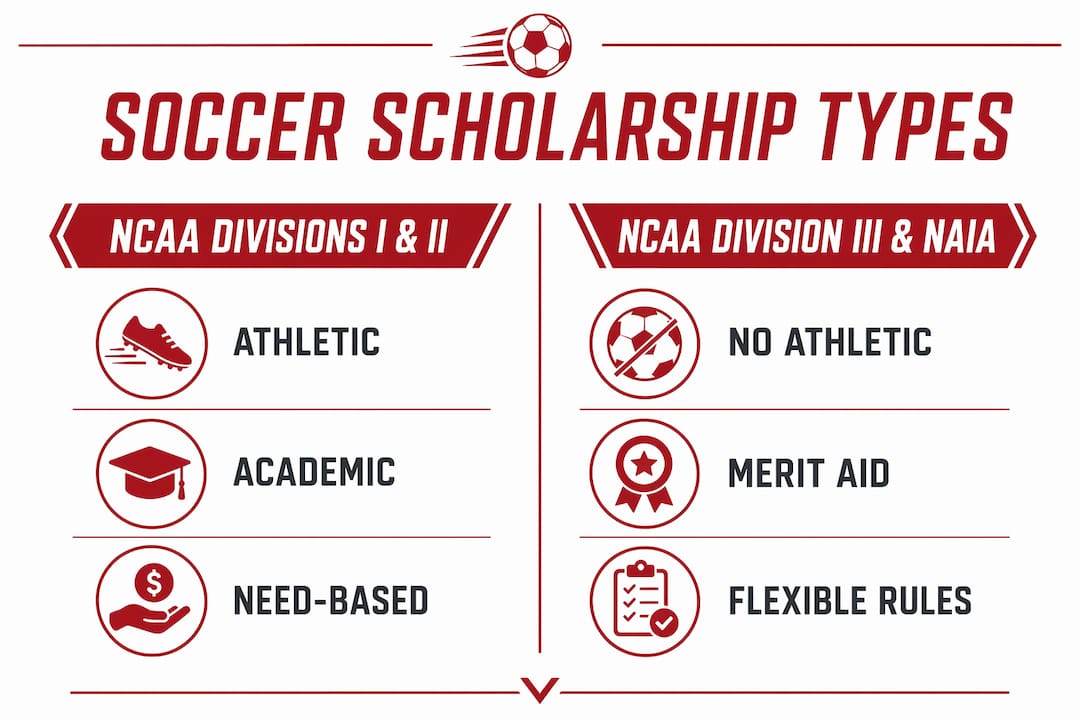
Division III coaches actively advocate for recruits with strong academic applications to secure institutional merit or need-based aid. That advocacy can produce financial packages comparable to partial athletic scholarships at Division I or II schools. Families who dismiss Division III purely because of the “no athletic scholarship” label often miss genuinely affordable options.
NAIA programs offer athletic scholarship opportunities with fewer restrictions than NCAA rules impose. Roster sizes and coach discretion play a large role in how aid is distributed at every level. A coach with a smaller roster and a flexible budget can sometimes offer more per player than a Division I program splitting aid across a large squad.
How can players and families maximize financial aid during soccer recruiting?
Maximizing financial support for soccer players requires coordinating multiple aid sources at the right time. No single scholarship type covers the full picture on its own.
- File FAFSA early. The recommended window is october 15 to november 1. Filing late reduces access to federal grants and institutional need-based aid. Every family should file, regardless of income level.
- Complete the CSS Profile if targeting private schools. Roughly 400 private institutions use the CSS Profile to award institutional aid. The first submission costs $25, with subsequent submissions at $16 each. Private schools often have larger endowments and more generous need-based packages.
- Build a strong academic profile. Academic scholarships based on GPA, test scores, and leadership can significantly reduce overall costs when combined with athletic aid. A player with a 3.8 GPA and strong test scores becomes more attractive to coaches and financial aid offices simultaneously.
- Communicate directly with coaches and financial aid offices. Coaches can flag recruits to financial aid staff. Financial aid offices can clarify what aid is available beyond the athletic package. Both conversations matter.
- Verify all scholarship terms in writing. Verbal offers are not binding. The National Letter of Intent and financial aid agreement are the documents that count.
- Do not factor NIL into financial planning. NIL and revenue sharing remain highly uncertain for non-revenue sports like soccer. Federal and institutional aid should serve as the primary financial foundation.
Pro Tip: Request a multi-year financial aid projection from each school. Ask specifically how your aid package might change if your athletic scholarship is reduced or not renewed in year two or three.
Understanding NCAA scholarship rules before you receive offers prevents costly surprises later in the process.
What misconceptions do families often have about soccer scholarships?
The most damaging misconception in soccer recruiting is treating a roster spot as a scholarship offer. A roster spot does not equal a scholarship. Some players earn a spot with no athletic aid, some receive academic or need-based aid instead, and others receive both. Families must ask directly what financial aid accompanies any offer.
Several other misconceptions consistently cost families money and time:
- “The biggest athletic scholarship is the best deal.” A large athletic scholarship at a high-COA school can leave a family paying more out of pocket than a smaller scholarship at a lower-cost institution. Always compare net cost, not scholarship size.
- “Athletic scholarships are guaranteed for four years.” Most are one-year agreements. A coaching change, budget cut, or performance issue can affect renewal.
- “Athletic aid and need-based aid always add up.” Athletic scholarships can reduce need-based aid eligibility dollar-for-dollar at certain private schools. A $20,000 athletic scholarship could displace $20,000 in grants, leaving the family no better off.
- “Division III is not worth considering.” Division III coaches have real influence over institutional aid awards. The Division III financial aid dynamic is frequently overlooked by families focused solely on athletic scholarship numbers.
Evaluating the total financial package, not just the athletic scholarship line, is the standard that separates informed families from those who commit to a school and later regret it. Review the difference between partial and full scholarships before making any commitment.
What financial aid tools and resources should families use during recruiting?
The right tools make the difference between a clear financial picture and a costly guess. Families should use all of the following resources before committing to any program.
- FAFSA (Free Application for Federal Student Aid): The foundation of all federal and most institutional aid. File at studentaid.gov each year starting october 1.
- CSS Profile: Required by roughly 400 private colleges. Submit through the College Board website. Costs $25 for the first school and $16 for each additional school.
- Net Price Calculators: Every college is required to publish one. Enter your family’s financial information to get an estimated out-of-pocket cost before applying.
- Financial aid offices: Contact them directly, not just the coach. Ask about merit scholarships, grant availability, and how athletic aid interacts with institutional aid at that specific school.
- Scholarship renewal policies: Request these in writing. Ask what GPA and credit hour requirements apply to maintain the award each year.
Academic eligibility is non-negotiable. Failure to meet GPA or credit hour requirements results in immediate scholarship loss. Players who treat academics as secondary to athletics risk losing their entire financial package.
Net Price Calculators and direct contact with financial aid offices are the two most underused tools in the recruiting process. Most families rely on the coach’s verbal description of the package. That is not enough.
Key Takeaways
Financial aid in college soccer recruiting works best when athletes and families combine athletic scholarships, academic merit awards, and need-based grants into a complete package evaluated against total cost of attendance.
| Point | Details |
|---|---|
| Aid stacking is allowed | NCAA rules permit combining athletic, academic, and need-based aid up to total cost of attendance. |
| Full rides are rare | Most soccer players receive partial scholarships; academic aid fills the remaining gap. |
| Division III has real value | Coaches advocate for institutional aid that can match partial athletic scholarships at higher divisions. |
| FAFSA filing timing matters | Filing between october 15 and november 1 maximizes access to federal and institutional aid. |
| Evaluate net cost, not scholarship size | A smaller scholarship at a lower-cost school often produces a better financial outcome. |
What I’ve learned about financial aid that most families find out too late
After working with hundreds of soccer families through the recruiting process, the pattern I see most often is this: families fixate on the athletic scholarship number and ignore everything else. A player gets a 40% scholarship offer from a $70,000-per-year school and feels like they won. Then they do the math and realize they are still paying $42,000 a year. Meanwhile, a Division II school offering 25% at a $30,000 COA costs the family $22,500. The “smaller” offer is actually the better deal by a wide margin.
The second thing families consistently underestimate is academic performance as a financial tool. A player with a 3.9 GPA and strong test scores does not just look good to coaches. That player qualifies for merit scholarships that stack on top of athletic aid. I have seen players at Division II and NAIA schools end up with packages that cover 90% of COA because they brought both athletic and academic value to the table.
My strongest advice: treat financial aid planning as a year-round process, not a decision you make after the offer arrives. Know your FAFSA numbers before you start talking to coaches. Know each school’s Net Price Calculator result before you visit. And never, under any circumstances, commit to a program based on a verbal scholarship promise. Get it in writing, understand the renewal terms, and compare the net cost across every offer on the table.
— Canas
How Canasrecruiting helps families build the right financial picture
Canasrecruiting works directly with soccer players and their families to position athletes for the strongest possible scholarship packages across NCAA, NAIA, and junior college programs. Our process includes direct coach outreach, scholarship positioning, and guidance on how to evaluate complete financial aid packages, not just athletic offers.
Families who work with Canasrecruiting avoid the most common and costly recruiting mistakes, from misreading scholarship offers to missing FAFSA deadlines. Our advisors help you compare net costs across programs, understand renewal terms, and communicate effectively with both coaches and financial aid offices. Read our 2026 recruiting mistakes guide to see the errors that derail families every year, and contact Canasrecruiting to build a recruiting plan that accounts for the full financial picture from day one.
FAQ
What is the role of financial aid in college soccer recruiting?
Financial aid in soccer recruiting reduces the total cost of attendance through a combination of athletic scholarships, academic merit awards, and need-based grants. Families who understand how these aid types stack together find more affordable paths to college soccer than those who focus on athletic scholarships alone.
Can athletic and academic scholarships be combined in NCAA soccer?
Yes. NCAA rules allow academic merit and need-based aid to stack with athletic scholarships without counting against team scholarship limits, as long as the combined total does not exceed the school’s total cost of attendance.
Are soccer scholarships guaranteed for four years?
No. Most athletic scholarships are one-year agreements renewed annually based on athletic performance, academic standing, and program budget. Families should plan for the possibility of reduced or non-renewed aid in any given year.
Does Division III offer any financial aid for soccer players?
Division III programs do not offer athletic scholarships, but coaches actively advocate for recruits to receive institutional merit and need-based aid. These packages can be comparable in value to partial athletic scholarships at Division I or II schools.
When should families file FAFSA for college soccer recruiting?
Families should file FAFSA between october 15 and november 1 each year to maximize eligibility for federal and institutional aid. Filing late reduces access to grants and need-based awards that do not require athletic ability to qualify.