

Division III and Division I soccer are defined by three core differences: scholarship availability, competitive intensity, and academic integration. Understanding the D3 soccer vs D1 soccer differences before you begin recruiting outreach can save your family thousands of dollars and prevent a poor program fit. D1 programs sit at the top of NCAA competition, offering athletic scholarships and year-round training demands. D3 programs offer no athletic scholarships but provide academic and need-based aid that often covers comparable costs, while placing greater emphasis on balancing athletics with academics. The division you target should match your athletic ability, academic priorities, and financial reality.
How do scholarships and financial aid differ between D3 and D1 soccer?
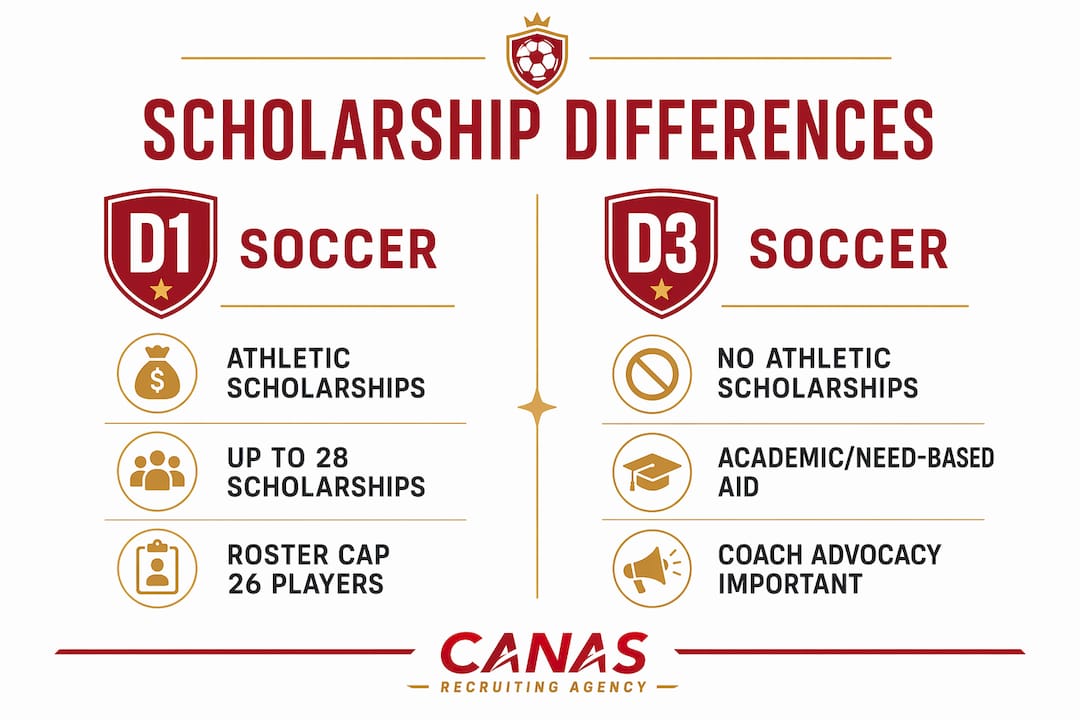
D1 soccer programs offer athletic scholarships; D3 programs do not. That distinction sounds straightforward, but the financial reality for families is far more nuanced than the label suggests.
Under new 2025-26 NCAA rules, D1 men’s and women’s soccer programs can offer up to 28 scholarships with a roster cap of 28 players. This means full scholarship coverage is theoretically possible, but most mid-major D1 programs divide their scholarship budget across many players. A $50,000 annual tuition at a mid-major D1 school might translate to a $10,000 or $15,000 athletic scholarship per player, leaving your family responsible for the rest.
D3 programs take a different approach. They cannot offer athletic money, but D3 aid packages frequently cover 60 to 90 percent of total college costs through academic merit awards, need-based grants, and institutional aid. A high-endowment D3 school like Williams College or Amherst College may produce a lower out-of-pocket cost than a partial D1 scholarship at a state university. The number that matters is net cost, not the scholarship label.
Pro Tip: Use each school’s Net Price Calculator before comparing offers. A net cost comparison between a D1 partial scholarship and a D3 institutional aid package often reveals the D3 option is more affordable.
There is one more financial lever specific to D3 that families rarely consider. Coach advocacy at D3 schools can directly influence admissions decisions by flagging recruited athletes to the admissions office. This admissions advantage can unlock merit scholarships that are not available to general applicants. A D3 coach cannot hand you athletic money, but a strong coach relationship can open financial doors that would otherwise stay closed.
| Division | Scholarship Type | Typical Aid Coverage | Key Consideration |
|---|---|---|---|
| D1 Power Conference | Full or partial athletic scholarship | Varies widely; some full rides | Highly competitive; few athletes receive full funding |
| D1 Mid-Major | Partial athletic scholarship | Often 20-50% of costs | Net cost may still be high after partial award |
| Private D3 | Academic and need-based aid | Often 60-90% of costs | Net cost can be lower than partial D1 offers |
What are the differences in athletic commitment and competition level?
The athletic experience in D1 and D3 soccer differs significantly in time, intensity, and lifestyle. D1 soccer demands year-round training, frequent national and sometimes international travel, and a schedule that functions more like a professional commitment than a college extracurricular. Preseason camps, fall competition, spring training, and summer conditioning cycles leave little room for other pursuits.

D3 athletes typically spend 15 to 20 hours per week on athletics during the season, with fewer year-round obligations. That difference in time commitment is not a sign of lower dedication. It reflects a deliberate institutional philosophy that treats athletics as one part of a broader college experience rather than the central organizing principle of student life.
The competition level gap between divisions is real but not absolute. Consider these distinctions:
- Top D3 programs such as those in the NESCAC or UAA conferences compete at levels comparable to mid-tier or lower D1 programs. The gap at the top of D3 and the bottom of D1 is smaller than most families assume.
- D1 power conferences like the ACC, Big Ten, and Pac-12 represent the highest level of college soccer in the country. The athleticism, tactical sophistication, and coaching resources at these programs are categorically different from most D3 environments.
- Conference quality varies widely within each division. A D3 program in a competitive conference may offer a more demanding athletic environment than a D1 program in a weaker conference.
Pro Tip: Watch game film from both the D3 programs and D1 programs you are considering. Seeing the actual pace and physicality of play is more informative than a division label when evaluating your athletic fit.
Team culture also differs in meaningful ways. D1 athletes often describe their sport as a full-time job layered on top of coursework. D3 athletes more frequently report time for internships, study abroad, club organizations, and social engagement. Neither experience is superior. They serve different athletes with different priorities.
How do recruiting processes and timelines differ between D3 and D1?
The recruiting process for D1 and D3 soccer operates under different rules, different timelines, and different commitment structures. Understanding these differences helps you plan your outreach and avoid costly timing mistakes.
-
D1 recruiting is calendar-regulated. D1 recruiting follows sport-specific NCAA contact periods with defined windows for official visits, phone calls, and in-person evaluations. Coaches cannot contact prospective athletes outside these windows without violating NCAA rules. Commitments at the D1 level often happen earlier, with some top programs identifying and verbally committing athletes as early as freshman or sophomore year of high school.
-
D3 recruiting is more flexible and less regulated. D3 coaches can contact athletes earlier and more freely without NCAA calendar restrictions. There is no National Letter of Intent in D3, and no athletic aid offer to sign. Commitments are tied to admissions decisions rather than athletic scholarship letters, which means the timeline often extends later into the junior or senior year of high school.
-
D3 commitments require admissions acceptance. A D3 coach can express strong interest and advocate for your application, but your commitment is not binding until the school’s admissions office accepts you. This structure gives athletes more time to evaluate options but also means the process feels less definitive until late in the cycle.
-
D1 coach communication is more restricted. During quiet periods and dead periods on the NCAA calendar, D1 coaches cannot initiate contact. Athletes and families must understand these windows to communicate effectively without putting coaches in a compliance violation.
-
Both divisions reward proactive athletes. Whether you are targeting D1 or D3 programs, coaches respond to athletes who initiate contact, send highlight video, and express genuine interest in the program. Waiting for coaches to find you is not a viable recruiting strategy at either level. Resources like NSB Scouting can help increase your visibility to college programs across both divisions.
What academic and campus life differences exist between D3 and D1 athletes?
Academic integration and campus engagement look meaningfully different depending on which division you choose. D3 programs are built around the expectation that student-athletes participate fully in academic life, including demanding majors, research opportunities, study abroad programs, and internships. The athletic schedule is designed to accommodate that participation rather than compete with it.
D1 athletes face a different reality. The time demands of year-round training, travel, and competition create real constraints on academic flexibility. Choosing a demanding major or pursuing a semester abroad is possible at D1 programs, but it requires deliberate planning and often involves trade-offs that D3 athletes do not face at the same scale.
Key differences in campus life and academic experience include:
- Major selection: D3 athletes have greater freedom to pursue time-intensive majors in fields like pre-medicine, engineering, or architecture without scheduling conflicts. D1 athletes in these majors often require special accommodations from coaches and academic advisors.
- Internship access: D3 athletes can more easily pursue competitive internships during the academic year. D1 athletes typically reserve internship activity for the summer, which limits options in fields with year-round cycles.
- Study abroad: D3 programs more frequently accommodate semester-abroad experiences. D1 athletes who study abroad typically do so in the spring semester of their junior year, if at all, and must coordinate carefully with coaching staff.
- Campus involvement: D3 athletes more often participate in student government, research labs, performing arts, and other extracurricular activities. D1 athletes tend to build their social and professional networks primarily within the athletic department.
Choosing the right academic fit alongside athletic fit is one of the most consequential decisions in the recruiting process. A D1 program at a school with a weak academic program in your intended field is a worse long-term outcome than a D3 program at a school with a nationally recognized department.
Key takeaways
Choosing between D3 and D1 soccer requires evaluating net cost, athletic fit, and academic priorities together, not in isolation.
| Point | Details |
|---|---|
| Scholarship structure differs fundamentally | D1 offers athletic scholarships; D3 offers academic and need-based aid that can cover comparable costs. |
| Net cost is the right financial metric | Use each school’s Net Price Calculator to compare real out-of-pocket costs across divisions. |
| Competition level varies within divisions | Top D3 programs can rival lower D1 programs; division label alone does not define competitive quality. |
| Recruiting timelines are division-specific | D1 follows NCAA-regulated calendars; D3 is more flexible with commitments tied to admissions decisions. |
| Academic experience differs by design | D3 athletes have greater access to demanding majors, internships, and study abroad opportunities. |
What families get wrong about division choice
The most common mistake I see families make is treating the D1 label as the goal rather than the outcome. Athletes spend years chasing a D1 offer without asking whether the specific program, at the specific school, with the specific coach, actually serves their development. I have worked with athletes who turned down partial D1 scholarships for D3 programs with stronger academic departments, better team cultures, and lower net costs. Every one of them made the right call.
The scholarship conversation also gets distorted early in the process. Families hear “D1 scholarship” and assume full funding. The reality is that most D1 soccer scholarships are partial, and a high-endowment D3 school often produces a better financial outcome after institutional aid is applied. The club soccer spending families invest chasing D1 exposure sometimes exceeds the scholarship value they eventually receive.
My honest advice is this: evaluate programs, not divisions. Visit campuses. Talk to current players, not just coaches. Ask what percentage of athletes in your intended major graduate on time. Ask where players go after their four years. Those answers tell you more about program quality than any division designation. The NCAA scholarship rules families need to understand are complex, but the underlying principle is simple. The best program is the one where you will grow as a player, a student, and a person.
— Canas
How Canasrecruiting helps you navigate D3 and D1 recruitment
Canasrecruiting works directly with soccer athletes and families to cut through the confusion of NCAA division differences and build a targeted recruiting strategy.
Our team evaluates your athletic profile, academic goals, and financial parameters to identify programs across D1, D3, NAIA, and junior college levels where you have a genuine opportunity. We handle direct coach outreach, help you position your profile for maximum scholarship consideration, and guide you through every stage from first contact to commitment. Whether you are weighing a partial D1 offer against a D3 institutional aid package or just starting to map your options, our recruiting services give you the structure and expertise to make a confident, informed decision. Schedule a call with our team to start building your personalized recruiting plan.
FAQ
Can D3 soccer programs offer any financial aid?
D3 programs cannot offer athletic scholarships, but they provide academic merit awards, need-based grants, and institutional aid that frequently cover 60 to 90 percent of total college costs. Net cost at a D3 school is often lower than a partial D1 athletic scholarship.
When do D1 and D3 coaches start contacting recruits?
D1 recruiting follows NCAA-regulated contact periods with defined windows for communication, while D3 coaches can contact athletes earlier and more freely without calendar restrictions.
Is D3 soccer competitive enough for serious athletes?
Yes. Top D3 programs in conferences like the NESCAC compete at levels comparable to mid-tier D1 programs. Division III has over 400 men’s and women’s soccer teams, and competitive quality varies significantly by conference.
What is the difference in time commitment between D1 and D3 soccer?
D1 soccer requires year-round training and extensive travel with intensive time demands, while D3 athletes typically commit 15 to 20 hours per week during the season with more flexibility for academics and campus life outside of it.
Do D3 coaches influence admissions decisions?
Yes. D3 coaches can flag recruits to the admissions office, giving recruited athletes a meaningful admissions advantage even without athletic scholarship money attached to the offer.