

The college soccer recruiting process is the structured path through which players aged 14 to 22 connect with college programs to secure roster spots and scholarships at NCAA, NAIA, and junior college levels. Understanding this process early gives you a measurable advantage. Families who engage proactively before coaches can initiate contact position their athletes ahead of the majority who wait. The process involves academic eligibility through the NCAA Eligibility Center, strategic coach outreach, highlight reel development, and adherence to a recruiting calendar that governs when and how communication is permitted. Starting in freshman year is not early. It is on time.
What is the college soccer recruiting timeline and how does it work by year?
The college soccer recruiting timeline is the year-by-year schedule of permitted recruiting activities, contact windows, and eligibility milestones that govern how players and coaches interact from freshman year through signing. Families often misunderstand recruiting start dates, failing to engage proactively before coaches can initiate contact. That misunderstanding costs athletes visibility during the exact window when coaches are building their evaluation lists.
Here is what the recruiting calendar looks like at each grade level:
-
9th grade: Build your academic foundation. Take NCAA-approved core courses from day one. Coaches cannot contact you yet, but they can watch you play at tournaments and ID camps. Use this year to identify target programs and begin building your highlight reel.
-
10th grade: Increase your visibility at showcases and club events. Coaches at Division I and II programs are evaluating players and building watchlists well before contact periods open. You can email coaches directly at any time. Send your first outreach emails this year.
-
11th grade: June 15 after sophomore year is the date when Division I and II coaches can begin initiating contact with recruits. This is the single most important date in the process. Coaches who have been watching you can now call, text, and make official offers.
-
12th grade: Official visits, scholarship negotiations, and commitment decisions happen here. The National Letter of Intent has been discontinued for Divisions I and II. Formal commitments are now made through Written Offers of Athletics Aid, with signing windows typically opening in mid-November.
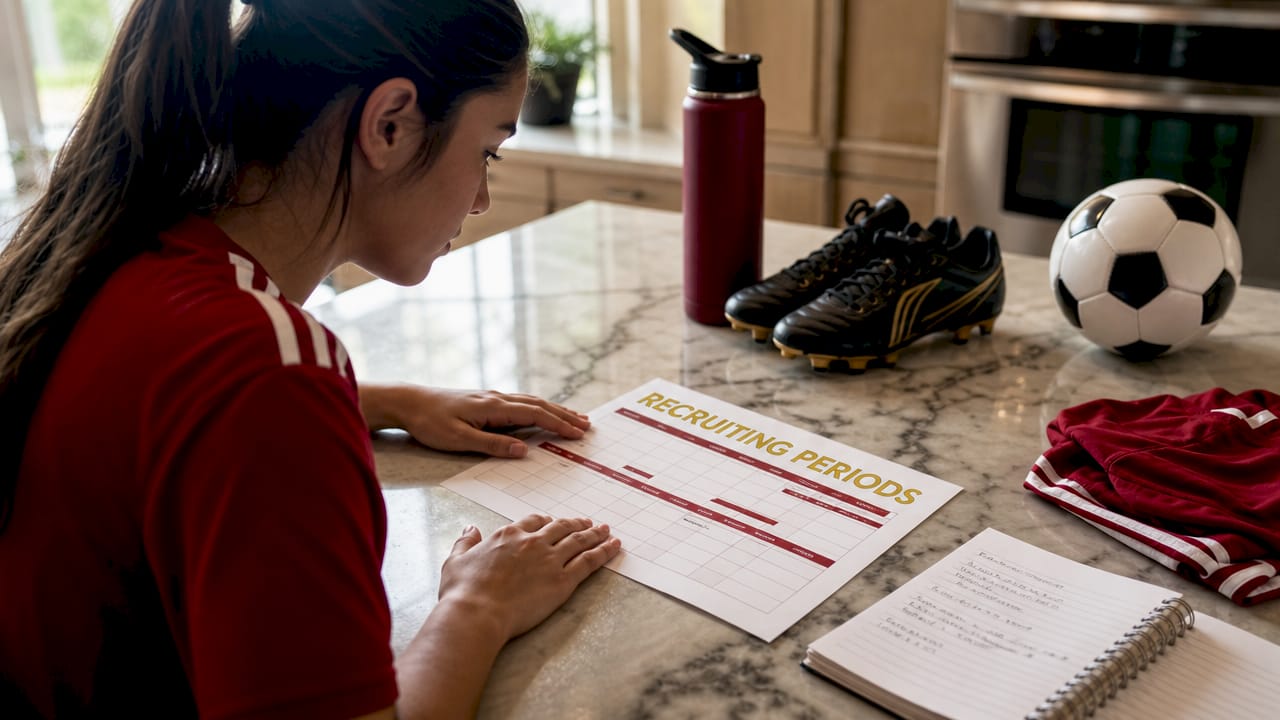
The recruiting calendar also includes four defined periods: contact periods, evaluation periods, quiet periods, and dead periods. During dead periods, coaches cannot have in-person contact with recruits, but players can still email coaches to maintain momentum. Many athletes go silent during dead periods and lose ground to players who stay in communication.
Pro Tip: Treat June 15 after sophomore year as a hard deadline. Have your highlight reel, unofficial transcript, test scores, and target school list ready before that date so you can respond immediately when coaches reach out.
How do NCAA eligibility requirements impact the recruiting process?
NCAA eligibility is the academic and amateurism clearance that determines whether a player can compete, receive a scholarship, and be officially recruited at Division I or II programs. The NCAA Eligibility Center is the gatekeeper for both divisions. Registering late compresses your timeline and can delay or block your clearance entirely.
Key eligibility requirements every player and parent must know:
- Core courses: Division I requires 16 NCAA-approved core courses. Division II requires 16 as well, with a different sliding scale for GPA and test scores. Course selection must align with the NCAA-approved core course list, not just your high school’s graduation requirements. These are not the same list.
- Transcript flags: The NCAA Eligibility Center requires official transcripts showing approved core courses. Online classes, credit recovery courses, and some dual enrollment credits often require extra verification and may not count.
- Registration timing: Creating your Eligibility Center account during junior year is the standard recommendation. Waiting until senior year compresses the clearance timeline significantly and can delay official offers.
- Certification statuses: The Eligibility Center assigns one of three statuses: qualifier, academic redshirt, or nonqualifier. An academic redshirt allows a Division I athlete to receive a scholarship and practice in their first year but not compete. Nonqualifier status blocks both.
- Amateurism certification: Beyond academics, you must certify your amateur status. Any paid participation in soccer outside of approved channels can jeopardize your eligibility.
Pro Tip: Work with your school counselor each semester to cross-reference your course schedule against the NCAA’s approved core course list for your high school. Do not assume a class counts. Verify it.
NACAC advises student-athletes to engage with the Eligibility Center early to avoid surprises, regardless of athletic ability. A player with Division I talent who fails clearance cannot be signed. Academic preparation is not secondary to athletic preparation. It runs in parallel.
What are the key differences in recruiting across NCAA divisions?
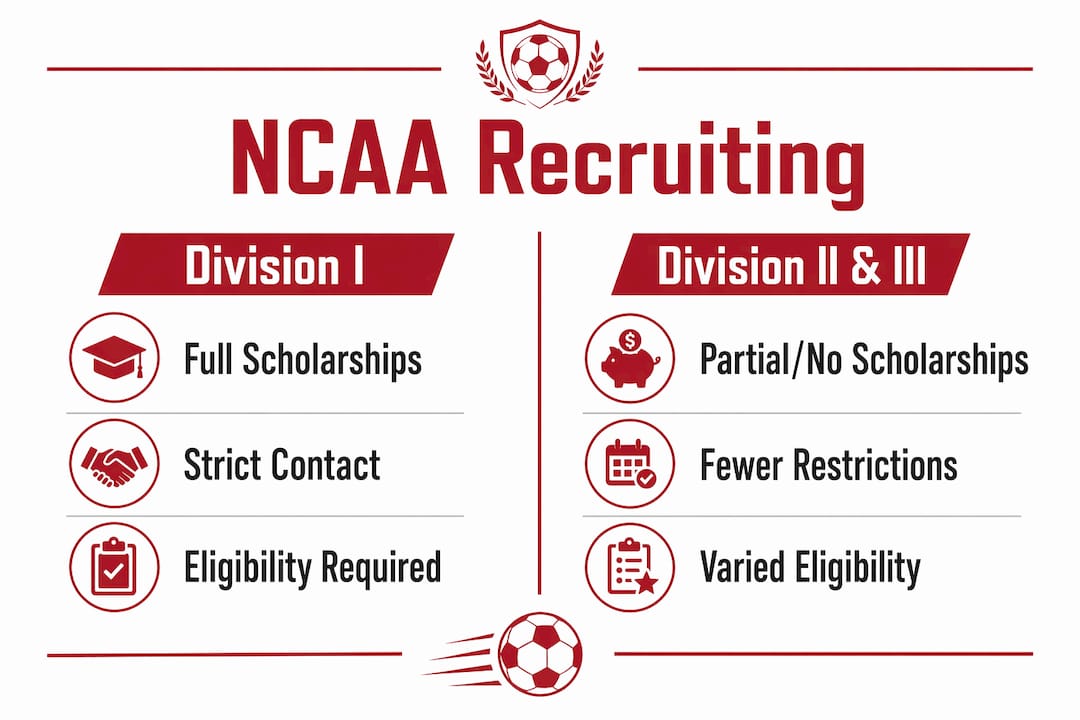
NCAA Division I, Division II, and Division III programs operate under different recruiting rules, scholarship structures, and communication timelines. Understanding these differences helps you target the right programs and set realistic expectations.
| Division | Contact permitted | Scholarship type | Eligibility Center required | Signing method |
|---|---|---|---|---|
| Division I | June 15 after sophomore year | Athletic scholarships (full or partial) | Yes | Written Offer of Athletics Aid |
| Division II | June 15 after sophomore year | Athletic scholarships (partial, equivalency) | Yes | Written Offer of Athletics Aid |
| Division III | Year-round | Academic and need-based aid only | No | Institutional offer letter |
| NAIA | Flexible, fewer restrictions | Athletic scholarships available | No (NAIA Eligibility Center) | Institutional offer letter |
Division I programs carry the most restrictions and the most scholarship money. Division II programs offer partial equivalency scholarships, meaning aid is split among multiple players rather than awarded in full to one. Division III coaches can communicate and contact recruits year-round, making that division more accessible for players who begin outreach later. Division III does not offer athletic scholarships, but many D3 schools offer substantial merit and need-based aid that rivals athletic packages at lower-resourced D2 programs.
NAIA programs represent a significant and often overlooked pathway. NAIA schools can offer athletic scholarships with fewer recruiting constraints than NCAA programs. For a detailed breakdown of D3 vs. D1 differences, including scholarship structures and recruiting timelines, that comparison is worth reviewing before finalizing your target list.
One critical note: verifying soccer-specific NCAA recruiting calendars is necessary because many families mistakenly apply dates from other sports to soccer. Soccer has its own contact and evaluation periods. Using the wrong calendar leads to missed opportunities and potential recruiting violations.
How to build a recruiting profile and communicate with college coaches
A recruiting profile is the complete package of materials a player presents to college coaches to initiate and sustain recruiting interest. It is not a single document. It is a coordinated set of assets that coaches evaluate before, during, and after contact periods.
The core components of a strong recruiting profile include:
- Highlight reel: A 3 to 5 minute video showing your best technical moments, game intelligence, and athleticism. Lead with your strongest 60 seconds. Coaches decide quickly.
- Academic information: GPA, class rank, SAT or ACT scores, and intended major. Coaches at academic programs weight this heavily.
- Athletic stats: Position, club team, tournament results, and any state or regional recognition.
- Contact information: Your personal email, cell number, and your parents’ contact details. Coaches need direct access.
- Social media presence: A modern recruiting profile includes a positive and professional social media presence. Coaches review Instagram, X, and other platforms. Negative content is a disqualifier.
Email outreach is the primary tool for initiating coach contact before June 15. Your first email should be concise: introduce yourself, state your graduation year and position, include your highlight reel link, and express specific interest in that program. Generic mass emails are easy to identify and are rarely effective. Reference something specific about the program, a recent season result, a coaching philosophy, or a player development track record.
Attending ID camps during contact and evaluation periods is one of the most efficient ways to gain direct exposure to multiple coaches simultaneously while staying within NCAA rules. ID camps are hosted by college programs and allow coaches to evaluate players in a controlled environment. Attending a camp at a target school signals genuine interest and gives coaches a live evaluation opportunity.
Pro Tip: Do not wait for coaches to find you. Send your first outreach email in 10th grade, follow up after every major tournament, and keep coaches updated on your academic progress. Coaches recruit players who make their job easier.
Key takeaways
The college soccer recruiting process rewards athletes and families who prepare early, understand the rules, and communicate consistently with target programs.
| Point | Details |
|---|---|
| Start before sophomore year | Build your profile, take core courses, and email coaches before June 15 contact windows open. |
| Register with the Eligibility Center early | Create your NCAA Eligibility Center account in junior year to avoid clearance delays that block official offers. |
| Know your division target | Division I, II, III, and NAIA have different scholarship types, contact rules, and timelines. Match your target to your profile. |
| Build a complete recruiting profile | Highlight reel, academic data, stats, and a clean social media presence are all evaluated by coaches. |
| Communicate during every period | Players can email coaches even during dead periods. Consistent contact keeps you on a coach’s radar. |
What I have learned working with athletes through this process
The players who get recruited are not always the most talented on the field. They are the most prepared off it. I have worked with athletes who had genuine Division I ability but lost offers because their transcripts had non-approved courses that flagged at the Eligibility Center. I have also seen players with modest athletic profiles earn strong scholarship packages at Division II and NAIA programs because they started outreach in 9th grade, built relationships with coaches over two years, and showed up to ID camps with a polished profile.
The transfer portal has changed the recruiting environment significantly. Coaches at every level now manage roster turnover more aggressively, which means they are recruiting younger players earlier to secure commitments before portal activity disrupts their plans. This makes early engagement more valuable than it was five years ago, not less.
One thing families consistently underestimate is the relationship component. Recruiting is not a transaction. Coaches are evaluating whether they want to work with you for four years. Your communication style, your responsiveness, and your attitude during unofficial visits all factor into their decision. The athlete who sends a thoughtful follow-up email after a campus visit stands out from the athlete who goes silent.
Be honest in your self-assessment. Targeting only top-25 programs when your profile fits a strong Division II or NAIA program wastes time and creates unnecessary stress. Build a tiered target list: reach schools, realistic targets, and safety programs. Pursue all three tiers simultaneously. The goal is the best fit academically, athletically, and financially. That combination exists at more programs than most families realize.
— Canas
How Canasrecruiting helps you through every step
Canasrecruiting works directly with soccer players and families to build targeted recruiting strategies, manage coach outreach, and position athletes for scholarship opportunities across NCAA, NAIA, and junior college programs. The process is structured, not reactive.
Canasrecruiting’s Scholarship Positioning System is built around your specific academic profile, athletic level, and target division. The team handles direct coach communication, profile development, and Eligibility Center guidance so no critical deadline is missed. If you are ready to move from uncertainty to a clear recruiting plan, schedule a call with a Canasrecruiting expert and get a personalized assessment of your recruiting timeline and scholarship potential.
FAQ
What does the soccer recruiting timeline mean?
The soccer recruiting timeline is the calendar of permitted recruiting activities, contact windows, and eligibility milestones that govern how Division I, II, III, and NAIA coaches interact with recruits from freshman year through signing. It defines when coaches can call, visit, and make offers.
When should a player start the college soccer recruiting process?
Players should begin the college soccer recruiting process in 9th grade by taking NCAA-approved core courses, building a highlight reel, and researching target programs. Outreach emails to coaches can begin in 10th grade, well before the June 15 contact window opens for Division I and II programs.
What is required in a college soccer recruiting profile?
A college soccer recruiting profile requires a highlight reel, GPA and test scores, athletic stats, contact information, and a professional social media presence. Coaches evaluate all of these components before and during the recruiting process.
Do Division III schools require NCAA Eligibility Center clearance?
Division III schools do not require NCAA Eligibility Center clearance, and their coaches can communicate with recruits year-round. Division III programs offer academic and need-based aid rather than athletic scholarships.
What replaced the National Letter of Intent for soccer recruits?
The National Letter of Intent was discontinued for Division I and II programs. Formal commitments are now made through Written Offers of Athletics Aid, with signing windows typically opening in mid-November depending on the institution.