

College soccer is defined as the primary talent pipeline connecting American youth players to professional clubs in MLS, USL, and international leagues. The role of college soccer in pro scouting has grown significantly as NCAA Division I programs produce players with the maturity, competitive experience, and physical readiness that professional scouts actively seek. Scouts from MLS academies, USL franchises, and even European clubs attend NCAA matches, College Cup events, and national combines to identify talent. For players aged 14–22 and their families, understanding how this system works is the first step toward making informed decisions about your athletic future.
How do pro scouts evaluate college soccer players?
Pro scouts evaluate college soccer players through a lens of consistency, maturity, and competitive performance. Scouts prioritize players from programs with elite coaching who demonstrate sustained performance across multiple seasons, not just one standout game. The ability to perform under pressure, balance academic demands, and respond well to adversity all factor into a scout’s assessment. These qualities are harder to fake over a four-year college career than in a short trial.

The evaluation criteria in college soccer differ from those used in professional academies. Academy scouts focus heavily on technical skill volume, since academy players train year-round and accumulate far more hours on the ball. College scouts, by contrast, weight mental toughness and coachability more heavily because the NCAA’s compressed season demands rapid adaptation. Scouts look beyond school reputation, focusing instead on how a player responds to a losing streak, a coaching change, or a physical setback.
One structural reality shapes every evaluation: the NCAA soccer season runs approximately 18 weeks. That compressed window limits the total match volume a college player accumulates compared to a professional academy player. International scouts, particularly those from European clubs, view this as a meaningful gap. They prefer year-round training environments where technical and tactical habits are built through repetition over months, not weeks.
- Consistency over time: Scouts track performance across multiple seasons, not single games.
- Coachability: How a player receives and applies feedback during matches directly influences scouting decisions.
- Mental toughness: Balancing a full academic load while competing at a high level signals resilience.
- Physical readiness: NCAA programs with strong sports science support produce players who arrive at pro trials in better physical condition.
- Attitude under pressure: Scouts observe body language, communication with teammates, and responses to referee decisions.
Pro Tip: Film every match, not just highlights. Scouts increasingly review full-game footage to assess positioning, work rate off the ball, and decision-making under fatigue. A highlight reel shows your best moments; full-game film shows your character.
What exposure opportunities does college soccer offer?
College soccer creates scouting visibility through four distinct channels: national tournament play, televised and streamed matches, showcases and combines, and direct coach-to-scout networking. Each channel serves a different function in getting your name in front of decision-makers.
-
NCAA tournament and College Cup: The College Cup is the most concentrated scouting event in American college soccer. College Cup and NCAA tournament play draw heavy scout attendance from MLS, USL, and select international clubs. Reaching the tournament is not just an athletic achievement. It places you on the same field as the scouts who can advance your career.
-
Televised and streamed matches: ESPN, ACC Network, and conference-level streaming platforms broadcast hundreds of NCAA matches each season. A scout who cannot attend in person can still evaluate you through a screen. Programs with national broadcast deals provide more passive visibility than smaller conference schools.
-
National combines and showcases: Events like the MLS SuperDraft Combine and various regional showcases give players a direct audition in front of professional staff. These events compress evaluation into a short window, so preparation and physical condition matter enormously.
-
Coach and agent networking: College coaches maintain relationships with professional scouts built over years. A strong recommendation from a respected NCAA coach carries weight. Agents also monitor college programs, and some begin conversations with players during their junior or senior seasons.
NCAA programs’ investments in coaching infrastructure and sports science raise the overall talent quality scouts encounter. That rising quality makes college soccer a reliable scouting destination, not an afterthought.
College soccer vs. MLS NEXT and professional academies
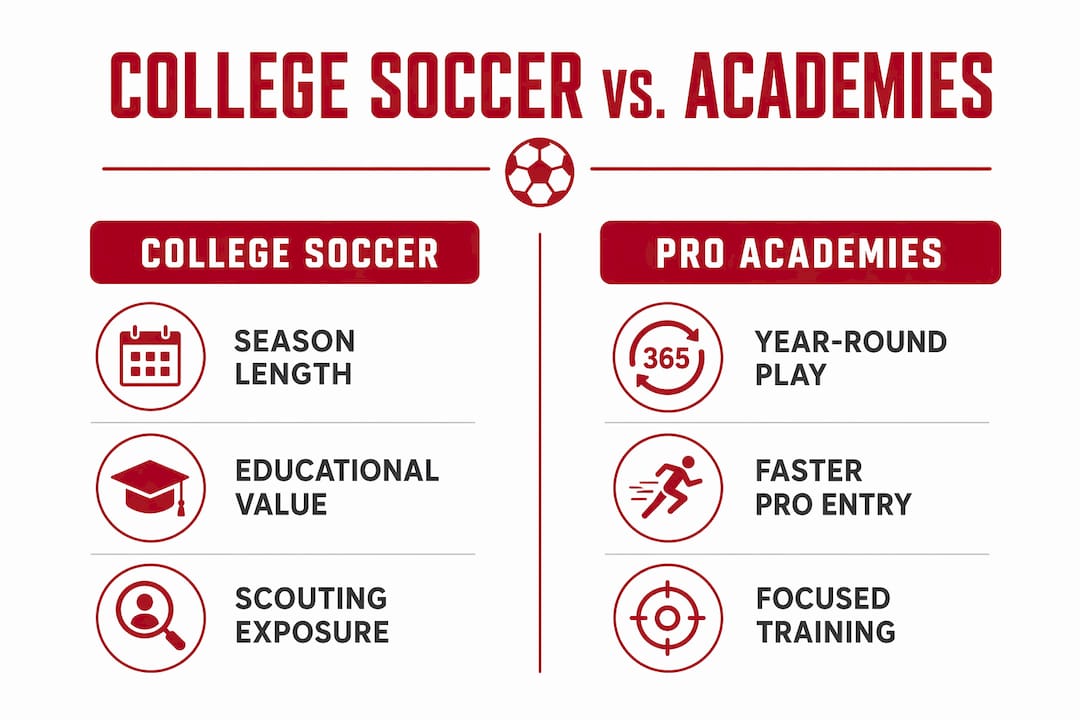
The comparison between college soccer and professional academies like MLS NEXT is not a simple ranking. Each pathway serves a different player profile, and scouts evaluate them accordingly.
| Factor | College Soccer (NCAA) | Professional Academy (MLS NEXT) |
|---|---|---|
| Season length | ~18 weeks | Year-round |
| Match volume | Lower | Higher |
| Education | Full degree | Limited or none |
| Scouting access | National tournaments, combines | Club-controlled evaluations |
| Player maturity | High (academic-athletic balance) | Variable |
| International appeal | Lower for European clubs | Higher for European clubs |
| Development pace | Gradual, structured | Accelerated |
Direct-to-pro and academy routes offer accelerated development timelines but sacrifice the educational foundation and personal maturity that college soccer builds. A player who signs a homegrown contract at 17 may reach the first team faster. That same player, however, may lack the resilience and decision-making depth that four years of college competition develops.
Players targeting overseas professional leagues often face a steep re-learning curve when relying solely on college soccer experience. European scouting networks prefer year-round training in professional or semi-professional environments. The NCAA’s compressed season is viewed as a structural limitation by international scouts, meaning college players who pursue European opportunities typically need additional development time after graduation.
Pro Tip: If your goal is a European club, supplement your NCAA season with high-level summer league play. Leagues like USL League Two operate during the college offseason and provide the match volume that international scouts want to see.
The right pathway depends on your goals, your current development level, and your family’s priorities. College soccer is not the only route to professional soccer. It is, however, the most structured route that combines athletic development with a degree and broad scouting access within the American system.
What steps maximize your scouting opportunities in college soccer?
Maximizing your scouting exposure through college soccer requires deliberate decisions at every stage of the process, starting with program selection.
Choose the right program. Not all NCAA programs offer equal scouting visibility. Division I programs in power conferences generate more scout traffic than lower-visibility programs. Research which programs have sent players to MLS, USL, or professional trials in recent years. That track record tells you more than a school’s ranking or facilities.
Balance academics and athletics deliberately. Scouts view academic performance as a signal of discipline and time management. A player who maintains strong grades while competing at a high level demonstrates the kind of focus professional environments demand. Identifying the right academic fit alongside athletic fit is not a secondary concern. It is part of your scouting profile.
Build your digital presence. Scouts increasingly use video platforms to evaluate players before attending matches in person. Maintain a current highlight reel on platforms like YouTube or Hudl. Update it after every significant performance. Include full-game footage alongside highlights, since scouts want to see how you perform when the ball is not at your feet.
- Attend national combines and showcases during your junior and senior seasons.
- Communicate directly with your college coach about your professional ambitions so they can advocate for you with scouts.
- Understand NCAA eligibility rules to avoid compliance errors that could limit your options.
- Research common recruiting mistakes early so you protect your eligibility and scholarship standing.
- Build relationships with agents and scouts through your college program’s network, not through unsolicited outreach that may violate NCAA rules.
Players must decide early whether to pursue a college degree with athletic development or an accelerated professional timeline. That decision shapes every subsequent recruiting choice. Making it with full information, rather than reacting to pressure, produces better outcomes for both players and families.
Key takeaways
College soccer remains the most structured and broadly accessible pathway to professional scouting in the American soccer system, provided players choose high-visibility programs and build consistent competitive records.
| Point | Details |
|---|---|
| College soccer as a pipeline | NCAA Division I programs are actively scouted by MLS, USL, and select international clubs. |
| Consistency over reputation | Scouts evaluate multi-season performance and coachability, not just school prestige. |
| Exposure requires action | College Cup, combines, and video platforms are the primary channels for scout visibility. |
| Academy vs. college tradeoffs | Academies offer more match volume; college soccer provides maturity, education, and broader domestic scouting access. |
| Program selection matters | Choosing a program with a professional placement track record directly affects your scouting opportunities. |
The evolving scouting landscape: what I’ve seen change
The conversation around college soccer and professional scouting has shifted noticeably over the past several years. When I started working with players and families at Canasrecruiting, the assumption was simple: play Division I, perform well, get seen. That formula still works, but the environment around it has grown more competitive and more nuanced.
What I observe now is that scouts are more systematic. They use video platforms, data analytics, and network referrals before they ever show up to a match. That means a player who performs brilliantly but has no digital footprint is invisible to a significant portion of the scouting community. The players who get seen are the ones who treat their visibility as a responsibility, not an afterthought.
The other shift I see is in how families approach the college-versus-academy decision. More families are asking the right questions earlier, which is encouraging. The players who struggle are the ones who commit to a college program without understanding how it fits into their professional timeline. College soccer is a genuine pathway to the pros. It is not, however, a passive one. You have to build your profile, choose your program carefully, and stay engaged with the scouting process throughout your collegiate career.
My honest advice: do not let the appeal of a big-name school override the question of whether that program actually produces professional players. A mid-major program with a coach who has strong MLS connections will serve your professional ambitions better than a prestigious school where you sit on the bench.
— Canas
How Canasrecruiting supports your path from college to pro
Navigating the college soccer recruiting process while keeping one eye on professional opportunities is a complex task. Canasrecruiting works directly with athletes and families to build a clear, structured recruiting plan that accounts for both scholarship positioning and long-term pro exposure.
Our team provides direct coach outreach, program evaluation, and compliance guidance so you avoid the most common recruiting mistakes that cost players scholarship offers and eligibility. We also help families recognize recruiting scam warning signs before they cause real damage. Whether you are targeting NCAA Division I, NAIA, or junior college programs, Canasrecruiting builds a targeted plan around your specific goals. Contact us to start building your recruiting profile today.
FAQ
What is the role of college soccer in pro scouting?
College soccer serves as a primary talent pipeline for MLS, USL, and select international clubs. Scouts attend NCAA matches, College Cup events, and national combines to identify players ready for professional environments.
Why do pro soccer scouts watch college games?
Scouts watch college games to evaluate player maturity, consistency, and coachability across a full competitive season. Consistent competitive performance over multiple years signals professional readiness more reliably than a single trial.
How does the NCAA season length affect scouting?
The NCAA’s 18-week season limits total match volume compared to year-round professional academies. International scouts, particularly from European clubs, view this compressed schedule as a development gap that players may need to address after graduation.
Is college soccer or a professional academy better for reaching the pros?
The answer depends on your goals and timeline. Academy routes offer more match volume and faster professional exposure, while college soccer provides a degree, broader domestic scouting access, and the maturity that many professional clubs value.
How much do soccer scouts earn?
Soccer scouts earn between $26,000 and $50,000 annually, with most operating part-time or alongside coaching roles. Understanding scout motivations helps players recognize that relationship-building and consistent performance matter more than one-time showcases.