

Avoiding common soccer recruiting mistakes is the single most important factor separating athletes who earn scholarships from those who miss their opportunity entirely. D1 programs fill rosters through verbal commitments set one to two years before signing dates, which means late outreach leaves almost no openings. Families who treat recruiting as a reactive process consistently lose ground to athletes who build a structured, proactive plan. This guide identifies the most costly errors in college soccer recruiting and gives you a clear framework to correct them before they cost you a scholarship.
What are the most common soccer recruiting mistakes?
The most frequent recruiting errors are predictable, and that makes them preventable. Understanding each one gives you a direct advantage over the majority of recruits who repeat them every cycle.
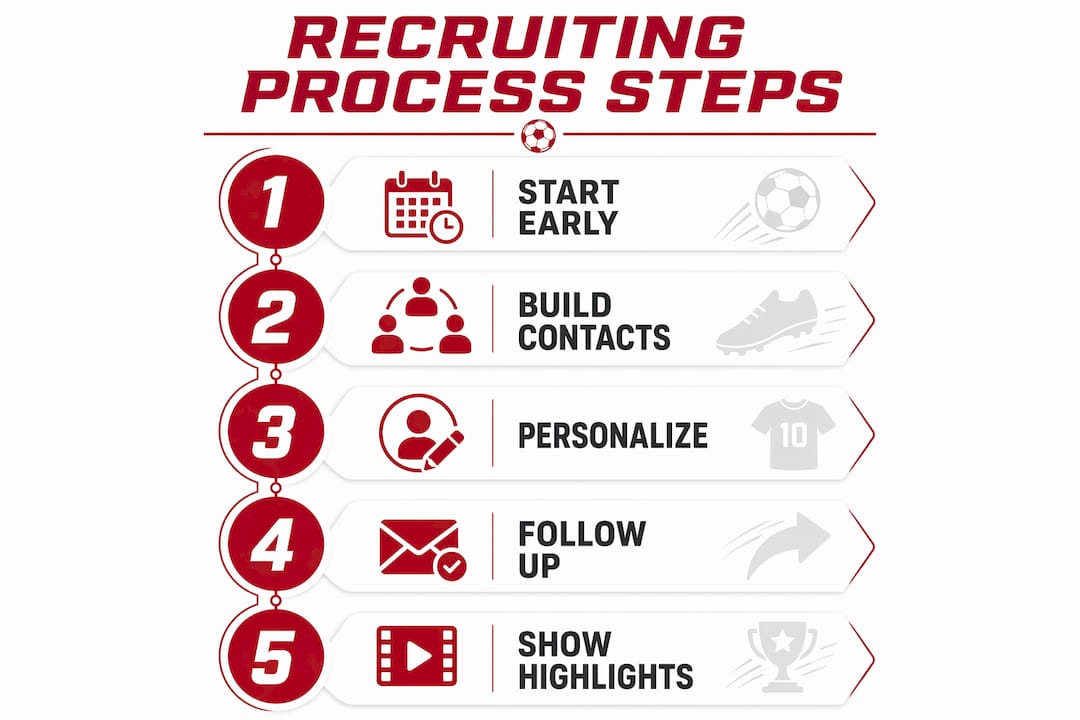
- Starting too late. Most families begin outreach in junior year. By then, many D1 programs have already filled their priority roster spots. Sophomore year is the realistic starting point for competitive programs.
- Sending generic mass emails. Coaches receive hundreds of emails and respond mainly to personalized messages that address program-specific needs. A copy-paste email signals low interest and gets deleted.
- Submitting poor highlight videos. Long intros, practice clips, and disorganized footage tell coaches nothing useful. A video that does not show your best play within the first minute loses the coach’s attention permanently.
- Ignoring academic eligibility. Academic status is a key recruiting filter for every coach at every level. An athlete who does not meet NCAA or NAIA academic thresholds cannot be offered a scholarship regardless of talent.
- Failing to follow up. A single email is almost never enough. Multi-touch outreach strategies with updates every few weeks demonstrate genuine interest and keep you visible.
- Targeting only Division I programs. Less than 1.1% of high school players make D1 rosters. Ignoring D2, NAIA, and D3 programs eliminates the majority of available scholarship opportunities.
Pro Tip: Build a contact spreadsheet from day one. Track every coach you email, the date of each message, and any response. This prevents duplicate outreach and shows you exactly where to follow up.
How can personalized communication improve your recruiting chances?

Targeted, coach-specific communication is the single most effective outreach method in college soccer recruiting. Coaches respond fastest to recruits who demonstrate program knowledge and include measurable performance stats. A generic email proves you did not research the program. A personalized one proves you did.
Follow this structure for every initial outreach email:
- Open with a program-specific detail. Reference the coach’s formation, a recent tournament result, or a program value you found on their website. One sentence is enough to prove you researched them.
- State your measurable stats immediately. Include graduation year, position, GPA, club team, and one or two specific performance metrics such as goals per season or defensive clearances.
- Write a professional subject line. Use a format like “2027 Midfielder | 3.8 GPA | [Your Club Name].” Coaches scan subject lines before opening anything.
- Include a clear call to action. Ask for a specific next step: a campus visit, a phone call, or feedback on your highlight video. Open-ended emails produce open-ended results.
- Keep the message under 200 words. Coaches read short emails. Long emails get skimmed or skipped entirely.
Pro Tip: Use a tool like Google Sheets or Notion to build a recruiting pipeline. Log each program, the coach’s name, email date, and follow-up schedule. Treat it like a professional contact management system.
Consistent follow-up is as important as the first message. Send an update every three to four weeks with new information: a recent tournament result, an updated highlight clip, or an academic achievement. Each message reinforces your interest without repeating the same content.
What are the best practices for creating a highlight video?
A highlight video is a scouting tool, not a trophy reel. Coaches decide within 10–15 seconds whether to keep watching, which means your best footage must appear in the first minute. Treat every second of the video as a direct audition.
What to include vs. what to cut
| Include | Cut |
|---|---|
| Real match footage only | Practice clips and training drills |
| Best plays in the first 60 seconds | Long intro sequences with music only |
| Clear jersey number visible throughout | Blurry or low-angle phone footage |
| Full range of skills: passing, defending, finishing | Repetitive clips of the same action |
| Supplemental full-game link in the description | Unedited 90-minute raw footage as the main video |
The ideal video runs 3–5 minutes. Anything longer signals poor editing judgment and tests a coach’s patience. Host the video on YouTube or Vimeo for reliable playback across all devices. Include your name, graduation year, position, and club team in the video title and description so coaches can find it later.
Supplemental full-game footage matters too. Coaches use full-game video for detailed evaluation once a highlight reel generates interest. Have at least one full match available and link it directly in your outreach email.
Why do academics and NCAA recruiting rules matter?
Academic eligibility directly determines whether a coach can offer you a scholarship. Ignoring academic requirements can end your recruiting chances regardless of how talented you are on the field. Coaches at NCAA programs cannot extend offers to athletes who do not meet clearinghouse standards, and no amount of athletic skill overrides that filter.
Register with the NCAA Eligibility Center as early as your sophomore year. Keep your core course GPA updated and verify that your high school courses meet NCAA Division I or II requirements. Athletes targeting Division I academic standards should confirm their course list with a counselor annually, not just at graduation.
NCAA recruiting rules also create specific windows that affect when and how coaches can contact you.
| Period | What It Means | What You Can Do |
|---|---|---|
| Contact Period | Coaches may contact you in person | Attend camps, visit campuses, meet coaches |
| Evaluation Period | Coaches may watch you compete | Play at showcases and tournaments |
| Quiet Period | Coaches may only contact you by phone or mail | Call coaches, send emails, update your profile |
| Dead Period | No in-person contact allowed | Send email updates to stay visible |
During dead periods, coaches cannot evaluate athletes in person, but email communication from recruits remains allowed and advisable. Sending a brief update during a dead period keeps you top of mind without violating any rule. Athletes who go silent during restricted periods lose ground to those who maintain communication through email consistently.
Pro Tip: Download the NCAA’s official recruiting calendar for your division and mark every period change. Schedule your outreach emails around these windows so your timing always works in your favor.
How do you build a recruiting strategy that maximizes opportunities?
A balanced recruiting strategy targets programs across multiple divisions from the start. Fewer than 1.1% of high school players earn D1 roster spots, which means a plan built exclusively around D1 programs is statistically unlikely to succeed. Expanding your scope to include D2, NAIA, and D3 programs multiplies your scholarship options and increases your chances of finding a genuine athletic and academic fit.
Consider these principles when building your recruiting plan:
- Assess your realistic level honestly. Watch film of current players at your target programs. If you are not at that level yet, identify programs one tier down where you would compete for playing time immediately.
- Research NAIA scholarship opportunities actively. NAIA programs offer athletic scholarships and often have less competition for roster spots than D1 programs. Many athletes find better financial packages and more playing time at this level.
- Understand how athletic admissions slots work. Each program has a limited number of roster spots and scholarship dollars. Knowing this helps you target programs where your profile fills a genuine need.
- Do not rely passively on recruiting platforms. Coaches rarely search platforms passively. Athletes must proactively reach out and deliver materials directly to gain visibility.
- Verify any recruiting service you hire. Some families invest in recruiting services without confirming what those services can legally do under NCAA rules. No service can guarantee a scholarship, and any claim otherwise is a red flag.
Review the D3 vs. D1 differences before finalizing your target list. D3 programs offer merit-based financial aid packages that can rival athletic scholarships at lower divisions, and the academic profiles of D3 schools are often stronger.
Key takeaways
Avoiding costly college recruiting mistakes requires early action, personalized outreach, strong academics, and a realistic multi-division strategy built before junior year.
| Point | Details |
|---|---|
| Start outreach early | Begin contacting coaches in sophomore year before D1 rosters fill. |
| Personalize every email | Include program-specific details, measurable stats, and a clear next step. |
| Build a coach-ready highlight video | Keep it 3–5 minutes, lead with your best plays, and use real match footage only. |
| Protect your academic eligibility | Register with the NCAA Eligibility Center early and track core course requirements annually. |
| Target multiple divisions | Expand beyond D1 to D2, NAIA, and D3 to maximize scholarship and playing time options. |
What i have learned after years in soccer recruiting
Most families come to Canasrecruiting after making at least one of the mistakes covered in this guide. The most common pattern I see is not laziness. It is misplaced confidence. Families assume a talented player will be found. That assumption costs scholarships every single year.
The athletes who succeed are not always the most talented. They are the most organized. They start early, they follow up consistently, and they treat academics with the same discipline they bring to training. I have watched players with mid-level athletic profiles earn strong scholarship packages simply because they communicated better than more talented recruits who waited and hoped.
One thing coaches tell me repeatedly: they remember the athletes who checked in during dead periods. A short email with a tournament update during a restricted window costs nothing and keeps your name in front of a coach when no one else is reaching out. That is a real competitive advantage most recruits leave on the table.
My honest advice is this: do not build your entire plan around one dream school. Build a list of 15 to 20 programs across multiple divisions, research each one specifically, and pursue every program on that list with the same energy. The scholarship you actually sign will likely come from a program you did not originally rank first. That is not a failure. That is how recruiting works when you do it right.
— Canas
How Canasrecruiting helps you avoid these recruiting errors
Canasrecruiting builds personalized recruiting plans for soccer athletes at every level, from initial coach outreach through scholarship negotiation. Every athlete we work with receives a targeted blueprint that includes direct coach communication, highlight video guidance, NCAA rule compliance support, and a structured follow-up schedule.
Our college soccer recruiting services cover the full recruiting timeline: eligibility center registration, recruiting calendar management, and program-specific outreach across NCAA, NAIA, and junior college programs. We also help families understand partial vs. full scholarship structures so you can evaluate offers with confidence. If you are ready to build a recruiting strategy that actually produces results, start with Canasrecruiting today.
FAQ
When should a soccer player start the recruiting process?
The recruiting process should begin no later than sophomore year of high school. D1 programs regularly extend verbal commitments one to two years before signing dates, so late outreach leaves few openings.
How long should a soccer highlight video be?
A highlight video should run 3–5 minutes and lead with your best plays in the first 60 seconds. Coaches decide within 10–15 seconds whether to keep watching, so front-loading strong footage is critical.
Can you contact coaches during NCAA dead periods?
Athletes can send emails to coaches during NCAA dead periods even though coaches cannot make in-person contact. Sending brief updates during these windows keeps your name visible without violating any recruiting rule.
Does GPA really affect soccer recruiting?
Academic eligibility is a direct recruiting filter at every NCAA and NAIA level. Coaches cannot offer scholarships to athletes who do not meet clearinghouse standards, regardless of athletic ability.
Is it worth targeting d2 and NAIA programs?
Targeting D2 and NAIA programs significantly increases your scholarship opportunities. Fewer than 1.1% of high school players make D1 rosters, and NAIA programs frequently offer competitive financial packages with more available playing time.